I just saw "Chinatown" with Jack Nicholson. It's an excellent film noir, in the best 1930s LA style. And a young Jack Nicholson doesn't look or act like a fat, old, disagreeable beast, as is his wont for the past decade or two. He's even sort of handsome.
What really struck me about the film is that the back story has to do with a rich tycoon who is pulling a land swindle. He tries to drive farmers off the land, buy up their parcels dirt cheap under false names (even names of dead people!), influence lawmakers to provide him with subsidized irrigation water, and then resell the now-precious land at a steep markup. It reminds me a lot of what's been going on in Colombia. Paramilitaries and the businessmen that fund them drive people off the land, take possession, develop big agricultural projects, and seek government aid and subsidies to further enrich themselves. I translated an excellent article some months ago on this subject, dealing with palm plantations in Colombia's Uraba and Choco regions.
Thursday, December 30, 2010
Community-Supported Carbon Sequestration: Another St Andrews Prize proposal
The Community-Supported Carbon Sequestration (CSCS) project aims to reduce the amount of carbon dioxide in the atmosphere, using existing technologies and an innovative financing mechanism that would benefit poor rural areas. CSCS would capture carbon dioxide from the atmosphere, based on a direct contact between concerned people who want to offset their carbon emissions, and independent small “farmers” managing carbon dioxide-absorbing synthetic trees. The idea follows the model of Community Supported Agriculture, in which a group of people pays a farmer up front in order to become shareholders in a season's produce. In a CSCS group, these shareholders would buy part of the carbon dioxide absorbed in a given year.
Klaus Lackner and the Earth Institute of Columbia University have worked on what they call synthetic trees, which use simple chemical reactions to absorb carbon dioxide and convert it to liquid form. This carbon dioxide can then be combined with minerals known as ultramafic rocks, which bind the carbon dioxide in an inert form.
There exist just such ultramafic rocks in parts of Appalachia in New England and the mid-Atlantic states. These comprise some of the poorest areas in the US. The establishment of a carbon sequestration industry, dispersed among individual family smallholdings, would bring a much-needed income infusion into the area. The construction of the synthetic tree components would also entail larger-scale factories. Hence a model of CSCS would benefit small family enterprises, as well as heavier industry. It would create green jobs in an area of poverty, destructive mining, and closed factories.
In time this model of mineral carbon sequestration through dispersed smallholder-held synthetic trees, financed through direct carbon payments from concerned individuals (and perhaps eventually larger corporate emitters), could be expanded to other areas. The west coast of the US is home to large deposits of ultramafic rocks. Even more interesting is that one of the world's largest such deposits is in the nation of Oman. Oman entertains friendly relations with the US, and collaboration on a project to promote both ecological and human well-being would be welcome in both countries. Individuals and companies in the US could buy shares in Omani CSCS projects, with communication and verification between countries facilitated by the Internet. Such a project would improve the image that residents of both countries have of one another, as well as serving as a much-needed diversification for Oman's oil-dependent economy.
Community-Supported Carbon Sequestration has the potential to durably absorb carbon dioxide from the atmosphere while creating small, farm-like businesses as well as larger factory employment. It could be a model to simultaneously reduce the US's climate impact, as well the poverty that plagues certain parts of the country. In time the CSCS model could even serve as a diplomatic link between the US or other large emitters of CO2, with countries like Oman looking to create a sustainable economic future.
Wednesday, December 29, 2010
Carp Harvest: another St. Andrews Prize proposal
The Carp Harvest would impede the spread of a destructive invasive species into the Great Lakes system, and at the same time produce a natural agricultural input for regional farmers.
The Great Lakes are under threat from the Asian carp, an invasive fish species that has colonized much of the Illinois river. The Illinois river is a separate waterway than the Great Lakes system, but since the 1800s the two have been linked by canals running through Chicago (and responsible for Chicago's initial strategic importance as a transport hub). The Asian Carp are now migrating up these canals, and despite certain efforts at blocking their advance, it is believed that eventually the fish will enter the Great Lakes, and very probably wreak ecological havoc there. The Asian carp is a filter feeder, meaning that it strains water through its mouth as it swims. This removes all the algae and plankton from the water, starving other fish species.
Aside from existing measures like electronic and chain fences in and around infested canals, an effective manner of preventing the Asian carp's progress into the Great Lakes would be overfishing them. Overfishing is a problem when a native, valuable species is harvested to the point of population crash. But in the case of an invasive species, overharvesting can lead to a desired population decrease. It may not be able to completely eliminate the species, but an intense harvesting pressure on Asian carp would help to check their existing population, and decrease the likelihood and speed of their advance into the Great Lakes.
However, the Asian carp does not enjoy great demand as food. It is said to have a bland or even disagreeable flavor, and the abundance of bones makes it difficult to process. Even sport fishermen won't pursue the fish, because as a filter-feeder it doesn't bite bait.
But the Asian carp could be very well-suited as an agricultural input. The fish could be netted en masse and ground up. The oil from the ground fish could be extracted and used for human or animal health supplements, and the remaining protein-rich meal channeled into a number of uses. Asian carp meal would be an excellent component of feed for many farmed species of livestock and fish. Asian carp meal could also be sold to farmers as a fertilizer rich in nitrogen and phosphorus. The meal could be sold fresh to farms along the Mississippi and Illinois rivers, and dehydrated into a powder for sale farther afield.
The Carp Harvest project would hence fight against the infestation of the Great Lakes by an alien species, while replacing part of the synthetic fertilizers used in the Midwest. Fertilizer runoff feeds algae, which feed Asian carp, so to turn that carp into fertilizer is to capture nutrient runoff and re-apply it to fields in a more stable, organic form. Hence the ecological health of the Great Lakes, Midwestern farm fields, and the Gulf of Mexico would all be improved by this project.
Sunday, December 26, 2010
Reverse pioneer front in forests: another St. Andrews Prize proposal
The Reverse Pioneer Front project aims to create a wave of reforestation at the degraded forest margins, through promoting tourism, peasant livelihoods, and carbon capture.
The Tenza Valley of Colombia is a growing destination for ecotourism. The Valley aspires eventually to welcome international visitors as well as domestic tourists. But how could the Valley justify its “eco” label if every tourist that arrives on a transoceanic flight contributes two or more tons of CO2 to the atmosphere? All the green practices in local hotels and restaurants would be outweighed by the greenhouse gas emissions of the tourists' transport.
The town of San Luis de Gaceno is well-positioned to undertake a reforestation program to capture carbon from tourist flights. The town is on the forest margin, with large areas of unused land. The municipality can offer land in trust to landless people, either families from the area or displaced from other areas by the Colombian conflict. Land would be given to each family, who would plant a hectare of native forest every year, interspersing annual and perennial crops with the tree seedlings to provide themselves with various sources of food and income.
Through a mix of annual crops, small livestock grazing, fruit trees, fast-growing timber trees, and native trees, peasants would generate income in the short, mid, and long term. The mature forest would bring economic benefits to the peasant in the form of payments for environmental services such as biodiversity conservation and carbon sequestration. The carbon captured each year in the soil and in the fruit and native trees would be measured using standard methods, and sold directly to tourists. Tourists would see the forests that capture the carbon from their flights, and would establish a direct contact with the peasants involved. The carbon capture forests would become a tourist attraction in themselves, which would bring business to other tourism providers in the town.
Land title would remain with the municipality, with the agreement that the peasant family maintains indefinite usage rights, as long as they plant and maintain the cover of native trees.
This proposal is for the specific case of the Tenza Valley, in particular San Luis de Gaceno. It combines a promotion of local ecotourism, with capture of carbon from the atmosphere, plus reforestation with native forest, and the provision of land and an income source for poor families. Instead of the clearcutting and progressive land degradation that usually occurs at the forest margins, we can encourage a gradual extension of the forest. A successful project in San Luis de Gaceno can serve as a model for future efforts along the same lines. Eventually the experience could be replicated in other forest margin areas, particularly in places like Colombia and Brazil where landlessness and poverty coexist with deforestation. Thus would be created a true pioneer front of reforestation and peasant prosperity in the world.
Saturday, December 25, 2010
Third World Green Daddy Part 10: Samuel natus est
After 39 weeks of waiting, our baby boy was born early last Tuesday morning. I guess it was an easy birth, as births go, but then again I wasn't the one doing all the work! In this blog I won't go into all the details of a smitten father waxing to relatives about his child's birth, but rather I'll limit my comments to things relating to sustainability and our Colombian developing-world health system.
On Monday afternoon, my wife and I took a walk around a park near our house. We had had a prenatal checkup that morning, and they'd told us to return in the afternoon after walking a bit. So we walked around our parish church's plaza, and then walked to the hospital, two blocks from our house. The day before my wife had walked some five miles in the course of the day, but today she wasn't feeling up to much walking.
Around 4pm, when we got to the consultation room in the maternity ward, the doctor on call told us Caro was already dilated 6 cm (10 cm is when they tell you to start pushing). The doctor said that if it were her, she'd be screaming by now, but my wife wasn't feeling any pain other than the back discomfort she'd had for some weeks. After making sure the doctor knew I was to be allowed to attend the birth, I went back to our house to get our baby suitcase with clothes, diapers, and my surgical scrubs.

I told my mom and my stepdaughter that Caro was already in labor, but that there was no rush. My mother and I headed to the hospital, and my stepdaughter caught up later.
Back at the hospital, my wife was in the fetal monitoring area, so we waited for her in the two-bed hospital room they'd assigned us. For the next few hours after my wife got back from the fetal monitor, we all just sat and chatted in the hospital room. It was a laid-back atmosphere with few complications, just like my wife and I try to keep our life.
Because my wife was so dilated but not having contractions, the nurses gave her an oxytocin drip. Oxytocin is a brain hormone responsible for labor contractions and breastmilk release. The hospital's (wise) policy is to administer it only when needed (as opposed to some places that give it to all mothers entering labor). In my wife's case they deemed it necessary. Nevertheless, my wife didn't have contractions until hours after they started to give her the hormone.
As we were waiting around the hospital, I read the posters in the maternity ward about breastfeeding. They stress that neither hospital staff nor family members of new mothers should discourage mothers from breastfeeding, and stipulate that the baby should have only breastmilk during six months, and freely available milk until he's two years old. My wife and I have friends that are still breastfeeding their immense babies at one and a half years of age, and it seems obscene to us. Are we the discouraging, anti-natural friends and relatives the posters are warning against?
Around 6:30pm or so we took my wife to the birthing room. The nurses felt like my stepdaughter was so nervous that she made everyone else nervous, so they thought it would be best for my wife and me to be alone. But Caro still had no labor pains or contractions or anything. By about 9pm I was wondering if the doctors were wrong, and Caro wouldn't really be going into labor for another few hours. I even thought it would have been better if we'd stayed home until the next morning! Everything was going fine thus far, and who were the doctors to force my wife to enter into labor with the oxytocin? Indeed, a woman that did her fetal monitoring in the room with us had broken water the night before, rode in a motorcycle until the nearest town, and from there took a bus to the hospital in our big city. She had had many of her six kids at home, with no doctors!
Of course my thinking was silly, the type of privileged complaints of us middle-class people that have assured access to medical care if anything goes wrong. I was shaken out of such musings when a woman was brought in screaming in pain, giving birth at 27 weeks or so of pregnancy. The subsequent silence from the delivery room (save her sobs and doctors' talk of formaldehyde) let us know that she'd had a stillbirth. I guess there are worse things than having to wait a few painless hours with your wife in a hospital.
Shortly after 11pm, my wife entered serious labor, with belabored breathing and pain. Basically we'd sat around from 4pm to 11:15pm, then Caro was laboring hard until 12:27am, when after two hard pushes our marvelous baby was born!
Since that day we've been settling into a nice domestic routine. I've been doing lots of washing, organizing, cooking, burping, changing, and the like, and my wife has been breastfeeding almost constantly. In our more tired, frustrated moments we describe ourselves as the maid and the cow, respectively. I initially felt bad I couldn't help more, but of course there are things I'm physically unable to do. Though our Sam has more personality than a typical newborn, and he seems to like me well enough, his main concern is eating, so of course my wife spends more time and is able to connect more with him. As much as I may wish to tear down traditional gender roles, there are certain things we can't change, nor should we. Right now my greatest utility is often outside of our apartment, away from Sam. I run about paying bills, getting groceries, and rehabbing our new house to welcome him as soon as possible. At night when my wife has to get up to feed our baby, I don't feel bad sleeping through it, because I have to rest so I can be productive and helpful by day, when in turn my wife doesn't have to feel bad for taking long naps.
Two of my favorite, most natural things we do with Sam are breastfeeding and sunning. For the first few days after his birth, I was constantly making a special brew for my wife of fennel leaves, milk, and panela (unrefined sugarcane juice).


This is said to promote milk production, and it sure has! My wife will feed Sam, who is a big eater, and then express ounces and ounces of milk in a breastpump our friends loaned us. This week we want to inquire at the hospital about whether they have a milk bank. It's a shame that all the good milk my wife is producing should go to waste! The other thing we do daily is put Sam in the sun for twenty minutes or so. The doctors told us it was important to lay him out naked in the morning and afternoon sun (filtered through a window).

This helps his body break down some liver enzyme, and keeps him from turning yellow. Sam loves the kiss of the warm sun, especially since we live in the cool highlands. He hates the cold, so after his bath he calms down a lot when we lay him in the light. Some of our friends insist that this has something to do with his being born on the winter solstice, as well as under a full moon.
A Third World Green Daddy couldn't ask for anything more than a solar baby!
On Monday afternoon, my wife and I took a walk around a park near our house. We had had a prenatal checkup that morning, and they'd told us to return in the afternoon after walking a bit. So we walked around our parish church's plaza, and then walked to the hospital, two blocks from our house. The day before my wife had walked some five miles in the course of the day, but today she wasn't feeling up to much walking.
Around 4pm, when we got to the consultation room in the maternity ward, the doctor on call told us Caro was already dilated 6 cm (10 cm is when they tell you to start pushing). The doctor said that if it were her, she'd be screaming by now, but my wife wasn't feeling any pain other than the back discomfort she'd had for some weeks. After making sure the doctor knew I was to be allowed to attend the birth, I went back to our house to get our baby suitcase with clothes, diapers, and my surgical scrubs.

I told my mom and my stepdaughter that Caro was already in labor, but that there was no rush. My mother and I headed to the hospital, and my stepdaughter caught up later.
Back at the hospital, my wife was in the fetal monitoring area, so we waited for her in the two-bed hospital room they'd assigned us. For the next few hours after my wife got back from the fetal monitor, we all just sat and chatted in the hospital room. It was a laid-back atmosphere with few complications, just like my wife and I try to keep our life.
Because my wife was so dilated but not having contractions, the nurses gave her an oxytocin drip. Oxytocin is a brain hormone responsible for labor contractions and breastmilk release. The hospital's (wise) policy is to administer it only when needed (as opposed to some places that give it to all mothers entering labor). In my wife's case they deemed it necessary. Nevertheless, my wife didn't have contractions until hours after they started to give her the hormone.
As we were waiting around the hospital, I read the posters in the maternity ward about breastfeeding. They stress that neither hospital staff nor family members of new mothers should discourage mothers from breastfeeding, and stipulate that the baby should have only breastmilk during six months, and freely available milk until he's two years old. My wife and I have friends that are still breastfeeding their immense babies at one and a half years of age, and it seems obscene to us. Are we the discouraging, anti-natural friends and relatives the posters are warning against?
Around 6:30pm or so we took my wife to the birthing room. The nurses felt like my stepdaughter was so nervous that she made everyone else nervous, so they thought it would be best for my wife and me to be alone. But Caro still had no labor pains or contractions or anything. By about 9pm I was wondering if the doctors were wrong, and Caro wouldn't really be going into labor for another few hours. I even thought it would have been better if we'd stayed home until the next morning! Everything was going fine thus far, and who were the doctors to force my wife to enter into labor with the oxytocin? Indeed, a woman that did her fetal monitoring in the room with us had broken water the night before, rode in a motorcycle until the nearest town, and from there took a bus to the hospital in our big city. She had had many of her six kids at home, with no doctors!
Of course my thinking was silly, the type of privileged complaints of us middle-class people that have assured access to medical care if anything goes wrong. I was shaken out of such musings when a woman was brought in screaming in pain, giving birth at 27 weeks or so of pregnancy. The subsequent silence from the delivery room (save her sobs and doctors' talk of formaldehyde) let us know that she'd had a stillbirth. I guess there are worse things than having to wait a few painless hours with your wife in a hospital.
Shortly after 11pm, my wife entered serious labor, with belabored breathing and pain. Basically we'd sat around from 4pm to 11:15pm, then Caro was laboring hard until 12:27am, when after two hard pushes our marvelous baby was born!
Since that day we've been settling into a nice domestic routine. I've been doing lots of washing, organizing, cooking, burping, changing, and the like, and my wife has been breastfeeding almost constantly. In our more tired, frustrated moments we describe ourselves as the maid and the cow, respectively. I initially felt bad I couldn't help more, but of course there are things I'm physically unable to do. Though our Sam has more personality than a typical newborn, and he seems to like me well enough, his main concern is eating, so of course my wife spends more time and is able to connect more with him. As much as I may wish to tear down traditional gender roles, there are certain things we can't change, nor should we. Right now my greatest utility is often outside of our apartment, away from Sam. I run about paying bills, getting groceries, and rehabbing our new house to welcome him as soon as possible. At night when my wife has to get up to feed our baby, I don't feel bad sleeping through it, because I have to rest so I can be productive and helpful by day, when in turn my wife doesn't have to feel bad for taking long naps.
Two of my favorite, most natural things we do with Sam are breastfeeding and sunning. For the first few days after his birth, I was constantly making a special brew for my wife of fennel leaves, milk, and panela (unrefined sugarcane juice).


This is said to promote milk production, and it sure has! My wife will feed Sam, who is a big eater, and then express ounces and ounces of milk in a breastpump our friends loaned us. This week we want to inquire at the hospital about whether they have a milk bank. It's a shame that all the good milk my wife is producing should go to waste! The other thing we do daily is put Sam in the sun for twenty minutes or so. The doctors told us it was important to lay him out naked in the morning and afternoon sun (filtered through a window).

This helps his body break down some liver enzyme, and keeps him from turning yellow. Sam loves the kiss of the warm sun, especially since we live in the cool highlands. He hates the cold, so after his bath he calms down a lot when we lay him in the light. Some of our friends insist that this has something to do with his being born on the winter solstice, as well as under a full moon.
A Third World Green Daddy couldn't ask for anything more than a solar baby!
Friday, December 24, 2010
Little Brothers of the Amazon: another St. Andrews Prize prposal
The Little Brothers of the Amazon project aims to harness the knowledge and practices of indigenous people to protect the Amazon rainforest. Throughout the Amazon, ethnic reserves held and managed by indigenous people are among the best-preserved patches of forest, even more so than many natural parks and reserves. This is due in large part to the longstanding forest management practices of indigenous groups that have lived from the forest for generations. They make a living through a mix of hunting, gathering, fishing, lumber extraction, and swidden farming (clearing small patches of forest to plant annual and perennial crops).
In contrast to the responsible practices of many native peoples, two related ills afflict many Amazonian countries. On the one hand, large timber extraction companies and industrial farms clear forest and convert it to permanent cropping or pastures. At the same time, in all the countries with territory in the Amazon, drastic inequality leaves many people without land. Often the two problems come together, as desperate peasants migrate to the Amazon and degrade land permanently using inappropriate logging and farming practices, after which large enterprises buy up the land for farming, mining, or other destructive uses.
However, putting indigenous forest people in contact with landless peasants has the potential to improve life for both groups, as well as preserving the forest. The Little Brothers project would recruit landless families to live with indigenous families during a sort of training period. The peasants would learn about sustainable livelihoods from indigenous people. Many indigenous groups call the non-indigenous their little brothers, and this project takes that concept literally. Native people would teach non-natives how to live a more prosperous, sustainable life.
After this training period the peasant family would be granted a parcel of forest land bordering the indigenous reserve. The family would draft a management plan in collaboration with indigenous, local, and national government authorities. For a parcel of 50 hectares or so, the family would be allowed to clear perhaps one hectare a year for farming, using the rest of the land to extract non-timber forest goods sustainably.
The Little Brothers of the Amazon project would empower indigenous people, provide livelihoods to landless peasant families, protect and expand areas under indigenous land management, and prevent deforestation. A dense, stable population living from the forest is the best way to protect it, and such a land use would provide long-term, sustainable income for the population and tax revenue for the government.
Third World Green Daddy Part 9: Third World Green Christmas
In my last post I talked about buying handmade Christmas gifts for people. Today I wanted to talk a bit more about my family's Christmas traditions here in Colombia. Normally in the US my family always would cut down a tree from a special Christmas tree farm in Wild Rose, Wisconsin, then took it back to Chicago to put up. Some people have concerns about cultivating Christmas trees during seven years or so, only to have them cut down and used for a month before getting rid of them. I don't have too much of a problem with the practice--farm-grown Christmas trees are like food or cotton in that they take nutrients from the rural soil and concentrate them in cities. Obviously it would be good if Christmas trees were recycled back to the countryside to close the nutrient cycle a bit, but this is not a problem only with Christmas trees. Sewage sludge is often flushed into our oceans instead of serving as fertilizer for farms. Furthermore, many US cities now have a mulching service to turn Christmas trees into park ground cover.
In Spain, where the soil doesn't freeze hard in winter, many families buy a live Christmas tree sapling. They decorate it for the holiday, then in January they plant it in a park or a forest preserve. I'd like to do something like this here in Colombia next year, when we've got our new house rehabbed and settled. For now we're still organizing our Christmas customs, so we have no tree this year. But since my cousin sent me an ornament, we figured we'd hang it in a pot I have of mustard greens, basil, rosemary, lulo fruit, passionfruit, and squash.

For this year, we'll just have this Christmas pot instead of a tree. We even put our presents under it!

You'll notice the presents are wrapped with bought wrapping paper. This is admittedly silly and wasteful, but my mom wanted to wrap things nice for our friends' kids. In my family in Chicago we used to "wrap" things for each other in plastic bags or newspaper. We only used fancy paper for people outside the immediate family. For those who insist on the elegance of wrapping paper, but don't want to waste, I think the nice gift bags seen above are a good option. The recipient of a gift in a bag can use the bag again to give gifts to others, or the giver can even just keep the bag when it's been opened and the gift taken out.
In Spain, where the soil doesn't freeze hard in winter, many families buy a live Christmas tree sapling. They decorate it for the holiday, then in January they plant it in a park or a forest preserve. I'd like to do something like this here in Colombia next year, when we've got our new house rehabbed and settled. For now we're still organizing our Christmas customs, so we have no tree this year. But since my cousin sent me an ornament, we figured we'd hang it in a pot I have of mustard greens, basil, rosemary, lulo fruit, passionfruit, and squash.

For this year, we'll just have this Christmas pot instead of a tree. We even put our presents under it!

You'll notice the presents are wrapped with bought wrapping paper. This is admittedly silly and wasteful, but my mom wanted to wrap things nice for our friends' kids. In my family in Chicago we used to "wrap" things for each other in plastic bags or newspaper. We only used fancy paper for people outside the immediate family. For those who insist on the elegance of wrapping paper, but don't want to waste, I think the nice gift bags seen above are a good option. The recipient of a gift in a bag can use the bag again to give gifts to others, or the giver can even just keep the bag when it's been opened and the gift taken out.
Thursday, December 23, 2010
Third World Green Daddy Part 8: Last minute preparations
Before our Samuel was finally born, we had to do a number of last-minute preparations. We had to visit the hospital, pack a baby suitcase, and get ready for my mother's arrival to Colombia for Christmas. And there were a few presents I had to get before Christ's birth and Samuel's birth.
First was our hospital visit. I wish I could have taken pictures, but the security guards at the door didn't let me bring my camera into the hospital. I think it's ridiculous that the public hospital in our small city has security guards. I am originally from Chicago, one of the most violent cities in the United States, and no hospital I've ever been to there has security guards behind barred doors that interrogate you and eye you suspiciously before even letting you in! What is the hospital afraid of? Are there really many people who try to enter hospitals that shouldn't be there? And even if there are, wouldn't it be easier and more in line with the mission of a public hospital just to have a lobby and a sign-in sheet at the entrance?
Anyway, the security guards said that it's forbidden to take photos in the hospital. Not only did this policy clash with the generally welcoming mood of all the nurses and hospital administrators we'd been talking to for the past few weeks, but it went explicitly against their requests that we take lots of photos and videos when Samuel was born.
That was the only unpleasant point of our special hospital tour. The rest was really cool. The head maternity nurse took us around the ward, and showed us the labor room, the delivery room, and the baby processing room. She explained that when the baby is born, they'd place him against my wife's belly for a while (while they cut the umbilical cord and such) so as to lessen the shock of leaving the womb. On his mother's belly, the baby would be able to hear her heartbeat and feel her warmth, just as he had been doing for the past nine months. In the same vein, after a few minutes with Mom, I would take the baby under my surgical gown, against my skin, to the processing room, where he'd be weighed, measured, vaccinated, and dressed, all under a warm lamp. As soon as that was done, I'd take him back to my wife to breastfeed. The nurse was really wonderful and warm, and explained to us the general philosophy of the hospital's maternity ward. They want to keep things as natural as possible (ie not injecting the mother with oxytocin or any other drugs unless absolutely necessary), and are really adamant about promoting breastfeeding. In the halls of the maternity ward there are even a series of posters describing the hospital's commitments as a "child-friendly hospital". A number of the posters proclaim in no uncertain terms that it is forbidden for hospital staff to recommend using infant formula, and even to receive samples of infant formula from companies. The strong language of these posters is an attempt to counter past campaigns of companies like Nestle to promote infant formula in the Third World.
With our hospital visit done, we were pretty much ready to welcome Samuel to the world. We packed our suitcase for the big day, aided by a list they gave us at the hospital (on horrible faded mimeographed paper--my wife said we should make a donation so they can print up new ones!). Here's the suitcase, complete with my multiple changes of surgical scrubs.


We also had to get ready for my mother. She was to arrive on December 14th, to stay a month for Christmas and to help us out as we adjusted to life with a newborn. Aside from picking her up from her flight, I also installed her bed in a spare room in our apartment.


Beds in Colombia usually have a frame, lots of wood boards laid across, and then a mattress. There are no box springs. I like this, and in fact I always wondered as a child what the hell the point of box springs was. They're heavy and hard, and if what you're looking for is just a hard surface under the mattress, it seems to me that the Colombian wooden boards are the easiest solution.

My mother brought a suitcase full of stuff for our baby. There were dozens of cloth diapers that I'd had sent to her house in Chicago (I'll write about the diapers in another post),

a Cubs outfit for Sam from a Chicago friend,

a puzzle of mine from when I was a baby

two quilts my cousin made

and a mug made by a friend of my mother's.

It has our baby's name, Samuel Mays, with an ear of corn. The Mays part comes from the Latin name for corn, Zea mays. Since in both the Midwest (my homeland) and central Colombia (my wife's), corn is so central to our life, livelihood, and culture, we thought this was an appropriate name (though too weird for a first name). If the baby had been a girl, she'd be Zea.
We also had to get some gifts for the upcoming Christmas and birthing season. I got the obligatory cigars to hand out after our baby was born.

I'm not a smoker--in fact I find the habit repulsive. But tradition is tradition, and it's even more important when you're living outside of your country of origin. I don't know exactly where the cigar-gifting came from, or what it means. Maybe it's a phallic fertility symbol. Anyway, I got 25 Colombian cigars, made in Santander, a state of Colombia a few hours north of us. I thought it would be a cool way of announcing Samuel's birth.
Apart from the cigars, we had our Christmas shopping to do. As has been our custom for the past few years, we got all our gifts at Expoartesanias, the artisan fair held every December in Bogota. Artisans from all over Colombia and even some international ones come and present their wares. Our favorite things are always in the indigenous and AfroColombian pavilion, and the toys pavilion. Obviously my wife didn't feel like making the trip to Bogota, but I went with my mother after picking her up at the airport, and got presents for thirteen special kids in my wife's and my life. Here's what we got.
Some paintable jigsaw puzzles:

These puzzles, like many of the toys at the fair, are made in Bogota and environs. I always like to spread the wealth a little farther afield, to the other provinces of Colombia, but the people making these toys are small craftsmen with a quality product, so it's good to support them even if they're concentrated around the capital.
Another stand had assemble-yourself mechanical wood toys, that move when you turn a crank. We got three--boats that bob on the waves, airplanes that circle around, and a wiggly caterpillar.

Here's a gift for Samuel when he's born. We weren't planning on getting him anything (except our undying love), but I couldn't pass this one up.

It's the Muisca king of the town of Hunza, today's Tunja in central Colombia. He's called Nemequene. The guy that makes these marionettes has like 50 designs of different historical figures. There are medieval friars, valkyries, Inca and Aztec warriors, Colombian historical peoples, Genghis Khan, Roman centurions, Alaric the Visigoth, and all sorts of other characters.
There was also this little mouse made from a gourd and some tree seeds.

You pull a cord, and then he darts along the ground!

For a difficult-to-please teenager, we got a wooden three-dimensional puzzle.

And finally for our three nieces we got some dolls.

I didn't want to reinforce gender roles by getting the girls dolls, but all of our baby relatives are girls, and dolls seem the most appropriate gift for a baby. They're very multicultural though (like our nieces!), and only one is definitively a girl.
On the left is a doll in Jaguar regalia, made by the Amazonian Tikuna people. Apparently these people classify themselves into clans. There's the toucan clan, the macaws, the jaguar, the monkey clan, and so forth. People from within the same clan cannot marry, and children inherit clan affiliation from their father. Occasionally the Tikuna dress up according to their clans and dance around. The doll is made from tree bark fiber, just like the real costumes. I learned this all from the Tikuna craftsman selling the dolls and other masks and such. He was uncharacteristically talkative and open for an indigenous person in Colombia. Often at the artisan fairs the indigenous people don't talk much, I imagine out of a combination of not speaking much Spanish, and their historical loathing of the mestizo Colombians that have taken all their land!
The other two dolls are from some Bogota craftspeople. One is an Arhuaco man, and the other is just a regular modern girl.
With our hospital tour, Mom's bed, gifts, and even cigars out of the way, we were finally ready to have Samuel!
First was our hospital visit. I wish I could have taken pictures, but the security guards at the door didn't let me bring my camera into the hospital. I think it's ridiculous that the public hospital in our small city has security guards. I am originally from Chicago, one of the most violent cities in the United States, and no hospital I've ever been to there has security guards behind barred doors that interrogate you and eye you suspiciously before even letting you in! What is the hospital afraid of? Are there really many people who try to enter hospitals that shouldn't be there? And even if there are, wouldn't it be easier and more in line with the mission of a public hospital just to have a lobby and a sign-in sheet at the entrance?
Anyway, the security guards said that it's forbidden to take photos in the hospital. Not only did this policy clash with the generally welcoming mood of all the nurses and hospital administrators we'd been talking to for the past few weeks, but it went explicitly against their requests that we take lots of photos and videos when Samuel was born.
That was the only unpleasant point of our special hospital tour. The rest was really cool. The head maternity nurse took us around the ward, and showed us the labor room, the delivery room, and the baby processing room. She explained that when the baby is born, they'd place him against my wife's belly for a while (while they cut the umbilical cord and such) so as to lessen the shock of leaving the womb. On his mother's belly, the baby would be able to hear her heartbeat and feel her warmth, just as he had been doing for the past nine months. In the same vein, after a few minutes with Mom, I would take the baby under my surgical gown, against my skin, to the processing room, where he'd be weighed, measured, vaccinated, and dressed, all under a warm lamp. As soon as that was done, I'd take him back to my wife to breastfeed. The nurse was really wonderful and warm, and explained to us the general philosophy of the hospital's maternity ward. They want to keep things as natural as possible (ie not injecting the mother with oxytocin or any other drugs unless absolutely necessary), and are really adamant about promoting breastfeeding. In the halls of the maternity ward there are even a series of posters describing the hospital's commitments as a "child-friendly hospital". A number of the posters proclaim in no uncertain terms that it is forbidden for hospital staff to recommend using infant formula, and even to receive samples of infant formula from companies. The strong language of these posters is an attempt to counter past campaigns of companies like Nestle to promote infant formula in the Third World.
With our hospital visit done, we were pretty much ready to welcome Samuel to the world. We packed our suitcase for the big day, aided by a list they gave us at the hospital (on horrible faded mimeographed paper--my wife said we should make a donation so they can print up new ones!). Here's the suitcase, complete with my multiple changes of surgical scrubs.


We also had to get ready for my mother. She was to arrive on December 14th, to stay a month for Christmas and to help us out as we adjusted to life with a newborn. Aside from picking her up from her flight, I also installed her bed in a spare room in our apartment.


Beds in Colombia usually have a frame, lots of wood boards laid across, and then a mattress. There are no box springs. I like this, and in fact I always wondered as a child what the hell the point of box springs was. They're heavy and hard, and if what you're looking for is just a hard surface under the mattress, it seems to me that the Colombian wooden boards are the easiest solution.

My mother brought a suitcase full of stuff for our baby. There were dozens of cloth diapers that I'd had sent to her house in Chicago (I'll write about the diapers in another post),

a Cubs outfit for Sam from a Chicago friend,

a puzzle of mine from when I was a baby

two quilts my cousin made

and a mug made by a friend of my mother's.

It has our baby's name, Samuel Mays, with an ear of corn. The Mays part comes from the Latin name for corn, Zea mays. Since in both the Midwest (my homeland) and central Colombia (my wife's), corn is so central to our life, livelihood, and culture, we thought this was an appropriate name (though too weird for a first name). If the baby had been a girl, she'd be Zea.
We also had to get some gifts for the upcoming Christmas and birthing season. I got the obligatory cigars to hand out after our baby was born.

I'm not a smoker--in fact I find the habit repulsive. But tradition is tradition, and it's even more important when you're living outside of your country of origin. I don't know exactly where the cigar-gifting came from, or what it means. Maybe it's a phallic fertility symbol. Anyway, I got 25 Colombian cigars, made in Santander, a state of Colombia a few hours north of us. I thought it would be a cool way of announcing Samuel's birth.
Apart from the cigars, we had our Christmas shopping to do. As has been our custom for the past few years, we got all our gifts at Expoartesanias, the artisan fair held every December in Bogota. Artisans from all over Colombia and even some international ones come and present their wares. Our favorite things are always in the indigenous and AfroColombian pavilion, and the toys pavilion. Obviously my wife didn't feel like making the trip to Bogota, but I went with my mother after picking her up at the airport, and got presents for thirteen special kids in my wife's and my life. Here's what we got.
Some paintable jigsaw puzzles:

These puzzles, like many of the toys at the fair, are made in Bogota and environs. I always like to spread the wealth a little farther afield, to the other provinces of Colombia, but the people making these toys are small craftsmen with a quality product, so it's good to support them even if they're concentrated around the capital.
Another stand had assemble-yourself mechanical wood toys, that move when you turn a crank. We got three--boats that bob on the waves, airplanes that circle around, and a wiggly caterpillar.

Here's a gift for Samuel when he's born. We weren't planning on getting him anything (except our undying love), but I couldn't pass this one up.

It's the Muisca king of the town of Hunza, today's Tunja in central Colombia. He's called Nemequene. The guy that makes these marionettes has like 50 designs of different historical figures. There are medieval friars, valkyries, Inca and Aztec warriors, Colombian historical peoples, Genghis Khan, Roman centurions, Alaric the Visigoth, and all sorts of other characters.
There was also this little mouse made from a gourd and some tree seeds.

You pull a cord, and then he darts along the ground!

For a difficult-to-please teenager, we got a wooden three-dimensional puzzle.

And finally for our three nieces we got some dolls.

I didn't want to reinforce gender roles by getting the girls dolls, but all of our baby relatives are girls, and dolls seem the most appropriate gift for a baby. They're very multicultural though (like our nieces!), and only one is definitively a girl.
On the left is a doll in Jaguar regalia, made by the Amazonian Tikuna people. Apparently these people classify themselves into clans. There's the toucan clan, the macaws, the jaguar, the monkey clan, and so forth. People from within the same clan cannot marry, and children inherit clan affiliation from their father. Occasionally the Tikuna dress up according to their clans and dance around. The doll is made from tree bark fiber, just like the real costumes. I learned this all from the Tikuna craftsman selling the dolls and other masks and such. He was uncharacteristically talkative and open for an indigenous person in Colombia. Often at the artisan fairs the indigenous people don't talk much, I imagine out of a combination of not speaking much Spanish, and their historical loathing of the mestizo Colombians that have taken all their land!
The other two dolls are from some Bogota craftspeople. One is an Arhuaco man, and the other is just a regular modern girl.
With our hospital tour, Mom's bed, gifts, and even cigars out of the way, we were finally ready to have Samuel!
Monday, December 20, 2010
Third World Green Daddy Part 7: The Crib
From early on in my wife's pregnancy, we had been thinking about Samuel's crib. We didn't want to pay a lot for it, and I have neither the time nor the skill to make one myself. We didn't want the typical crib made of composite wood product (glued together with toxic glue), toxic paint, and a toxic foam mattress. Luckily, my wife works in an area with an important basketry tradition, so we settled on the idea of special-ordering a baby basket, called a "moisés" in Spanish after Moses's basket in the bullrushes.
We had heard of someone in the town of Somondoco in the Tenza Valley who makes baskets from corn husks. This would have been very appropriate, since our new son's middle name will be Mays, from the Latin term for corn. But we were never able to connect with this woman. My wife's coworkers might have a bouncy-chair made from corn husks in the future, but for now we decided we'd just have the crib made from normal wicker, which in our region is made from cane of Castilla, a wild grass.
In the end a basketmaker from Sutatenza named Doña Ilvania made us this delightful basket.

It measures about 2.5 feet by 1 foot, and comes complete with loops on top from which to hang the basket. Unfortunately, our apartment doesn't have any overhead beams to hang the basket from, so for now we'll just keep it on top of a special piece of furniture, which we recently ordered from a carpenter in Arcabuco.

Once we got the basket, our next task was to find a mattress. The unique shape of the moises meant that we'd need to get it tailor-made, which was fine, since I didn't want it made with the fume-releasing, dust mite-harboring agglomerated foam that most mattresses are made of here.
I asked around the mattress shops, which are all located in one particular sector of our town, but none had the makings of a cotton-stuffed mattress. One place referred me to a factory that they gets mattresses from. I drove out to said factory, which is in a sort of informal (read underground) industrial park on the outskirts of town.
Surrounding the mattress factory are a gas depot, lots of denuded countryside,

And some sort of steel beam processor.

The mattress factory isn't so much a factory as a mid-sized workshop. They make mattresses in both foam and cotton, that they wholesale to retail mattress stores in town.

The owner said he'd have no problem making a mattress to my specifications. He'd use a soft, striped cotton cloth outside, and stuff it with scrap cotton from a textile mill on the Venezuelan border. Some green parents want virgin organic cotton for stuffing, so as not to expose their kids to the pesticides sprayed on conventional cotton. We probably could have found virgin organic cotton for Samuel's mattress, but I was happy with what the mattress guy had. Indeed, the fact that the stuffing would be from already-processed cotton that had been ginned, spun, and probably washed already, meant that it would be free of most nasty chemicals.

Anyway, here's the final product:

It's firm but soft, and the cloth lining feels great. I had originally thought of putting a trash bag or some rubber lining around the mattress so Samuel doesn't soak it in piss. But then I figured that he'll only be using the mattress for a few months, so the occasional diaper leak won't ruin the mattress.
With the crib and the mattress already made, we just had to put on the finishing touches. Of course we put sheets on the mattress (hand-sewn by a friend of ours), and put a little skirt on the inside and the outside of the crib.


We also tied a string of Amazonian nuts on the basket's bonnet, to serve as a sort of rattle for Samuel.


Now we have the crib next to our bed, just waiting for Samuel to come.

Many people that have visited us and seen the crib have said that they'd love to crawl inside and sleep there. It's that cozy.
We had heard of someone in the town of Somondoco in the Tenza Valley who makes baskets from corn husks. This would have been very appropriate, since our new son's middle name will be Mays, from the Latin term for corn. But we were never able to connect with this woman. My wife's coworkers might have a bouncy-chair made from corn husks in the future, but for now we decided we'd just have the crib made from normal wicker, which in our region is made from cane of Castilla, a wild grass.
In the end a basketmaker from Sutatenza named Doña Ilvania made us this delightful basket.

It measures about 2.5 feet by 1 foot, and comes complete with loops on top from which to hang the basket. Unfortunately, our apartment doesn't have any overhead beams to hang the basket from, so for now we'll just keep it on top of a special piece of furniture, which we recently ordered from a carpenter in Arcabuco.

Once we got the basket, our next task was to find a mattress. The unique shape of the moises meant that we'd need to get it tailor-made, which was fine, since I didn't want it made with the fume-releasing, dust mite-harboring agglomerated foam that most mattresses are made of here.
I asked around the mattress shops, which are all located in one particular sector of our town, but none had the makings of a cotton-stuffed mattress. One place referred me to a factory that they gets mattresses from. I drove out to said factory, which is in a sort of informal (read underground) industrial park on the outskirts of town.
Surrounding the mattress factory are a gas depot, lots of denuded countryside,

And some sort of steel beam processor.

The mattress factory isn't so much a factory as a mid-sized workshop. They make mattresses in both foam and cotton, that they wholesale to retail mattress stores in town.

The owner said he'd have no problem making a mattress to my specifications. He'd use a soft, striped cotton cloth outside, and stuff it with scrap cotton from a textile mill on the Venezuelan border. Some green parents want virgin organic cotton for stuffing, so as not to expose their kids to the pesticides sprayed on conventional cotton. We probably could have found virgin organic cotton for Samuel's mattress, but I was happy with what the mattress guy had. Indeed, the fact that the stuffing would be from already-processed cotton that had been ginned, spun, and probably washed already, meant that it would be free of most nasty chemicals.

Anyway, here's the final product:

It's firm but soft, and the cloth lining feels great. I had originally thought of putting a trash bag or some rubber lining around the mattress so Samuel doesn't soak it in piss. But then I figured that he'll only be using the mattress for a few months, so the occasional diaper leak won't ruin the mattress.
With the crib and the mattress already made, we just had to put on the finishing touches. Of course we put sheets on the mattress (hand-sewn by a friend of ours), and put a little skirt on the inside and the outside of the crib.


We also tied a string of Amazonian nuts on the basket's bonnet, to serve as a sort of rattle for Samuel.


Now we have the crib next to our bed, just waiting for Samuel to come.

Many people that have visited us and seen the crib have said that they'd love to crawl inside and sleep there. It's that cozy.
Sunday, December 19, 2010
Salt Cedar: From Nuisance to Biofuel
A few months ago I entered six ideas in the St. Andrew's Prize contest. This contest awards serious money every year to three proposals for solving social and environmental problems. I just found out that none of my ideas advanced beyond the first round, so I'll be publishing them over the next few days here on my blog. Here's the first one:
Salt Cedar: from Nuisance to Biofuel
The salt cedar or tamarisk shrub is originally from Eurasia, but it is a nuisance invasive species in West Texas. In this semi-arid area, the trees suck up scarce groundwater and salinate the soil. There exist conservation programs to encourage farmers to remove these plants from their land In these programs, farmers simply uproot the shrubs and leave them in place to die.
We propose a private business to turn salt cedar bushes into biofuel. We would offer the service of bush uprooting to farmers, receiving money either from the farmer or through conservation payment programs. But we would also haul bushes that farmers have already uprooted. We would crush and grind the bushes in the field or at a centralized plant, turning the wood into a series of products. Mid-size chips can be sold as gardening mulch, as closet fresheners, for barbecue grilling, or ground into sawdust for pets. But the biggest use for the chips would be sale as biofuel. This biofuel could be used in coal-fired power plants, where the incorporation of the hot-burning wood chips in a mix with the coal would clean the plants' emissions. The wood can also be sold to homeowners in small logs, chips, or compressed sawdust pellets for home heating.
The Salt Cedar Biofuel project would accomplish a number of environmental and social goals. It would eliminate a noxious invasive species, as well as replacing fossil fuels with biofuel in electric plants and home furnaces. The removal and processing of salt cedar would create jobs and economic activity in West Texas, an area where jobs are scarce and immigration is high.
Friday, December 17, 2010
Christmas trees and Wisconsiners in Chicago
Here is an article about guys from Central Wisconsin (one place where I grew up) migrating to Chicago (the other place I grew up) to sell Christmas trees. Central Wisconsin is an amazing place, with a diverse economy based on small manufacturing, small tourism, antique sales, dairy farms, potatoes, vegetables, and above all pine trees, both for paper milling and for sale as Christmas trees. I have never known it as a prosperous area, but the mixed economy seemed to offer a stable livelihood for many people. According to this article though, the area is now hemorrhaging jobs, which is what drives these men to seek migrant work selling trees in Chicago. It's interesting to read about intra-US migrants, because for so long the migrant and agrarian-linked jobs in the country have gone to foreigners. I wonder if in the end this aspect of the economy's readjustment is a good thing, because it will bring more US nationals into the more basic, agrarian-linked jobs, and perhaps these jobs will become better-paid in relation to other jobs. Or maybe not. Either way, if you haven't gotten your Christmas tree yet, be sure to throw the salesman a little extra cash so he can have a nice holiday with his family.
Wednesday, December 15, 2010
Sunday, December 12, 2010
Third World Green Daddy Part 6: Reading Material

My wife and I are big readers. I tend to lean more toward non-fiction essays, histories, and things like that, while she prefers novels. But both of us read pretty much whatever comes our way. In this vein, I've been reading to Samuel even in utero. He gets excited and jumps around when he hears my voice, or when I touch my wife's belly. At first I thought this was just wishful thinking on my part, and that Samuel would jump around at anyone's touch. But it really does seem that somehow he distinguishes my voice or something.
We started with a book of Grimm fairy tales my godmother gave me when I was born.

It's a beautiful edition, illustrated with color plates by Kay Nielsen.

Many of the tales are stern and weird and sort of amoral. There are people put in nail-studded barrels and pulled by horses until they die, knights whose heads get cut off and put back on, twins that sleep with the same woman. By the twelfth tale my wife was happy to be done with the book.
Nowadays I'm reading Robert Service's Tales of the Yukon to our son.

These are manly tales of the gold rush, drinking, fortunes made and lost, loyalty, betrayal, and the supernatural. My father was a big Service fan, calling him "the best bad poet" (for his incessant, almost puerile rhyming), and I grew up with a beautifully illustrated edition of The Cremation of Sam McGee, of which I've subsequently obtained a new copy for my stepdaughter.

I want our Samuel to grow up with these tales of wild men and wild places, and I hope the world will still harbor some wild places when Samuel is grown.
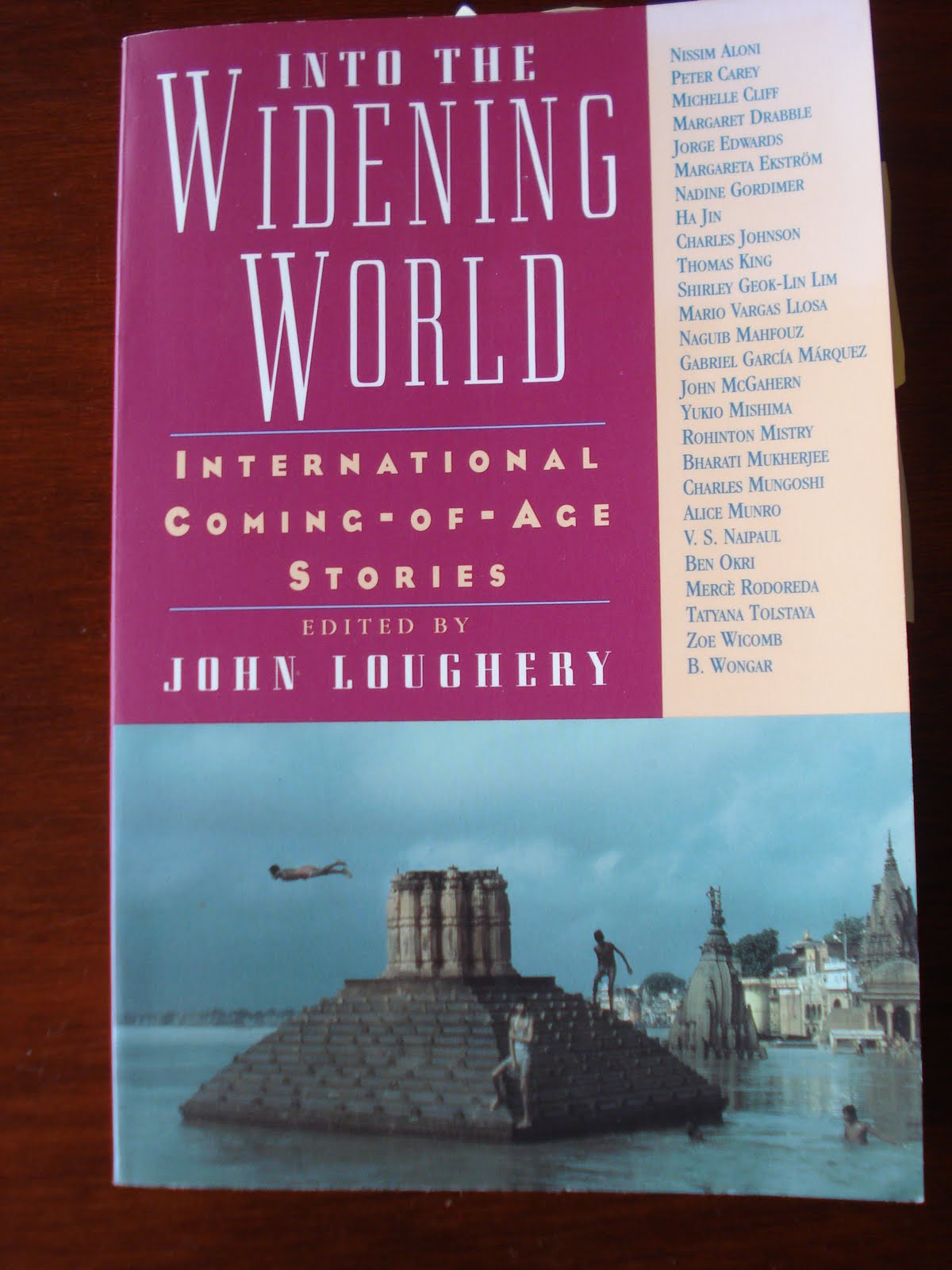
My wife, desiring a break from Service's poetry, also has us reading an anthology of coming-of-age stories from great world writers like V.S. Naipaul, Gabriel Garcia Marquez, and Nadine Gordimer. I believe my father used some stories from this book in textbooks he compiled and edited.
We're even starting little Samuel's spiritual formation in the womb. This morning I finally got around to reading him a bit of the Bible. I'm starting with the Gospel of John, which I think is the most interesting version of the most interesting part of the Bible. I'm also reading St. Augustine's Confessions on my own time, so reading John today I ran across a lot of passages Augustine refers to. All that about the Word being with God, and being God, comes from pre-Christian Platonist thinking. Augustine found many of Christianity's roots in such thinking, but what was lacking was the Incarnation. The Platonists had an idea of a Logos, an emissary from God and of God, but they had no belief that this Logos would take human form. It's also impressive how much of the Catholic liturgy comes from just the first chapter of John.

The Bible I'm reading to Samuel from is a Protestant version I got maybe 12 years ago from a friend in high school. Obviously it's missing things like Maccabees and Wisdom that we Catholics use, but I like the translation a lot.
I always read and talk to Samuel in English, and my wife Caro talks to him in Spanish. I don't think it makes much of a difference now, as what he can hear from his perch within the uterus is probably just indistinct rumbling. But once he's born, I intend to keep this up. From what I've read and seen, kids whose parents speak multiple languages to them indiscriminantly often can't differentiate between the different languages, and mix them together when they speak. On the other hand, if there are clear boundaries between when one language or another is spoken, it's easier for the child to learn. So if Dad (and Grandma) always talk to Samuel in English, and Mom (and Sister and society) always in Spanish, he should be able to figure things out better. I've heard that Nabokov was like five years old before he realized he was speaking multiple languages. Until then he had just thought that you talked with Grandma in one way, and Mom in another, and your cousins in another, but it turned out he was speaking English, French, and Russian to different family members.
Eventually I'd love to read Samuel books in other languages, and get him speaking things like French

or Chinese. But that will have to wait until he knows the difference between when we're speaking one language or another.

Once Samuel's born I hope to make reading an important part of his life, as it has been for me, my wife, and our families. Of course there will be kiddy books like the great Eric Carle works my cousin gave us,

and the classic Dr. Seuss, Haunted House, and Dwindling Party books my mom has kept wrapped in plastic since I was a baby. We've also got a beautiful book of Greek myths by the D'Aulaires,

and Maurice Sendak's Nutcracker.

But especially while Samuel's still a non-talking infant, I don't imagine it'll make much difference if I'm reading him Spot's First Christmas or Dostoyevsky! Maybe even the heavy, profound stuff will sink in somewhere in his subconscious, seeding in him a love for great books and for contemplating what life's all about.
Microlending, or microequity?
As I discussed in a past blog post, there are some problems with microlending. Namely, interest rates are often high, and some large microlenders threaten borrowers or drive them crazy in the course of trying to collect.
An issue of the excellent Tiers Monde journal was devoted expressly to the possibilities of microlending to reach the poor, and improve their life or not. It was entitled "Is microfinance socially responsible?". An interview in the Grain de Sel journal gives background on microfinance and its limitations for promoting agrarian development.
But this last article from the World Policy Institute is really interesting. It speaks of microequity, not just microloans. Given the lack of evidence that microcredit has driven any sort of widespread, sustained growth in the world, the author says that microfinance should aim to foster entrepreneurs that create businesses and prosperity. His prescription to achieve this is that microlending institutions become microfinance institutions writ large. They should not just lend, but become part-owning business partners, through investing venture capital in new businesses created by borrowers. According to the author, this approach would have better potential to promote development than does microlending, because it's difficult for a business to build itself on debt alone.
An issue of the excellent Tiers Monde journal was devoted expressly to the possibilities of microlending to reach the poor, and improve their life or not. It was entitled "Is microfinance socially responsible?". An interview in the Grain de Sel journal gives background on microfinance and its limitations for promoting agrarian development.
But this last article from the World Policy Institute is really interesting. It speaks of microequity, not just microloans. Given the lack of evidence that microcredit has driven any sort of widespread, sustained growth in the world, the author says that microfinance should aim to foster entrepreneurs that create businesses and prosperity. His prescription to achieve this is that microlending institutions become microfinance institutions writ large. They should not just lend, but become part-owning business partners, through investing venture capital in new businesses created by borrowers. According to the author, this approach would have better potential to promote development than does microlending, because it's difficult for a business to build itself on debt alone.
Saturday, December 11, 2010
Third World Green Daddy Part 5: Hospital Preparations
As I've mentioned in a prior post, my wife and I decided months ago to have our child in our town's public hospital as opposed to one of the crappy private clinics and hospitals here. After an unpleasant experience at a private hospital, I was worried that on the day of my son's birth I wouldn't be able to accompany my wife. It seemed that the standard policy in many places was to have the family of the delivering mother wait while she bore alone, a la 1950s USA.
We thought that in order for me to accompany my wife during childbirth, we'd have to have Samuel at our house. We asked our general doctor about it, and he said he liked the idea. But he was worried about safety and ethics. Namely, if he attended our birth and he saw that something were going wrong, he'd have to take us to the emergency room, after which he might be sanctioned in his practice as a doctor for not having provided adequate conditions for our childbirth.
With our doctor out of the running, we were even considering having a friend of ours assist with the birth at our house. She is an old, somewhat out-of-practice midwife living in a semi-rural slum of our town. We know her because she keeps up the 17th century church we attend. But obviously we'd be in trouble if something went wrong during the birth, because she has no fetal monitors or anything.
In the course of our regular prenatal controls, we went to the town's public hospital, just a few blocks from our house. We were attended by a lovely young gynecologist that allowed me into the consultation room, and answered our questions about the childbearing setup at the hospital. During that and subsequent visits, we've gotten a full idea of how the hospital runs things. Basically mothers in labor enter through the emergency room, from whence they are immediately spirited to a hospital bed in the maternity ward. They begin labor there, and when they've advanced to a certain stage, they go to another place called the labor room, where they and other mothers are looked after by a team of nurses and doctors, with all the essential monitoring equipment. When the baby is ready to come out, the mother is taken to the delivery room, which has an adjacent operating room in case anything goes wrong.
We didn't come easily by this information. For a long time no one could tell us exactly in what places and moments I might be with my wife, and when not. Both doctors and nurses said that everything depended on the judgment of the doctor on call at the moment of our delivery. Often I wasn't allowed to join my wife in her regular checkups and doctor visits at the hospital, which didn't bode well for my attending the birth. Hence we remained in a tense limbo, not knowing if I'd be able to be with my wife during our delivery, and not knowing where to get concrete, sure answers. The last thing we wanted was to add even more chaos to the birth process, with me arguing and getting pushed around by hospital staff on the big day!
Luckily my wife's co-worker used to be a secretary at the hospital, so she put us in touch with the hospital administration. It seems that one family member is always allowed to accompany the mother until the labor room, which is to say right up until the final moments of childbirth. Beyond that, we would have to set things up specially. Apparently the hospital had had trouble with fathers who were allowed into the birth room and then caused problems, either by getting in the way of the medical staff, or even fainting! Furthermore, because it's a teaching hospital, things can get crowded when you add another person to the mix of interns, pediatricians, OB-gyns, nurses, and other students in the birthing room. Granted, the convenience of doctors and other workers shouldn't be the prime consideration, but I could understand to some extent the reticence of the hospital to let fathers into the birth process. Anyway, once I found out that I could be with my wife until more or less the final moments, I was happy. My main concern was and is helping my wife to have a healthy, relaxed childbirth. I'm by no means the crucial person in the process, so insofar as my presence is a help, I want to be there, but if I'm in the way at any point, I'd be most useful by making myself scarce.
Yesterday I finally had my interview with the hospital administration. They asked me a few general questions and basically tried to ascertain whether I was comfortable around childbirth and babies, so that I wouldn't freak out or faint in the delivery room. Then they took me and my wife to meet the head obstetrician, who was also very nice. He explained in depth the process I've detailed above of different rooms in different moments of childbirth, and reiterated that I'd be welcome in the delivery room unless there were some unforeseen emergency or difficulty in the birth. After that we talked with a nurse that is the hospital's point person for incorporating fathers into the childbirth process. She was really gracious, giving us a list of things to bring, and setting up a date for my wife and me to make the rounds of the maternity ward this Monday, to prep us for how things work. The nurse also charged me with buying a few full-body disposable surgical scrubs--one set for Monday, one for the day of Samuel's birth, and another to change into before entering the final birth room. The hospital of course has scrubs for patients and family, but she was worried they wouldn't fit me!
In the end my take is that the hospital administration is trying to promote fathers' participation in childbirth, but many of the doctors aren't quite on board. Though my wife and I felt like rock stars yesterday with the attention the administration gave us, we weren't actually getting any special, exclusive treatment. Our friend told us who to get in touch with at the hospital to set up my attending the birth, but she didn't pull any levers or get us any undue privilege. In theory the attention we're getting, and the possibility of fathers' being present at the childbirth, is available to any patient. But we wouldn't have known about these rights and opportunities if it weren't for our friend's telling us. The administration's campaign to involve fathers seems not to arrive to the level of patients. Many doctors and nurses claim that either the father or the mother is usually reluctant to have the father present during childbirth, but I believe it's mainly that people don't know that it's an option. Doctors either don't tell them about it or even dissuade them from it, out of laziness, reluctance to change, or desire for convenience on the doctor's part.
The hospital has a concentrated campaign to push breastfeeding and mothers' spending time with their babies right after birth to establish a bond, and I imagine their designation of the special nurse in charge of father involvement is an extension of this more progressive, holistic approach to childbirth. It's probably like the US in the 1970s and 1980s, when hospitals started treating birth in a more human manner, cutting down on drugs, allowing and encouraging fathers to help out, pushing breastfeeding. It's exciting to be part of this change.
As in many aspects of life in our small town, certain practices and possibilities are lacking when compared to Bogota or Chicago, but that just means that there are lots of things yet to be done! Our efforts to introduce new ways of doing things (or in this case our participation in changes that are already underway) can really make a difference, and are greatly appreciated by our fellow townspeople. The special nurse as well as the hospital administrator seemed thrilled that we were interested and involved in our upcoming childbirth (as opposed to just swooping in on the day of and demanding treatment). They even asked if they could take promotional photos of us on Monday during our maternity ward tour. I told them that if they wanted they could present us as an international delegation coming specifically to their hospital to have our child. They asked if I was going to film the birth. We hadn't been planning on filming anything, but if it helps the hospital out, we're willing to consider it. They also informed us that we were free to request that no interns be present. Some people are annoyed or embarrassed to have a bunch of young doctors in training looking at them and prodding them. But my wife argues that if we don't allow interns to attend and learn, where will our future doctors come from?
With our hospital visit this coming Monday, we'll have everything in order for our baby's birth. I'm hoping Samuel holds out not just for our tour on Monday, but also for me to pick up my mother, who arrives in Bogota on Tuesday. If the big guy can wait until Thursday or so, that will be great. But we'll take him whenever he comes.
We thought that in order for me to accompany my wife during childbirth, we'd have to have Samuel at our house. We asked our general doctor about it, and he said he liked the idea. But he was worried about safety and ethics. Namely, if he attended our birth and he saw that something were going wrong, he'd have to take us to the emergency room, after which he might be sanctioned in his practice as a doctor for not having provided adequate conditions for our childbirth.
With our doctor out of the running, we were even considering having a friend of ours assist with the birth at our house. She is an old, somewhat out-of-practice midwife living in a semi-rural slum of our town. We know her because she keeps up the 17th century church we attend. But obviously we'd be in trouble if something went wrong during the birth, because she has no fetal monitors or anything.
In the course of our regular prenatal controls, we went to the town's public hospital, just a few blocks from our house. We were attended by a lovely young gynecologist that allowed me into the consultation room, and answered our questions about the childbearing setup at the hospital. During that and subsequent visits, we've gotten a full idea of how the hospital runs things. Basically mothers in labor enter through the emergency room, from whence they are immediately spirited to a hospital bed in the maternity ward. They begin labor there, and when they've advanced to a certain stage, they go to another place called the labor room, where they and other mothers are looked after by a team of nurses and doctors, with all the essential monitoring equipment. When the baby is ready to come out, the mother is taken to the delivery room, which has an adjacent operating room in case anything goes wrong.
We didn't come easily by this information. For a long time no one could tell us exactly in what places and moments I might be with my wife, and when not. Both doctors and nurses said that everything depended on the judgment of the doctor on call at the moment of our delivery. Often I wasn't allowed to join my wife in her regular checkups and doctor visits at the hospital, which didn't bode well for my attending the birth. Hence we remained in a tense limbo, not knowing if I'd be able to be with my wife during our delivery, and not knowing where to get concrete, sure answers. The last thing we wanted was to add even more chaos to the birth process, with me arguing and getting pushed around by hospital staff on the big day!
Luckily my wife's co-worker used to be a secretary at the hospital, so she put us in touch with the hospital administration. It seems that one family member is always allowed to accompany the mother until the labor room, which is to say right up until the final moments of childbirth. Beyond that, we would have to set things up specially. Apparently the hospital had had trouble with fathers who were allowed into the birth room and then caused problems, either by getting in the way of the medical staff, or even fainting! Furthermore, because it's a teaching hospital, things can get crowded when you add another person to the mix of interns, pediatricians, OB-gyns, nurses, and other students in the birthing room. Granted, the convenience of doctors and other workers shouldn't be the prime consideration, but I could understand to some extent the reticence of the hospital to let fathers into the birth process. Anyway, once I found out that I could be with my wife until more or less the final moments, I was happy. My main concern was and is helping my wife to have a healthy, relaxed childbirth. I'm by no means the crucial person in the process, so insofar as my presence is a help, I want to be there, but if I'm in the way at any point, I'd be most useful by making myself scarce.
Yesterday I finally had my interview with the hospital administration. They asked me a few general questions and basically tried to ascertain whether I was comfortable around childbirth and babies, so that I wouldn't freak out or faint in the delivery room. Then they took me and my wife to meet the head obstetrician, who was also very nice. He explained in depth the process I've detailed above of different rooms in different moments of childbirth, and reiterated that I'd be welcome in the delivery room unless there were some unforeseen emergency or difficulty in the birth. After that we talked with a nurse that is the hospital's point person for incorporating fathers into the childbirth process. She was really gracious, giving us a list of things to bring, and setting up a date for my wife and me to make the rounds of the maternity ward this Monday, to prep us for how things work. The nurse also charged me with buying a few full-body disposable surgical scrubs--one set for Monday, one for the day of Samuel's birth, and another to change into before entering the final birth room. The hospital of course has scrubs for patients and family, but she was worried they wouldn't fit me!
In the end my take is that the hospital administration is trying to promote fathers' participation in childbirth, but many of the doctors aren't quite on board. Though my wife and I felt like rock stars yesterday with the attention the administration gave us, we weren't actually getting any special, exclusive treatment. Our friend told us who to get in touch with at the hospital to set up my attending the birth, but she didn't pull any levers or get us any undue privilege. In theory the attention we're getting, and the possibility of fathers' being present at the childbirth, is available to any patient. But we wouldn't have known about these rights and opportunities if it weren't for our friend's telling us. The administration's campaign to involve fathers seems not to arrive to the level of patients. Many doctors and nurses claim that either the father or the mother is usually reluctant to have the father present during childbirth, but I believe it's mainly that people don't know that it's an option. Doctors either don't tell them about it or even dissuade them from it, out of laziness, reluctance to change, or desire for convenience on the doctor's part.
The hospital has a concentrated campaign to push breastfeeding and mothers' spending time with their babies right after birth to establish a bond, and I imagine their designation of the special nurse in charge of father involvement is an extension of this more progressive, holistic approach to childbirth. It's probably like the US in the 1970s and 1980s, when hospitals started treating birth in a more human manner, cutting down on drugs, allowing and encouraging fathers to help out, pushing breastfeeding. It's exciting to be part of this change.
As in many aspects of life in our small town, certain practices and possibilities are lacking when compared to Bogota or Chicago, but that just means that there are lots of things yet to be done! Our efforts to introduce new ways of doing things (or in this case our participation in changes that are already underway) can really make a difference, and are greatly appreciated by our fellow townspeople. The special nurse as well as the hospital administrator seemed thrilled that we were interested and involved in our upcoming childbirth (as opposed to just swooping in on the day of and demanding treatment). They even asked if they could take promotional photos of us on Monday during our maternity ward tour. I told them that if they wanted they could present us as an international delegation coming specifically to their hospital to have our child. They asked if I was going to film the birth. We hadn't been planning on filming anything, but if it helps the hospital out, we're willing to consider it. They also informed us that we were free to request that no interns be present. Some people are annoyed or embarrassed to have a bunch of young doctors in training looking at them and prodding them. But my wife argues that if we don't allow interns to attend and learn, where will our future doctors come from?
With our hospital visit this coming Monday, we'll have everything in order for our baby's birth. I'm hoping Samuel holds out not just for our tour on Monday, but also for me to pick up my mother, who arrives in Bogota on Tuesday. If the big guy can wait until Thursday or so, that will be great. But we'll take him whenever he comes.
Friday, December 10, 2010
High standards (or hype) in education
Here is an article about high test scores in Shanghai schools, and how they compare to scores in other countries. This is another article about the stress kids suffer at ultra-elite schools in the US.
Frankly, I think a lot of what these articles discuss is hullaballoo. I don't believe in the worth of whatever education gotten by Chinese kids who don't go outside because they study so much. And I don't believe in the value of the resume-padding undertaken by the whole elite school racket in the US. Many of the kids with whom I attended the much-maligned Chicago public schools are smarter and more cultured than most other people I've met, be they suburban overachievers from the US or obsessive studiers from China.
While I don't agree with what a recent NYT debate implies, that perhaps having an education in China isn't worth much because job prospects don't improve considerably (indeed, in recession USA the same argument might seem to hold), I do believe that education is much more than just what schools you attend or graduate from. This seems to be borne out by the fact that in two of the three articles I've cited here (as well as this one on the apparent inadequacies of Chinese or any testing-based education system), it seems that college graduates are trying to get hired working for others, instead of creating productive businesses themselves.
I can understand the motivation of Chinese parents and teachers to push kids hard, and I can understand the worry of elite parents in the US that see their kids getting stressed out. I'd advise a healthy dose of common sense for both groups. Make sure your kids read a lot (which is only possible if you in turn read a lot). Talk to them. Go outside. Learn with your kids about how the world works, from genetics to capital finance to African religions. Know how to do things, make things, grow things, fix things, and share this knowledge with your kids. This is the way to form a brilliant, well-rounded human being. Such human beings are what make the world a better place, whether through starting a company, volunteering their skills with a worthy organization, working for the government, thinking and sharing new ideas, or just generally promoting better, more decent ways of living life.
Frankly, I think a lot of what these articles discuss is hullaballoo. I don't believe in the worth of whatever education gotten by Chinese kids who don't go outside because they study so much. And I don't believe in the value of the resume-padding undertaken by the whole elite school racket in the US. Many of the kids with whom I attended the much-maligned Chicago public schools are smarter and more cultured than most other people I've met, be they suburban overachievers from the US or obsessive studiers from China.
While I don't agree with what a recent NYT debate implies, that perhaps having an education in China isn't worth much because job prospects don't improve considerably (indeed, in recession USA the same argument might seem to hold), I do believe that education is much more than just what schools you attend or graduate from. This seems to be borne out by the fact that in two of the three articles I've cited here (as well as this one on the apparent inadequacies of Chinese or any testing-based education system), it seems that college graduates are trying to get hired working for others, instead of creating productive businesses themselves.
I can understand the motivation of Chinese parents and teachers to push kids hard, and I can understand the worry of elite parents in the US that see their kids getting stressed out. I'd advise a healthy dose of common sense for both groups. Make sure your kids read a lot (which is only possible if you in turn read a lot). Talk to them. Go outside. Learn with your kids about how the world works, from genetics to capital finance to African religions. Know how to do things, make things, grow things, fix things, and share this knowledge with your kids. This is the way to form a brilliant, well-rounded human being. Such human beings are what make the world a better place, whether through starting a company, volunteering their skills with a worthy organization, working for the government, thinking and sharing new ideas, or just generally promoting better, more decent ways of living life.
Wednesday, December 8, 2010
Double entry
I've long maintained that it's a sin
That there should be so many with so little.
But in a Great Accounting
Of types, names, and kinds,
Would a lot of a little
Count as
Poverty or Plenty?
Third World Green Daddy Part 4: Some Metaphysical Questions
Recently I had an electronic exchange with a friend of mine about some of the concerns I've brought up in my Third World Green Daddy blogs. I also recently read a New York Times piece about balancing fundamental individual and societal convictions with acceptance of diversity. All this got me to thinking about a pertinent question for those of us who would pursue a greener, more responsible lifestyle. How do we balance our own convictions about how to do things, with the convictions, preferences, and practices of others?
My friend had written to congratulate me for starting my Green Daddy blogs, as well as to share his disillusion with certain aspects of modern society that supposedly represent advances or development. My response to him was:
"It's true, much of what my wife and I are pursuing as special things for Samuel's upbringing were in fact common practice in our own childhoods. We both grew up with glass baby bottles, cloth diapers, etc. (On the other hand, we also grew up in an age when synthetic infant formula often replaced mother's milk, something which today seems to be returning more to the natural order of things, fortunately).
"So I share your frustration with certain changes that supposedly represent improvements or development, but that really seem more like decadence or a step backward. At the same time, I believe we all welcome other changes that have come with modernity--better roads, long-distance communication, the Internet. And it is always important for us, the middle class of Latin America, to remember that while things like using disposable diapers instead of cloth may seem ridiculous, perhaps for the poor families that comprise the majority of our countrymen those same disposable diapers indeed represent a big improvement over what they used in the past (old rags, garbage bags, or just leaving their kids naked). Or maybe not. In any case, I'm reluctant to condemn all that we call development, lest in doing so I deny to other people certain things of value. I think it's the same challenge as always, to use our insights and our position of privilege to improve things for and with our neighbors, but without imposing on anyone the definition of what counts as an improvement, and what doesn't."
I feel that this sums up my outlook on living a sustainable lifestyle. Obviously I want to live in a way that does as little damage as possible to myself, my neighbors, and my environment. And because I believe this is a good way to live, I am going to work to promote what I see as responsible practices among other people, companies, and government. Such promotion can entail making suggestions or arguments, or even working to impose my vision on society through the means available to me (my voice, my vote, my dollar, etc.). But it's always a balancing act to know when to go with my convictions (even when they impose on others) or when to accept other ways of doing things, and be content to live my way within my own little sphere of being.
But beyond this, my exchange with my friend brings up the larger question of when we have the right to speak in the name of others, or to strive for a change in our society.
I often feel odd talking about Latin American issues in the first person--"We in Latin America should do X". I wasn't born here, and surely many would resent someone from the US dictating what should or shouldn't be done in Latin America, or even merely identifying himself as a Latin American. But I usually decide that my life and my work in Colombia, and on behalf of Colombia, give me the right to comment as a Colombian, as a Latin American.
But this brings up an interesting point. Do all Latin Americans have a right to comment in the name of Latin America? The societies of our continent are so diverse in terms of class, race, culture, and geography that it may seem presumptuous for anyone to speak on behalf of the collective. Does a wealthy descendent of Spaniards living in posh Lima have a right to speak in the name of an Indian in the Guyanese jungle? Even within the same country, does a slumdweller in Bogota really understand the problems and priorities of the sparsely-settled Eastern Plains?
Finally I realize that this isn't only a problem in Latin America, but in any place. Despite the common purpose and ideals to which those in the US lay claim, does a Wisconsin dairy farmer really understand the life of the sun of Haitian immigrants living in Coral Gables, Florida? On the other hand, surely places like France and the Sudan differ in many aspects, but doesn't our common humanity entitle any person to opine on what's happening to any other? Our world is a diverse one, broken into hundreds of countries, each of them in turn comprised of many cultures and viewpoints. The stark social divisions in Latin America may be a more visible manifestation of the problem, but the question remains the world over. What is the collective? Who is justified to speak in the name of others? Who has the right to change society?
My friend had written to congratulate me for starting my Green Daddy blogs, as well as to share his disillusion with certain aspects of modern society that supposedly represent advances or development. My response to him was:
"It's true, much of what my wife and I are pursuing as special things for Samuel's upbringing were in fact common practice in our own childhoods. We both grew up with glass baby bottles, cloth diapers, etc. (On the other hand, we also grew up in an age when synthetic infant formula often replaced mother's milk, something which today seems to be returning more to the natural order of things, fortunately).
"So I share your frustration with certain changes that supposedly represent improvements or development, but that really seem more like decadence or a step backward. At the same time, I believe we all welcome other changes that have come with modernity--better roads, long-distance communication, the Internet. And it is always important for us, the middle class of Latin America, to remember that while things like using disposable diapers instead of cloth may seem ridiculous, perhaps for the poor families that comprise the majority of our countrymen those same disposable diapers indeed represent a big improvement over what they used in the past (old rags, garbage bags, or just leaving their kids naked). Or maybe not. In any case, I'm reluctant to condemn all that we call development, lest in doing so I deny to other people certain things of value. I think it's the same challenge as always, to use our insights and our position of privilege to improve things for and with our neighbors, but without imposing on anyone the definition of what counts as an improvement, and what doesn't."
I feel that this sums up my outlook on living a sustainable lifestyle. Obviously I want to live in a way that does as little damage as possible to myself, my neighbors, and my environment. And because I believe this is a good way to live, I am going to work to promote what I see as responsible practices among other people, companies, and government. Such promotion can entail making suggestions or arguments, or even working to impose my vision on society through the means available to me (my voice, my vote, my dollar, etc.). But it's always a balancing act to know when to go with my convictions (even when they impose on others) or when to accept other ways of doing things, and be content to live my way within my own little sphere of being.
But beyond this, my exchange with my friend brings up the larger question of when we have the right to speak in the name of others, or to strive for a change in our society.
I often feel odd talking about Latin American issues in the first person--"We in Latin America should do X". I wasn't born here, and surely many would resent someone from the US dictating what should or shouldn't be done in Latin America, or even merely identifying himself as a Latin American. But I usually decide that my life and my work in Colombia, and on behalf of Colombia, give me the right to comment as a Colombian, as a Latin American.
But this brings up an interesting point. Do all Latin Americans have a right to comment in the name of Latin America? The societies of our continent are so diverse in terms of class, race, culture, and geography that it may seem presumptuous for anyone to speak on behalf of the collective. Does a wealthy descendent of Spaniards living in posh Lima have a right to speak in the name of an Indian in the Guyanese jungle? Even within the same country, does a slumdweller in Bogota really understand the problems and priorities of the sparsely-settled Eastern Plains?
Finally I realize that this isn't only a problem in Latin America, but in any place. Despite the common purpose and ideals to which those in the US lay claim, does a Wisconsin dairy farmer really understand the life of the sun of Haitian immigrants living in Coral Gables, Florida? On the other hand, surely places like France and the Sudan differ in many aspects, but doesn't our common humanity entitle any person to opine on what's happening to any other? Our world is a diverse one, broken into hundreds of countries, each of them in turn comprised of many cultures and viewpoints. The stark social divisions in Latin America may be a more visible manifestation of the problem, but the question remains the world over. What is the collective? Who is justified to speak in the name of others? Who has the right to change society?
Tuesday, December 7, 2010
To fade from history
I have known great men
That receive no mention in the history books.
When I die, or perhaps my son,
Their memory will live no longer.
Just as those who died long before me,
My very flesh and blood,
Are unknown to me.
These men who gave me my DNA
Are total strangers.
How sad that my father will fade too one day,
As we all will.
But perhaps it doesn't matter
To those who frolic and bask
In the Great Beyond.