Sometimes in the development sector we discuss so-called non-economic or non-quantifiable quality of life factors. These are things like fresh air or the satisfaction of growing your own food that are not adequately accounted for in purely economic analyses. Often people who advocate for such things are essentially saying that the poor should remain barefoot and backwards in order to maintain traditional values that the outside observer finds cute. Such arguments amount to "Don't expand your cash crop production--it offends my agrarian sensibilities" or "Don't move to the city, even if it means multiplying your income by 10". I perhaps lean toward such discourses, though I normally try not to let my own dogmas or personal preferences keep other people in situations with which they are not satisfied.
Anyway, today we took a group of my wife's visiting sisters and nieces and nephews to visit the same farm in Arcabuco I've profiled before. The kids marveled at the animals, the fish, the streams, and everything else that always wows me when I go there. It made me realize that despite my wife's and my occasional gripes with the poor selection of movies and restaurants in our small city, we really do benefit from many non-economic quality of life factors. Our food is fresher, we have easy access to the countryside, we derive satisfaction from working with farmers that can really use our help. The kids we took to the farm would never be able to have such an experience in their hometowns of Medellin and Bogota. All the money of these big cities can't buy a simple, free jaunt to a nearby farm to buy trout. In fact, we can even quantify the benefit of our ready access to this place; a visit to the agriculture-based theme parks just outside of Bogota and Medellin (a concept I fully support) costs 30000 pesos, or about $16US per person. So for the twelve people we took to our friend's farm, it would have cost almost $200US to get into a synthetic version of a real farm. As is, we paid like $40US for about 14 pounds of fresh-caught filleted trout, plus $11US I gave to our friend for having showed us around.
So small-town life may not be great for movie-goers or eat-out gourmands, but it's got its bright spots.
Saturday, December 31, 2011
Tuesday, December 27, 2011
A Megapark for the Calumet region?
I just saw this article recently on plans to create a massive state park peppered throughout southern Chicago's Calumet region. It would apparently cover 140000 acres in all, and represent a reclamation of what is at once one of the US's most biodiverse regions (where forest meets prairie meets coastal sand dunes meet swamp meet lake, with lots of migratory birds thrown in for good measure) and one of its most polluted (think active and abandoned factories, chemical waste dumps, municipal waste dumps, municipal sewage treatment).
This idea excites me for its size and ambition, and it would obviously be great to restore polluted brownfields into intact wetlands open to public visits. I have a soft spot in my heart for the Calumet region after living there for a while for a job I had a few years ago. But I don't know if I buy the optimistic prognosis as far as boosting tourism and creating jobs. Calumet is remote, unknown, and scary to most Chicago dwellers. Who's going to visit this park? What jobs will it create? Will the State take on more employees in these lean times?
At any rate, I look forward to hearing more about this in the near future.
This idea excites me for its size and ambition, and it would obviously be great to restore polluted brownfields into intact wetlands open to public visits. I have a soft spot in my heart for the Calumet region after living there for a while for a job I had a few years ago. But I don't know if I buy the optimistic prognosis as far as boosting tourism and creating jobs. Calumet is remote, unknown, and scary to most Chicago dwellers. Who's going to visit this park? What jobs will it create? Will the State take on more employees in these lean times?
At any rate, I look forward to hearing more about this in the near future.
Saturday, December 24, 2011
Geoengineering and Brazil nuts
Today I was talking with a friend about climate change and other catastrophes we humans are creating on a planetary scale. The subject came up of finding technological solutions to get us off the hook. I have in other places argued that indeed, an industrial, technological fix seems to me to be the only realistic option for getting the atmosphere's CO2 levels back down to normal, and I have proposed socially-sustainable ways of implementing large-scale carbon sequestration. Of course we will also need other, nature-based approaches to sequestering carbon, for example massive reforestation projects such as those profiled for the northern China loess plain and in Las Gaviotas, Colombia. I've also suggested agrarian reforestation projects along these lines. Anyway, I sincerely hope that humans will someday soon find a magical fix to carbon-dioxide-caused global warming, but hope is not a sound problem-solving strategy. And despite my numerous ideas and proposals to reduce global warming in our time, I'm not too hopeful about the prospects of solving this massive problem.
At any rate, our conversation also got me thinking about so-called geoengineering. This is a neologism that refers to engineering large-scale, planet-wide processes, especially in the context of combating global warming. I've heard proposals of things like seeding the oceans with iron to encourage CO2-absorbing algal blooms, or shooting aerosols into the atmosphere to reduce the solar radiation reaching (and thus heating) our planet. Such proposals seem like lethal hubris to me, the product of minds accustomed to dealing with systems far less complex than the Earth's intricate web of relations and balances. The potential negative side effects (plummeting crop yields due to reduced sunlight, massive dead zones in the ocean, etc.) are horrid, and those side effects we can foresee are surely a mere fraction of the disasters that would actually result.
An example of a system that mankind has yet to fully control is the production of Brazil nuts. Brazil nuts grow on trees scattered throughout the Amazon rainforest. Ingenuous entrepreneurs have long dreamed of producing these valuable nuts on an industrial scale in plantations, but it has never worked. Brazil nut trees in plantations tend not to produce many or any nuts. Today we understand that this is because Brazil nuts require a complex ecological web to produce fruit. The flower of the tree is pollinated only by a certain species of bee, which depends for mating on a certain species of orchid. This epiphytic orchid, in turn, grows not on Brazil nut trees but on other intact rainforest species. So what would seem like a simple operation--plant Brazil nut trees and harvest Brazil nuts--can't work without a whole series of other considerations. Even now that we know the general ecological functioning behind Brazil nut pollination, plantations of the tree are still not productive. I imagine this is because there are other factors we don't yet understand that impede our successful manipulation of the factors we do understand. So as of today, all the Brazil nuts you buy at the store have been manually harvested from wild trees in intact forests.
Anyway, if we can't even suitably control the production of a simple nut whose ecology we more or less understand, how could we expect to manage the millions of similar systems encompassed in the entire geosphere?
At any rate, our conversation also got me thinking about so-called geoengineering. This is a neologism that refers to engineering large-scale, planet-wide processes, especially in the context of combating global warming. I've heard proposals of things like seeding the oceans with iron to encourage CO2-absorbing algal blooms, or shooting aerosols into the atmosphere to reduce the solar radiation reaching (and thus heating) our planet. Such proposals seem like lethal hubris to me, the product of minds accustomed to dealing with systems far less complex than the Earth's intricate web of relations and balances. The potential negative side effects (plummeting crop yields due to reduced sunlight, massive dead zones in the ocean, etc.) are horrid, and those side effects we can foresee are surely a mere fraction of the disasters that would actually result.
An example of a system that mankind has yet to fully control is the production of Brazil nuts. Brazil nuts grow on trees scattered throughout the Amazon rainforest. Ingenuous entrepreneurs have long dreamed of producing these valuable nuts on an industrial scale in plantations, but it has never worked. Brazil nut trees in plantations tend not to produce many or any nuts. Today we understand that this is because Brazil nuts require a complex ecological web to produce fruit. The flower of the tree is pollinated only by a certain species of bee, which depends for mating on a certain species of orchid. This epiphytic orchid, in turn, grows not on Brazil nut trees but on other intact rainforest species. So what would seem like a simple operation--plant Brazil nut trees and harvest Brazil nuts--can't work without a whole series of other considerations. Even now that we know the general ecological functioning behind Brazil nut pollination, plantations of the tree are still not productive. I imagine this is because there are other factors we don't yet understand that impede our successful manipulation of the factors we do understand. So as of today, all the Brazil nuts you buy at the store have been manually harvested from wild trees in intact forests.
Anyway, if we can't even suitably control the production of a simple nut whose ecology we more or less understand, how could we expect to manage the millions of similar systems encompassed in the entire geosphere?
Friday, December 23, 2011
Third World Green Daddy 25: Thanksgiving

This year we had a big Thanksgiving. Ever since we got to Colombia in late 2008, I've made a special Thanksgiving dinner every year. In Colombia they don't celebrate Thanksgiving, but among our friends and family we have sort of inserted the holiday as a major event in the year. Now everyone knows and looks forward to Thanksgiving at our house. Next year I'm thinking of introducing a football game in our local park as part of the get-together (though in my family we never played football at Thanksgiving).
I always make a big fuss for the Thanksgiving meal. Our first year I made some stuffed roasted chickens, and since then I've been gradually adding more dishes to the affair. Most of the recipes are my expatriate reconstructed version of US classics, with a twist of Andean flavor. This year I made Andean stuffed chicken, Boston baked beans, sauteed spinach, key lime pie, mashed potatoes, and corn bread. Guests brought more roast chicken, salads, cranberry sauce, green beans, and mashed squash. My corn bread turned out harder and less sweet than my usual recipe, but as such it resembled traditional US conbread even more. I was particularly proud of my home-made key lime pie.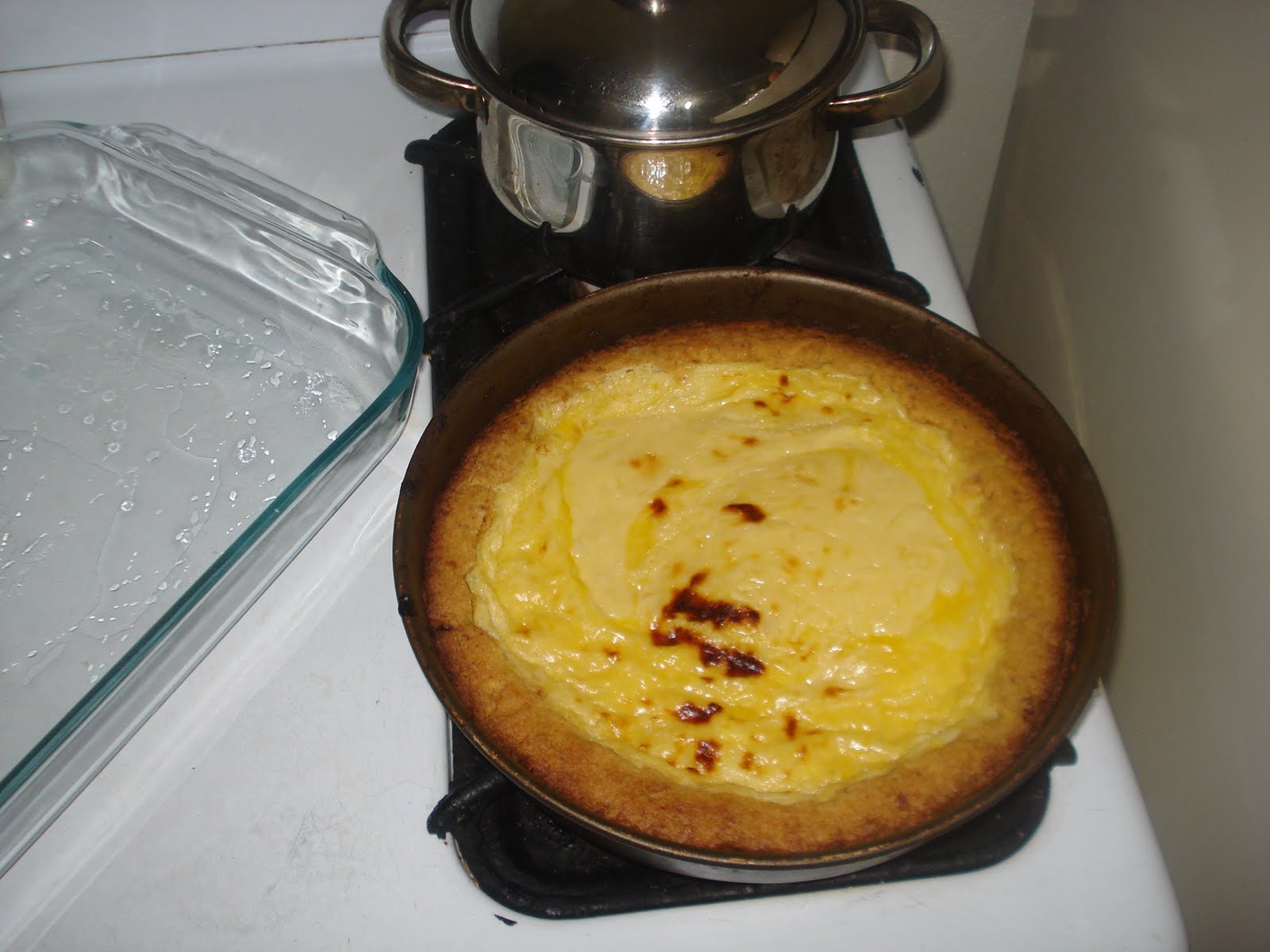
The recipe is actually really easy--a can of condensed milk, a half-cup of lime juice, and (gasp!) five egg yolks. The real point of pride is that I made a graham-cracker-style crust from scratch. Since we don't have graham crackers in Colombia, I used the crumbs from galletas de sagu (made from the achira starch I'm studying in my job). These are delicious cookies made in Guayata, in the Tenza valley. However, their crumbly nature, combined with the awful, bumpy road into and out of Guayata, make for a lot of broken cookies. I took advantage of them to make this crust.
Here is the bed of vegetables on which my Andean chicken sat in the oven.
I arranged the photo so you can see bits of cassava, guatila (Sechium edule), four varieties of potato, cubios (Tropaeolum tuberosum), ibias (Oxalis tuberosa), ruba (Ullucus tuberosus), balu (Erythrina edulis), butternut squash, and arracacha (Arracacia xanthorriza). Hence the whole vegetable bed consists in New World crops.
The chickens and their seasonings are entirely Old World. They have celery, bread crumbs, white mushrooms, eggs, and onions in the stuffing, and a rub/baste of olive oil, curry, sage, thyme, rosemary, cilantro, and a few other things. Here's the finished product:
This year we had something like 20 people for Thanksgiving dinner. Many of them were my wife's workmates. We had a few kids running around, which really lent a nice family flavor to the event. I think many people in Bogota, especially my wife's single coworkers, don't get to spend much time in family celebrations. In our town in Boyaca, families are bigger and more people live together with their whole family. Hence before my wife moved to Bogota, we didn't realize how special our frequent family get-togethers were, and we often longed for the more modern, urbane life of the big city. But seeing and talking to my wife's coworkers, I realized that for them family get-togethers are rare, and they in turn have an overdose of late-night parties shared only with other adults.
In preparation for the explanation I always give to our guests, I read up a bit on the original Thanksgiving celebration. I know there were actually some Thanksgiving-style celebrations in Virginia before 1620, but the Plymouth Colony version is the one we've accepted as our collective heritage in the US. I really like this Thanksgiving story of the Plymouth settlers and the Massassoit Indians, and sometime I would like to read more original documents and commentaries on it. Also, the harvest celebration of native New World crops that is at the heart of Thanksgiving relates very well to the Muisca Garden project at my work.
As has often happened to me in the six years I've been living outside the States, what had seemed familiar and boring growing up now seems cool and exotic. I am rediscovering the fascinating story of Thanksgiving, the early history of our nation, the conflicts and cooperation between Europeans and Native Americans that has defined us as a people. I miss the autumn, the change of weather, all the aspects of the natural environment in the Midwest that I never appreciated as a college student longing to learn about the tropics. Above all, I miss the traditions I grew up with in the US, though my wife and I are steadily building our own traditions to guide and anchor us as a family.
Here is an interesting radio essay that my friend's big sister presented on NPR a few years ago. She too talks about creating and changing traditions, though in her case the traditions are a fusion of Nigerian and US customs.
Another part of my imported US traditions this year was what we did after Thanksgiving. I boiled down the two stripped chicken carcasses and made bouillon, which I then froze into ice cubes to use in future soups. Then I added more water to the carcasses and made a soup that lasted a few days (and that everyone in the house was sick of by the end). The interminable leftovers are an important part of Thanksgiving.
In fact, I've recently been thinking more explicitly about a sacred ethic of food. This is a term I've coined to describe a reverent, non-wasteful attitude towards food. Here would be the components of such an ethic:
Food is sacred. This means it is not to be thrown away. Even food waste (leaves, stems, trimmings, etc.) should be recycled in some form, be it composting, feeding to domestic animals, or any other creative re-use (fermenting into vodka, for example). It also means that you shouldn't overeat. When you overeat, especially when you overeat protein in the form of lots of meat, your body can't process it all, and you piss out a good deal of the nutrients consumed. This to me is equivalent to throwing away good food, or even like the ancient Roman custom of eating huge banquets, then vomiting them up to eat some more. Another conclusion that follows if we accept that food is sacred is that you should eat real food, not processed artificial food-like items (Michael Pollan has gone more into depth with this last point in his "In Defense of Food"). Just as no Catholic would consider a piece of Wonder Bread that's been mumbled over by some guy on the street to be a sacred piece of the body of Christ, no eater should consider Cheez-Its or 7-up to be real food.
Mealtime is sacred. This means food is to be eaten with others around a table, as a ritual. Food is not a mere fuel to be shoveled furtively into one's mouth, on the run or while doing other things. Food is as much a social event as a nutritive one. An implication of this is that you should eat all of what's put before you. Food is not a mere consumer good, which we are to pick and choose according to our superficial caprices or fickle fashions. All food is good, and any meal prepared by another is to be revered. So no one should pick at their food, or claim not to like certain things, especially when someone else has prepared the food as an act of love and communion.
How would such an ethic of sacred food mesh with other sustainable food movements or currents? Veganism and even strict vegetarianism are out, at least for meals prepared elsewhere, because the offense you would cause your host by being a picky eater would offset any positive ecological or moral impacts you might have by not eating animal projducts. As for sermonizing on sustainable food choices (a flaw which I am wont to display), a follower of the sacred food ethic should work to make his family or friends' choices more sustainable over time (less meat, less junk food, smaller portions), but at the moment of eating a given meal, we need to show graciousness and reverence for what others offer us, even if it doesn't meet with the sustainability seal of approval.
My wife and I have tried to live these values in our home. We don't waste food (though I've spent three years now saying I'll soon get around to composting our food scraps), and we eat our meals at table. I think this latter point has been a positive point for our son Sam. He eats really well and widely, not like some kids that refuse to eat certain things or whose parents have to chase them around the room shoving yogurt in their face. I know to some extent kids' eating habits are inborn and thus hit-or-miss, but I have to think that our marking mealtime as a special, ritual moment and serving a wide variety of real food must have something to do with Sam's healthy habits.
I don't want to be too self-righteous about our eating habits, because it's very possible that Sam will go through a picky eater phase and I'll have to retract my self-congratulation. Even I, who in my infancy and from adolescence onwards am one of the most versatile, open-minded eaters I know, went through a few years where I only or mainly ate the garbage marketed to me by the US junk food machine. Spaghetti-Os, sugary cereals, and chicken nuggets were my go-to foods, though I never spurned the vegetables my mother served at every meal. You would think this might make me more tolerant and sage around picky eaters, able to reflect on the temporality of such a situation. But I have never been a very understanding person when I see picky eaters. Frankly, I don't know how I'd manage it if Sam went through a phase where he was like that. Aside from our infant son, my wife and I are raising two teenagers that don't always eat well, and to date I have not found any way of managing or changing the situation other than sulking or making acerbic comments, neither of which is of any use. Lately though I've been reading books about childraising, so maybe by the time Sam's older they'll have helped me to figure out how to constructively manage these tricky situations!
Here is a video of a guy whose family gets three quarters of their food from the dumpsters of high-end grocery stores. He's really living the sacred ethic of food. Dumpster-diving isn't as much of an option here in Colombia, where we don't use dumpsters and where supermarket waste seems to be lower than in the US, but when we go to live in the States I think I'd get a kick out of getting good, free food from places like Trader Joe's or Whole Foods. I'd feel like I was bucking the system.
In the meanwhile, I'll keep trying to live a sacred food ethic in the context we live in.
Thursday, December 15, 2011
A farm in the middle Rio Suarez region
A few weeks ago, on the same trip when we passed by our friend's farm in Arcabuco, our final destination was my brother-in-law's farm in Santander, in the Hoya del Rio Suarez region. The area is mainly known for growing panela (solid cane molasses), but my brother-in-law has an innovative product: grass silage.
Silage is a way of preserving animal fodder for the long-term. Especially in temperate environments with marked seasons, it's always a challenge to keep livestock fed over the winter, when there's little green food available (and sometimes in the summer, when pastures dry up and die). Silage is one method among many (hay, crop stubble grazing, grain feeding, haylage, etc.) for setting aside feed during times of abundance, in order to use it in times of scarcity.
Preparing silage consists in chopping up grass or other fodder and leaving it in a tightly-sealed place. The sugars in the grass ferment up to a certain point, until they consume all the oxygen in the container and create an environment too acidic for any microbes to survive.
I believe the preparation of silage has its origin in Ireland, where the constantly-wet weather prevented the drying of hay for winter feeding. So farmers used the moisture to their advantage and prepared silage in dugout pits. Today in the US many dairy farmers raise corn for silage. They let the corn grow until it's nice and green and juicy, then chop the whole plant, leaves and stalks and ears and all, into little bits. These little bits are then compressed into upright silos or long horizontal polyethylene bags. If you see a purple tower in the rural Midwest, it's likely a glass-lined silo, while if you see a big mound covered by a black tarp and lots of tires, it's a pile of silage. The glass or plastic are to keep air out.
Here in Colombia silage isn't too common. Many places don't have a long enough dry or wet season to impair grass availability. However, as ranchers raise the density of animals on their pastures, and climate change leads to more drought and flooding, there is an increasing need for storeable animal feed. My brother-in-law Alejo is meeting that need. Indeed, the worst weather years in the rest of the country are the best business years for him!
He mainly produces silage from king grass. This is a fast-growing species of tropical grass that's high in protein, energy, and other nutrients necessary for meat and dairy cattle. My brother-in-law hires a crew of guys to cut the grass with machetes when it's two months old (the farm is too steeply sloping to use tractors or mechanized cutters). They load the 10-foot stalks into a truck and bring them back to a central processing point, where it goes through two machines linked together.

The first machine chops the grass and blows it out of a chute leading to a second machine, which packs the chopped grass into a bag. When the bag is full (weighing about 40 kg), it is pushed out of the machine, and a worker grabs it and ties it. Then the bag goes into a pile to await shipping to a buyer.
The process has undergone various changes over the past years. Initially they blew the chopped grass into a pile, then had to shovel it into a bag that they subjected to a hydraulic press. This gave way to the linking of chopping and packing machines so as to avoid the intermediate shoveling process. They also now use a heavy-gauge plastic in the bags so that clients can return the bags for reuse. When the bags get worn out after a few uses, they sell them to a guy that recycles them to make irrigation hoses. Thus the major waste product of the process has been virtually eliminated.
In the first video below my brother-in-law Alejo loads a new bag onto the packing machine, while his assistant gets a bunch of king grass ready to chop. The stuff he pours onto the grass from the white bucket is a bit of cane syrup, which helps get the fermentation process going in the bag.
In the next video the bag is full after a number of batches of king grass have been chopped and shoved into it. So Alejo takes it from the machine and to a staging area, where he'll later tie off the bag and stack it in a pile with other bags.

Most of the silage is made from king grass, but Alejo also makes cane into silage. This cane mainly comes from other farms, whose owners tell Alejo to bring his team and his machinery to their farm and harvest their cane for silage. This usually occurs when the price of panela is too low to justify the farmer's processing it as such.
However, Alejo is slowly planting cane of his own for turning into silage. Cane silage has a slightly different nutritional profile from king grass silage, so some ranchers prefer one or the other. Alejo is also branching into corn silage. Here is a field planted to the locally-adapted peasant variety of corn.

It compares very favorably to a hybrid variety he also tried planting, which hardly germinated in the farm's humid tropical conditions.

A different hybrid did fare pretty well though, as seen in the background of the next photo.

The farm doesn't only grow silage. There are also a number of cattle, some of which I partly own. We've set up a deal much like the Peul people of western Africa set up with their neighbors. Alejo takes care of the herd, for which he gets to keep the female offspring. I will keep the males, and sell them off for meat at about 2 years of age. These cattle are a Holstein-Angus mix, so they are good for both milk and meat production. We brought them to the farm young, so they could adjust to the warm climate despite their cool-weather European ancestry.


This fellow with the white face is the only male of the bunch.

He will serve as an indicator of when the cows are in heat. My brother-in-law has scarred the young bull's penis so it will grow slightly crooked. This way he will try to mount receptive females without impregnating them, and Alejo will thus know they're ready for artificial insemination.
Alejo has also branched into subsistence crops, thanks in part to my wife's and my incessant nagging that he shouldn't put all his effort into commercial products that might suffer big fluctuations in demand. Here is his chicken area, fenced in by stalks of wild grass native to the area.


The farm also has fruit trees planted long ago. There's this mandarin lime tree. It gives a sweet lime that looks and breaks apart like a mandarin orange.

I harvested a bucket full of them to make a typical treat of lemonade with panela.

There are also some wild lulo bushes. This is what they look like.

Wear gloves to pick the fruits. They're spiny!


We always eat well when we visit the farm. When we arrived this time, Alejo and his wife were making envueltos.

These consist in corn dough with cottage cheese, wrapped and cooked in corn leaves. They steamed them in a big pot cooking over a barrel fire.


Here's the finished envuelto, ready to eat

accompanied by eggs scrambled with local chorizo.

The unused corn husks go to feed the cattle.

What is a barrel fire, you ask? Basically you take a metal oil drum and fill it with sawdust.

You leave PVC pipes in as you fill the barrel with the sawdust, so as to create a chimney from bottom to top. Then you take out the pipes, and it's ready to light.

We also cooked our trout (brought from Arcabuco) on plantain leaves over such a fire. They turned out good, with slices of lime from the farm.


I hope you enjoyed visiting my brother-in-law's farm!
Silage is a way of preserving animal fodder for the long-term. Especially in temperate environments with marked seasons, it's always a challenge to keep livestock fed over the winter, when there's little green food available (and sometimes in the summer, when pastures dry up and die). Silage is one method among many (hay, crop stubble grazing, grain feeding, haylage, etc.) for setting aside feed during times of abundance, in order to use it in times of scarcity.
Preparing silage consists in chopping up grass or other fodder and leaving it in a tightly-sealed place. The sugars in the grass ferment up to a certain point, until they consume all the oxygen in the container and create an environment too acidic for any microbes to survive.
I believe the preparation of silage has its origin in Ireland, where the constantly-wet weather prevented the drying of hay for winter feeding. So farmers used the moisture to their advantage and prepared silage in dugout pits. Today in the US many dairy farmers raise corn for silage. They let the corn grow until it's nice and green and juicy, then chop the whole plant, leaves and stalks and ears and all, into little bits. These little bits are then compressed into upright silos or long horizontal polyethylene bags. If you see a purple tower in the rural Midwest, it's likely a glass-lined silo, while if you see a big mound covered by a black tarp and lots of tires, it's a pile of silage. The glass or plastic are to keep air out.
Here in Colombia silage isn't too common. Many places don't have a long enough dry or wet season to impair grass availability. However, as ranchers raise the density of animals on their pastures, and climate change leads to more drought and flooding, there is an increasing need for storeable animal feed. My brother-in-law Alejo is meeting that need. Indeed, the worst weather years in the rest of the country are the best business years for him!
He mainly produces silage from king grass. This is a fast-growing species of tropical grass that's high in protein, energy, and other nutrients necessary for meat and dairy cattle. My brother-in-law hires a crew of guys to cut the grass with machetes when it's two months old (the farm is too steeply sloping to use tractors or mechanized cutters). They load the 10-foot stalks into a truck and bring them back to a central processing point, where it goes through two machines linked together.

The first machine chops the grass and blows it out of a chute leading to a second machine, which packs the chopped grass into a bag. When the bag is full (weighing about 40 kg), it is pushed out of the machine, and a worker grabs it and ties it. Then the bag goes into a pile to await shipping to a buyer.
The process has undergone various changes over the past years. Initially they blew the chopped grass into a pile, then had to shovel it into a bag that they subjected to a hydraulic press. This gave way to the linking of chopping and packing machines so as to avoid the intermediate shoveling process. They also now use a heavy-gauge plastic in the bags so that clients can return the bags for reuse. When the bags get worn out after a few uses, they sell them to a guy that recycles them to make irrigation hoses. Thus the major waste product of the process has been virtually eliminated.
In the first video below my brother-in-law Alejo loads a new bag onto the packing machine, while his assistant gets a bunch of king grass ready to chop. The stuff he pours onto the grass from the white bucket is a bit of cane syrup, which helps get the fermentation process going in the bag.
In the next video the bag is full after a number of batches of king grass have been chopped and shoved into it. So Alejo takes it from the machine and to a staging area, where he'll later tie off the bag and stack it in a pile with other bags.

Most of the silage is made from king grass, but Alejo also makes cane into silage. This cane mainly comes from other farms, whose owners tell Alejo to bring his team and his machinery to their farm and harvest their cane for silage. This usually occurs when the price of panela is too low to justify the farmer's processing it as such.
However, Alejo is slowly planting cane of his own for turning into silage. Cane silage has a slightly different nutritional profile from king grass silage, so some ranchers prefer one or the other. Alejo is also branching into corn silage. Here is a field planted to the locally-adapted peasant variety of corn.

It compares very favorably to a hybrid variety he also tried planting, which hardly germinated in the farm's humid tropical conditions.

A different hybrid did fare pretty well though, as seen in the background of the next photo.

The farm doesn't only grow silage. There are also a number of cattle, some of which I partly own. We've set up a deal much like the Peul people of western Africa set up with their neighbors. Alejo takes care of the herd, for which he gets to keep the female offspring. I will keep the males, and sell them off for meat at about 2 years of age. These cattle are a Holstein-Angus mix, so they are good for both milk and meat production. We brought them to the farm young, so they could adjust to the warm climate despite their cool-weather European ancestry.


This fellow with the white face is the only male of the bunch.

He will serve as an indicator of when the cows are in heat. My brother-in-law has scarred the young bull's penis so it will grow slightly crooked. This way he will try to mount receptive females without impregnating them, and Alejo will thus know they're ready for artificial insemination.
Alejo has also branched into subsistence crops, thanks in part to my wife's and my incessant nagging that he shouldn't put all his effort into commercial products that might suffer big fluctuations in demand. Here is his chicken area, fenced in by stalks of wild grass native to the area.


The farm also has fruit trees planted long ago. There's this mandarin lime tree. It gives a sweet lime that looks and breaks apart like a mandarin orange.

I harvested a bucket full of them to make a typical treat of lemonade with panela.

There are also some wild lulo bushes. This is what they look like.

Wear gloves to pick the fruits. They're spiny!


We always eat well when we visit the farm. When we arrived this time, Alejo and his wife were making envueltos.

These consist in corn dough with cottage cheese, wrapped and cooked in corn leaves. They steamed them in a big pot cooking over a barrel fire.


Here's the finished envuelto, ready to eat

accompanied by eggs scrambled with local chorizo.

The unused corn husks go to feed the cattle.

What is a barrel fire, you ask? Basically you take a metal oil drum and fill it with sawdust.

You leave PVC pipes in as you fill the barrel with the sawdust, so as to create a chimney from bottom to top. Then you take out the pipes, and it's ready to light.

We also cooked our trout (brought from Arcabuco) on plantain leaves over such a fire. They turned out good, with slices of lime from the farm.


I hope you enjoyed visiting my brother-in-law's farm!
Transregional poopline, another failed St. Andrews Prize proposal
Transregional poopline
United States agriculture currently raises feed crops in the eastern Midwest region, and cattle on feedlots in the western Midwest. This makes economic sense in many respects, but it causes grave ecological problems. Farmers used to keep livestock on their grain farms, where the manure fed the crops that fed the animals, but we have now separated the two parts of this natural cycle. Today grain farmers must import fertility in the form of expensive synthetic fertilizers, and feedlot operators are left with a toxic amount of animal waste that no one has figured out how to dispose of in a responsible way. Greenhouse gases are emitted at both ends of the chain, in the production of synthetic fertilizers and from the anaerobic decomposition of animal waste.
Trucking the animal waste from the feedlots to the fields where it's needed is not a viable option. Because the waste comes mixed with lots of water, it is heavy and cumbersome, and it costs a lot to haul the waste hundreds of miles by truck or train to fertilize distant fields. Farmers nearer to the feedlots have often already saturated their fields with nutrients from the animal waste, and don't want any more.
The Transregional Poopline project proposes a solution to this ecological problem. If the US were to install a pipeline from animal production areas to grain production areas, we could somewhat close the nutrient cycle. Once constructed, the pipeline would use little labor or energy to move nutrient-rich liquid animal waste from feedlot states like Kansas to corn belt states like Illinois. It would operate much like the Alaskan oil pipeline, but over a much shorter distance. The liquid nature of feedlot waste, which prevents its profitable transport in vehicles, would favor transport by such a pipeline.
A pilot pipeline would run from the area of greatest feedlot concentration (around western Kansas) to the area with the highest use of synthetic fertilizers in Iowa or Illinois. Feedlots would be required to hook up to the pipeline and pump their waste away. On the other end, farmers would organize themselves into special fertilizer usage districts. From the main pipeline would branch off smaller, regional pipelines, and from there county, township, and field-level pipelines. Users would take turns applying pipeline fertilizer to their fields, and divide the cost of pipeline maintenance and operation at local, regional, and national levels.
If the pilot pipeline were successful, more lines could be incorporated, linking other livestock-producing regions (like the chicken farms of the South or the hog farms of Iowa) and other crop-producing regions (the Southern cotton belt or Michigan's orchards and vegetable fields). There could also be a line East of the Appalachians to spread North Carolina's hog waste to the farms and gardens of the Eastern seaboard and Florida.
This project would reduce pollution in the cattle feedlot areas, partially replace fossil-fuel-based fertilizers in the Corn Belt, and generally close the cycle of nutrients and organic matter between field and livestock.
Wednesday, December 14, 2011
Up without smoke: the Foreclosed House Gasifier
In what is becoming a yearly tradition, I once again submitted various proposals to the St. Andrews Prize for the Environment, and once again none made it past the first round. Here is an idea I call the House Gasifier:
Up without smoke: the Foreclosed House Gasifier
Blighted neighborhoods have long been plagued with vacant houses, and given the mortgage foreclosure crisis of the past years, abandoned homes are popping up even in traditionally middle-class areas. Some will eventually be resold, but most are condemned to remain unoccupied indefinitely. Abandoned houses look ugly, lower property values of surrounding homes, and serve as a den for wild and stray animals, crime ranging from prostitution and drug sales, and a target for arson.
Many houses that have been definitively abandoned are subject to asset stripping, in which the valuable components of the building (copper pipes and wires, steel structural members, and high-end countertops) are taken out and resold. While this is often illegal, it is a positive development in terms of environmental sustainability and extracting value from an otherwise frozen asset.
However, much of the construction elements of modern houses do not have resale value. Vinyl siding, asphalt shingles, drywall, and dimensional lumber are not easy to reuse. They are easily damaged by removal, and their base components do not have enough intrinsic value to justify breakdown and recycling.
The Foreclosed House Gasifier (FHG) project proposes a solution to the scourge of abandoned houses in the US, which would also reduce importation of fossil fuels for winter heating. The house gasifier combines a household-sized high-temperature gasifier, furnace, electrical generator, and a versatile chopping unit. This way neighbors that are sick of abandoned, unclaimed houses can gradually rip them down themselves. The construction debris (shingles, siding, lumber, etc.) is then loaded into the chopper and used throughout the winter in each neighbor's personal FHG unit, for household heating and electrical generation. The FHG also works with natural gas or gas oil, household waste such as paper or plastic, and wood resulting from landscape pruning, tree removal, or scavenging the forest floor for fallen limbs. This versatility is very important in the new recession-era landscape of the US, in which many municipalities are cutting down on garbage collection, foreclosed houses are the site of rampant bush and tree regrowth, and the unemployed are rediscovering skills of searching the manmade and natural environments to meet vital needs.
The design of the gasifier assures that fuel is burned cleanly. Even the toxic fumes emitted from burning vinyl or plastic waste are further combusted into harmless carbon dioxide and water.
The FHG would replace or complement the existing household furnace, plugging into the heating systems and chimney of the house, as well as the electric meter, which runs in reverse when the FHG is functioning.
The Foreclosed House Gasifier would thus get rid of ugly, unliveable houses, decrease arson and other crimes, eliminate havens for dangerous stray animals, and even lower toxic mold levels. It would make it possible to reclaim lots that were eyesores, for other uses that contribute to neighborhood development (gardens, businesses, parks, parking lots), and would decrease household environmental impact by reducing fossil fuel consumption (for heat and electricity) and landfill use.
Tuesday, December 13, 2011
Cheeseburger in Paradise
This is an interesting article about the impracticality or indeed impossibility of making cheeseburgers except in our industrialized, post-agrarian society. Getting summer-bearing tomatoes, spring-ripe lettuce, winter-slaughtered livestock, and cheese together in one place wouldn't be very easy in the US or Europe before the age of greenhouses, international shipping, and refrigeration.
I agree with the article's central point, though there is obviously a temperate-climate bias operating here. I say this because in a mountainous equatorial climate like Colombia's, you can get wheat, meat, tomatoes, lettuce, and cheese at almost any time of year, without any industrial climate tinkering. Even pre-industrial mule transport could get your ingredients from one altitudinal climate gradient to another within a day, though in my region's cool mountain climate, we can grow all the ingredients in the same garden (even heat-loving tomatoes give some yield in our area).
I agree with the article's central point, though there is obviously a temperate-climate bias operating here. I say this because in a mountainous equatorial climate like Colombia's, you can get wheat, meat, tomatoes, lettuce, and cheese at almost any time of year, without any industrial climate tinkering. Even pre-industrial mule transport could get your ingredients from one altitudinal climate gradient to another within a day, though in my region's cool mountain climate, we can grow all the ingredients in the same garden (even heat-loving tomatoes give some yield in our area).