Saturday, April 28, 2012

Groucho Marxists


I don't like graffiti.  I've seen some in my life that might qualify as art, but most of it is little more than childish self-glorification or facile political platitudes.  The campus of the university I work at is covered in graffiti.  While it provokes in me a certain nostalgia for my old neighrborhood, I never expected a university, much less my place of work, to look like the gang-infested East Lakeview area of 1980s Chicago.

At any rate, I did appreciate the irony and wit of this little scribble, which appeared some days ago just outside the door of my museum.  It translates to something like, "I am a Marxist of the Groucho school".

Friday, April 27, 2012

Thoughts on Haiti and development from an aid worker

Here is an interesting blog post from an aid worker in Haiti.  He details the frustration that often assails people doing development work in some of Earth's most forsaken places.  The self-doubt about one's mission, the exasperation at your reception by locals, etc.  I have felt many of these things before, in different contexts and in varying degrees. 

That said, I have not felt as much of this type of frustration on my latest visits to Haiti.  In fact, despite the common descriptions of the country on the news and such, I don't think of it as one of Earth's most forsaken places (in my biased mental framework that distinction goes to places like Somalia or Afghanistan).  I'm not sure why this is.  Maybe it's because Haiti is a less desperate place than when I first came, or because I'm more comfortable there.  It's probably in large part because I haven't lately (ever?) gone to Haiti in the context of an extreme aid mission that might bring me in contact with the most impoverished, beleagered, diseased, violent, or earthquake-hit areas.  When I go to Haiti, although it's usually under the aegis of some aid-related effort or group, it seems I deal with people in "normal" situations.  They may not have much in the way of clothes or luxuries or even a very diverse diet, but the poor Haitians I've met live in a relatively stable, manageable peasant poverty, not the dire emergency straits of a camp-dweller or an AIDS victim or something.  And this is not to speak of the middle-class Haitians I've palled around with.

Maybe I am no longer as vulnerable to the despair of the blog author simply because my mindset has changed, and I no longer think of myself as an outsider coming to help (which would make me frustrated when I see that I'm not helping that much) but rather as a person with very set objectives, be they professional or recreational, and hence I can take satisfaction in fulfilling my limited duties or desires.  I'm seeing and appreciating what little is in my control, and not the great deal that is beyond my control.  Likewise, when I go to Haiti I'm not "doing time".  It's not for a long stint that I'm thinking of as "my time in Haiti".  Even if I did spend a longer stretch of time there, at this point it would be with my wife and son, so it would feel less like an extreme project, divorced from real life, and more like my normal, everyday routine of work and family.

On the same note, I haven't often experienced the type of anti-foreigner vitriol the blog author describes.  I chalk this up to my visiting or working in areas or in social contexts where people aren't as embittered toward foreigners.  I can imagine the earthquake-shattered population of Leogane must see a lot of foreigners, and there might be more angry sentiments there than in Cap Haitien, where I went on my last trip to Haiti. 

At any rate, I wanted to link to this post because I think it's a valuable insight into the psyche of an aid worker, as well as raising some important issues and questions about aid and development in general.

Friday, April 20, 2012

Christine Chew's Slimkicker app

Almost a year ago (as I was getting ready to work in Haiti for a month, of all things), I was contacted by a woman developing a smartphone app to help with weight loss. She had read my blog and wanted my opinion on her idea. Here's what I responded:


Christine--

I'm not sure if you really read my blog and are a real person asking for insight, or if this is an automatically-generated email to promote the new app. Assuming the first possibility, here is my input. I don't really know much about smartphones or applications. I live in a small town in the Third World, and my cellphone is a Nokia model that's probably close to seven years old or so. I'm not too interested in electronic diversion or things like that.

That said, I know that a lot of people are really into their iPhones etc., using them both to better organize their lives as well as to waste time. I think your app idea is a novel, noble use of smartphones; you're tying the impulse to goof around on one's smartphone to real-life choices. It's the fun of Farmville or the Sims, but applied to health and decisions that are occurring in the real world. And it sounds flexible. Whether someone is doing an official diet like Jenny Craig or Weight Watchers, a structured exercise regimen, or simply trying to use common sense in their eating choices, your app could fit in with and complement what they're doing. So you've got my admiration. Instead of apps that make kazoo sounds when you blow on your phone, or that automatically select mediocre music to fit a mediocre occasion, you're doing what mobile devices and social apps should be doing: bringing real-time insights and organization to pertinent issues in the real world.

I hope my meager reflections are of some use to you. Feel free to consult me on any finer points of your new venture.

Greg


I doubt my input was of much use to her, and despite losing ten pounds or so during my month in Haiti, I don't have any other weight-loss advice for my readers. At any rate, she recently and kindly got back to me to announce the release of her app. It's called Slimkickers, and is set up almost like a role-playing game in which you track your food intake, take on challenges to earn points, and can follow your progress against yourself or other companions. Except instead of just a video game, it's based on your real life choices and actions. Those of you who know me know that I'm not into weight loss programs, or anything very intentional and artificial, for that matter. But I also constantly lament the state of the US and the world in terms of the prevalence of totally preventable obesity and the countless related ills it brings. Gimmicky diets and deceptive processed food companies have only made the problem worse, but equally gimmicky or extreme exercise programs or food dogmas don't seem to be a realistic solution for the problem, either. What I like about Chew's program is that it's flexible and uses achievable, common-sense goals (like avoiding pop for a week or moving around during TV commercials) to promote good eating and exercise habits. I don't know if she'll make any money from it, or if that was her initial goal, but perhaps the search for profit is part of what has gotten us into such unhealthy habits.

Tuesday, April 10, 2012

Adventure in Peru 4; the National Museum of Archeology

One of the highlights of our trip to Peru was a visit to the National Archeology Museum in Lima. We focused especially on food and agriculture, as per the theme of our project. There is no exhibit in the museum dedicated exclusively to food, but many of the cultures highlighted have fascinating representations of food and crops.

We got a personal tour from the museum's director, who happens to be passionate about studying archeological food and farming. It was great bouncing ideas around with him during the tour.

We started with cave art.


Very different from our rock paintings in Colombia, though of course the photo here is from pre-agricultural hunter-gatherers, not settled agricultural peoples as in the case of Boyaca, Colombia. At any rate, these cave paintings remind me of cave paintings from hunter gatherers in Europe, Africa, and Australia.

The first big event for me was seeing the famous Tello obelisk. This is a carved column from the Chavin culture depicting animals and mythical creatures, and most importantly for me, some crop plants. Lathrap, quoted by Piperno and Pearsall, postulated that this column represents the hot, lowland tropical roots of this culture that flourished in the high Peruvian mountains during the millennium before Christ. Toward the bottom of the picture below is a grotesque head with leaves sprouting from the top. It has been theorized that this represents monocot root and tuber crops like malanga (Xanthosoma sagittifolium), achira (Canna indica), and arrowroot (Maranta arundinaceae).


By the same token the next angle shows a knobby bush growing from an underground head. This would represent manioc, a dicot root crop.

There are also depictions on the obelisk of peanut, gourds, and peppers, but I didn't get good photos of those.


This next photo is from the Mochica culture that flourished on the northern coast of Peru shortly after the time of Christ. They have great depictions of crops that are still eaten today.


In the above photo we have stuffing cucumber (Cyclanthera pedata), sweet potato (Ipomea batata), sweet nightshade melon (Solanum muricatum), and cassava (Manihot esculentum), in addition to some llamas and some fruits at the lower left that I can't identify.

This is unmistakeably an achira rhizome.


In the foreground of the next photo is lucuma, a fruit I never tried in Peru, and to the left is a cornstalk!


These have nothing to do with farming or food, but they show the amazingly detailed human depictions of the Moche.


Here's death being masturbated:


And a llama or deer mother with its baby.


Below is a vase from the Wari culture, I believe. They were in power in coastal and inland Peru during the later part of the first millennium after Christ. I'm not sure what the yellow plant depicted in the foreground of this photo is. Perhaps stuffing cucumber (Cyclanthera pedata) or peppers of some sort (Capsicum spp.).


Here is another angle of the same urn. The plant shown here is either potato (Solanum spp.) or ruba (Ullucus tuberosus), and below it are a few stray tubers of other species.


Another urn from the same period shows more plants. At the upper-left-hand corner is cubio (Tropaeolum tuberosum), unmistakeable for the shape of its leaves and tubers. At the right is something that looks like corn with a bunch of ears, but I assume it's pepper or something. At the lower left the plant might be corn (Zea mays) or achira (Canna indica). It's not very clear or accurately depicted if it's one of those.


I don't know what the hell the next plant is. Cassava? Peppers?


Below, from the Lambayeque or Sican culture that followed the Mochica and the Wari on the northern coast, here are depictions of stuffing cucumber, achira, gourd (Lagenaria siceraria), guamo (Inga edulis), and a guinea pig (Cavia porcellus)!


I believe also from this culture are the following depictions of corn and guamo.


And this cornucopia with potato, corn, sweet potato, and perhaps some type of squash.


Here are some Inca-era tools. These were ostensibly for prying rocks while mining, though I wonder if they also served for agricultural purposes.


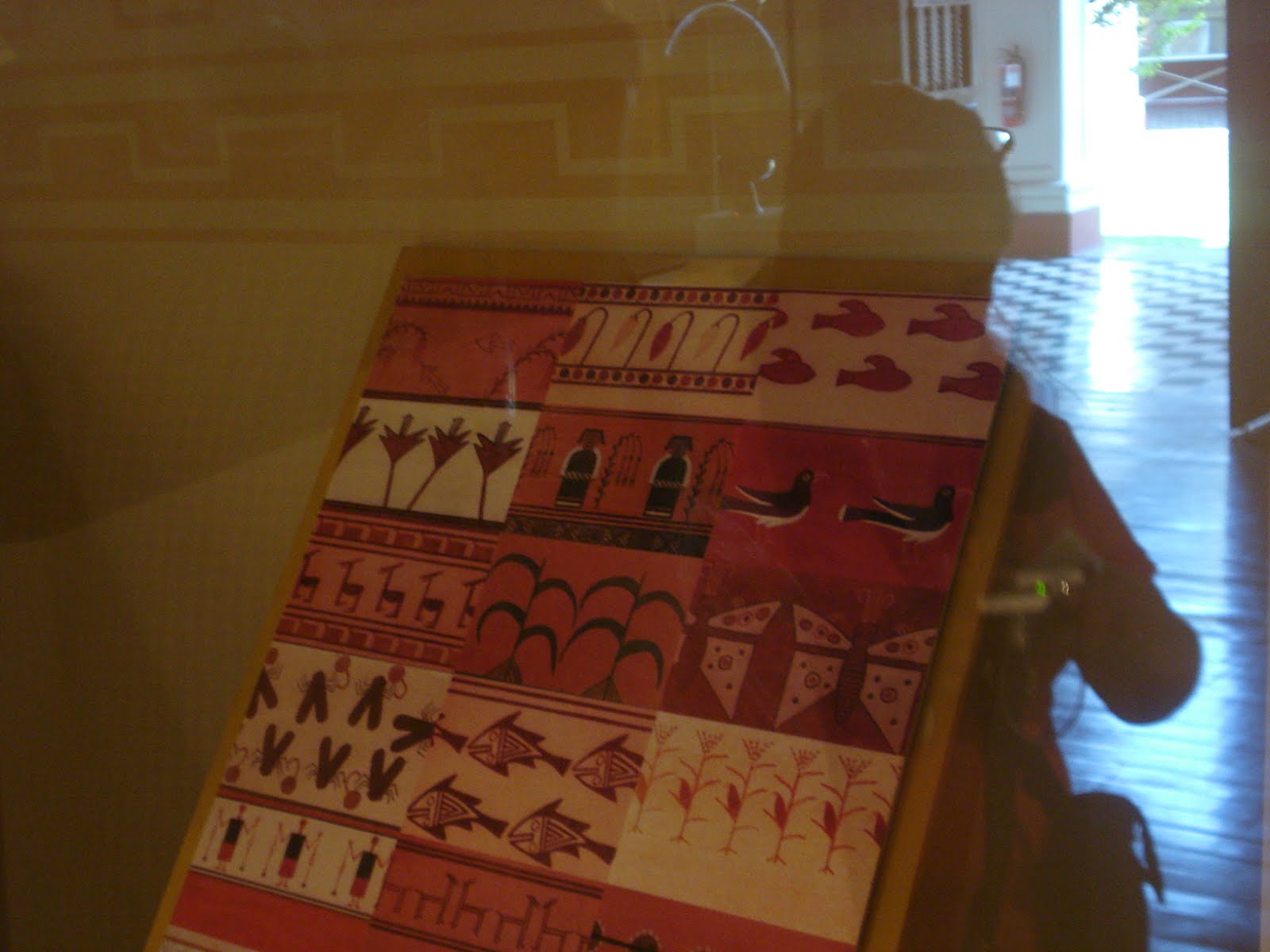
I believe the following cloth, showing what seem to be peppers, corn, fish, and a bunch of other things, is also from the Inca era.


Our visit ended at the Museum's repository for organic materials. Much of the volume of the pieces in the refrigerated, humidity-controlled chamber consists in pieces of wood from different excavation sites. Here are a few impressive oars.


But the largest number of items pertains to vegetable remains from different excavations around Peru.


The Museum is the official reception point for anything dug up in archeological expeditions. Unlike in humid Colombia, Peru's dry climate allows for the intact preservation of organic remains from thousands of years ago. Many of these jars were excavated almost a century ago, as evidenced by their old-style glass packaging. They've been entrusted to the Museum ever since. There are so many that the staff haven't yet even identified or classified them all. There are lots of peanuts, and also many soil samples that might hold interesting information about ancient cultures.

Here is a mislabeled achira, probably dug up in the 1930s and put in an old jar that had contained another type of root crop. In Colombia you'd never find such a well-preserved, whole specimen of a fleshy tuber crop. The best we can hope for are microscopic remains that tell us that a plant lay in a particular place and decomposed long ago.


In the central patio that the museum staff would like to turn into a living garden, much like our Huerta Muisca, there are lots of non-indigenous plants. Among them this fig tree supposedly planted by Simon Bolivar himself!


Strolling about in the garden was a nice postlude to our visit. Here we were in modern Lima, in a house used by the Great Liberator, converted into a museum showcasing Peru's ancient heritage. I felt so privileged to partake of it, as I often feel in my work with the archeological past.

Sunday, April 8, 2012

Reflections on indulgence

About six months ago, my wife, stepdaughter, son, and I went to Chicago to visit the rest of my family. I owe my readers a more in-depth blog on that in the near future, but for now I wanted to share some reflections on indulgence, the old liberty vs. license debate.

The framework for my thinking about these things was that on the flight to Chicago I finished a book called "Reporter in Red China", by Charles Taylor (no, not the Liberian dictator). Taylor was a Canadian reporter stationed in China, and as such one of the few Westerners to witness the aftermath of the Great Leap Forward and the stirrings of the Cultural Revolution up close. The book is a fascinating look at daily life during a distinct period in China's history: the mid-1960s.

Anyway, aside from his understandable and oft-since-repeated interest in the privations and difficulties of life in China (lack of liberty, lack of luxuries, etc.), I was stricken by the author's depiction of a nation of people relatively well-cared-for by the State and each other. Above all I got a sense of a nation moving forward in lockstep, progressing toward a better tomorrow. From traditional festivals to the adoption of new egalitarian values to the plans for economic growth and well-being, Taylor's book shows a society of people sharing a common purpose. Despite the occasional government excesses and oppression from which the people were suffering in that period, the salient feature of Taylor's book is a constant improvement in people's well-being thanks to a sense of the collective, of the common good.

If Taylor's portrayal of the national project (which comes out as positive despite his obvious misgivings about China and Western frame of reference) is accurate, then today's economic boom and steady rise in living standards in China is the fruit of this common effort, this subjugation of personal, short-term comfort to the greater good. In China it has taken the form of a monolithic dictatorship, but the phenomenon of a unified society rapidly improving its economic well-being also mirrors the US experience. In various moments of our history, we have seen our collective fortunes rise as the society banded together for a common project. The most-cited example is the post-World War II economic expansion in the 1950s and 1960s. In this era the people of the US harnessed a sense of our intertwined fates (likely inspired by the shared wartime experience) to create a prosperous society. Economic inequality was low, medicine and electricity arrived to almost everyone, educational attainment steadily increased, both unions and private companies were strong. Common depictions of this era highlight the rigid cultural and moral strictures that bound people, with the extreme manifestation being the McCarthy Communist witch hunt. I sometimes wonder if an inherent part of this type of rapid, shared economic development is a certain suppression of personal freedoms. If everyone can do whatever he pleases, then it's difficult to undertake large-scale pursuits requiring a shared set of values and a unified front of work.

There were other problems going on in the 1950s, too. Institutionalized racism was rampant, with a constant terror campaign leveled at Southern blacks in particular (though I wonder how 1950s black-white economic inequality compares to that of our day). That said, it seems that the prosperity and sense of shared purpose forged in the 40s and 50s laid the groundwork for people from all walks of life to challenge and eventually overcome this stifling institutional racism. Other problems have their roots in the 1950s, and their solutions have not yet arrived. In particular I'm thinking of the consumerist, petroleum-dependent lifestyle that expanded thanks to new electrodomestic machines, cheap cars and gas, and above all the suburban explosion. Perhaps this increase in apparent personal liberty at a consumer level was a compensatory response to the stifling of other freedoms of thought and conscience.

The 1950s began our departure from a life linked to the land and certain rational limits (living close to where you work and play, living in settings that can support human life, living in a balance with certain "pest" organisms instead of aiming for their total destruction). And we have only continued this trend, living with more sprawl, in ever-less-appropriate climates (Phoenix, Orlando, Los Angeles), and more dependent on artificial manipulation of the life forms around us.

At any rate, my take is that in the 1960s our monolithic morality started to crumble, and from then on our sense of shared values and purpose went downhill, as did our economy. Of course it has been positive that we as a nation have torn down the evil aspects of our shared morality, such as discrimination and hatred against certain people, or that we protested against an immoral war like Vietnam. But the collateral effect of the 60s counterculture was that it shattered the idea that we're all in this together. From the 60s onward we became more atomized, a nation of individual conscience and preferences. First it happened on the ethical and political level, then it spread into our wider consumerist cultural framework, such that by the time I was born, we were like a nation of solipsistic animals, each one seeking only its own pleasure through purchases and perhaps its particular, extreme political or social affinities.

I sum up all of this with the term indulgence. I feel that in the US we are now a bunch of self-indulgent children, so concerned with their own narrow caprices that they can't band together for a common purpose. We can't teach real science in our schools because it might offend a few religious fundamentalists. We can't teach black history because it offends whites, we can't inculcate patriotism because it offends left-wing free-thinkers, and we can't rally around the founding fathers because they were slaveholders, and it wouldn't be politically correct to recognize their foresight and bravery. Narrow-minded monolinguals who don't even speak their native English very poetically bristle at the idea of offering government services in other languages (as they were in fact offered for their grandparents). We can't address climate change because no one wants to turn down their AC or get off their fat asses and walk to work. Minorities are so centered on the laundry list of sufferings visited upon their particular group that they don't find common cause with other oppressed people. We can't pursue excellence in our educational system because it might offend the mediocre. In short, everyone is caught up in his or her own self-indulgence, and our most ardent political passions are stir not to secure a better life for us all, but rather to fuck over whatever group we don't happen to belong to.

Ironically, it seems that all of this narcissistic, counter-productive individualism is borne in large part of our relative prosperity, which in turn was the result of hard work in the name of collective greatness, a common cause. If this is so, a unified common effort to improve life for all sows the seeds for its own destruction, in the form of the prosperity and well-being it engenders. This seems to have happened in the Soviet-bloc countries, in Libya, and surely in other places I don't know about. The narrative of these revolutions that we've always received in the US has been one of people rising up to demand civil liberties from an oppressive regime, but I think my narrative also fits: people's living standards rise (in the aforementioned cases, thanks to an ugly dictatorship that has simultaneously imposed many measures to improve collective well-being), and once they get to a certain point, people are either too comfortable, or the steam has run out from the big push forward, and they stop feeling so unified. They start bickering and coveting junk (bluejeans in the Soviet Union, low-cost air-conditioning in the US Sun Belt, an extreme racist religious fanatic culture in Libya), and they no longer see their fellow citizens as partners in a shared project, but rather as competitors to get the scarce luxury goods. (Religious extremism is simply another luxury good, only conceivable to the pampered well-off, and founded like rampant consumerism on the same divorce from objective reality and natural limits).

If my reading is correct, then I would certainly apply it to the current economic crisis in the US. Everyone was so caught up in indulging their own absurd wishes that they didn't take the steps to avoid personal and collective catastrophe. Regular people decided they wanted to live beyond their means, with more TVs and cars and clothes and restaurant meals than their wages allowed for, so they made up the difference with ill-advised borrowing. Banks and their employees wanted to make ever-more money, so instead of sticking to managing loans and deposits they added all sorts of arcane scams to fabricate money out of thin air. And of course they were all too happy to make loans to people they shouldn't have. The big investment banks and traders were in the same game, lying and scamming to make more money and obtain more luxury shit, though any sensible person could have seen that they were merely concentrating wealth, not creating it. And now even Obama and the US government are in the game of coddling and indulgence. Instead of making borrowers and lenders and fraudsters and bankers pay for their sins, the government is taking measures to kick the ball of debt down the road. Politicians and those who vote for them are engaged in navel-gazing contests, making increasingly extreme and impracticable ideological statements, preferring grandiose moral theater to a shared commitment to our nation's well-being.

Some argue that a free market and/or a free democracy inevitably trends toward this state of affairs. If your economic or your political system insists on constant short-term expansion of consumption and indulgence, what do you do once you've satisfied most people's basic needs? You have to keep adding on layers of decadent pampering to keep the system going. Of course this pampering is only apparent, because in the end our living standards are going down, as are our political freedoms. But this is precisely because we and our systems are so focused on the ideal of short-term satisfaction that we can't organize ourselves to attain long-term improvement. A while ago Vanity Fair did a good profile of the tax crisis facing much of California, and I feel it captures well what I'm trying to say.

Another book that seemed to me a microcosm of this trend of atomization of our republic into little selfish individual spheres is called Power! How to get it, how to use it. It's by Michael Korda (incidentally the father of the leader of the Church of Euthanasia). It's a silly little corporate-inspiration book from the 1970s. I dug it up some years ago in my dad's basement, and took it back from Chicago this time to read here in Colombia. I'm surprised that my father would have touched such tripe, but I believe that it dates from a brief phase in which he tried to transform his affable, traditional morality of the common good into an attitude that would bring him success in 1980s corporate America.

Anyway, Korda's book is an amateurish study (no citations or anything, just pure anecdote) of the big-dick movers and shakers of late 1960s Manhattan. He talks about how to gain power in conversations, parties, office space arrangements, etc. I wonder if the people he profiles, or anyone who would follow his advice, actually do any work, or if they spend all their time jockeying for power. He never talks about excellence in your work, or team spirit, or anything like that. While I appreciate that power exists and it's good and interesting to know how to analyze it and use it, real life depends on real work. If you are planting or hunting your own food, there's no one to dick around with in power games. You either work or you perish. In higher social strata of society, or especially in more modernized, compartmentalized societies, it's possible to substitute social power intrigue for actual work, but ultimately what you're doing is sapping resources from the collective, and free-riding your way through life.

Korda's advice of constant power-plays and little work must have seemed to him like an unfulfillable fantasy in his day. He came from the hard-working 60s, in which our quaint common purpose made the nation great and strong, and diminished interpersonal differences in wealth and power. But little must he have known that by the 80s everyone would be following his advice, and with what results! People worked less and schemed more, companies offshored their operations or dedicated themselves to mergers instead of actual production, power-lusty talking heads like Pat Robertson or Rush Limbaugh took over a big part of our nation's political discourse, and our nation became a shambles, a land of sloth and immorality and inequality. Once again my reading is that the prosperity borne of collective effort and shared values allows some societal leeches to come to power, to desire more and trick others into believing that they too can have more by ransacking and derailing the collective train and pursuing their own self-indulgence.

At any rate, these are the comings-and-goings that have been happening in my head since that trip to Chicago in October. The reality of the trip was that I didn't see people acting particularly self-indulgent or self-destructively. Everyone seemed nice and hard-working, so I'm not sure how the collective can be so screwed up. Perhaps the ambiguity of my thinking on this matter can be summed up by an anecdote from the trip.

I found out about a guy who's a furry. This term describes people who feel like they should be an animal instead of a human, or at least a sort of anthropomorphic animal. This seems pretty silly to me, but on the other hand I don't want to be intolerant. Perhaps some people have either an all-encompassing personal need, or a tenacious neurotic compulsion, to dress up like animals, and if so, I wouldn't want them to suffer by stifling their true selves. But short of that, I feel that if you have an urge to dress up like an animal, or drink coffee compulsively, or shout like a maniac, or anything else that compromises your ability to function as a productive member of society, then you should err on the side of discretion, and keep it to yourself. I mean, where is the line between personal rights and self-indulgence? I don't do everything I feel like doing, because certain things seem inappropriate, counterproductive, or even harmful to myself or others. I don't see that dressing up like a fox would be particularly harmful, but if you were totally centered on it, and all you want to do is be a fox, what good are you for yourself or your society?

Again, I also see the flipside of this. I wouldn't agree if someone said that gays should just straighten up and stop being gay being it's a waste of time, or that meat-eaters should be forced not to eat meat because it's better for the planet. I do respect civil liberties. But is it a God-given right to dress like a poodle? Perhaps I'm a victim of my time, and in the future my questioning the validity of furry-hood might sound similar to a 1950s condemnation of the "sodomite lifestyle" or something. Then again, we could argue that our tolerance is also a mere caprice of the era we live in. If today's gay man lived in a time and a place in which being gay wasn't even a societal option, would he be that miserable? If success and happiness were collectively defined as having a productive farm, a loving wife, and lots of kids, how much would that societal standard be valid for that man, and how much would he still long to express his inner gay man? Likewise, if an ostensibly heterosexual man lived in ancient Sparta, or today's misogynistic, gay-cultured Pashtu regions, or a densely-populated Polynesian island where certain boys are assigned to an effeminate third sex, wouldn't he find satisfaction in the loving, sharing relationship with another man that his society proposed as the norm or the ideal?

I haven't totally defined my opinion on what I'll call the "furry issue", but in my mind I link it to the issue of short-sighted self-indulgence. Is a nation of furries going to pull together to address the challenge of improving life, healing the planet, fighting injustice? I don't think so, any more than will a nation of scheister investment bankers, or Big Mac-atarians, or complacent megachurch fundamentalists, or everything-rights activists. That said, my wife, who since meeting me has adopted a surprisingly sympathetic, sweet, tolerant, concerned attitude toward the culture and the trials of the US, has a different take on the furry guy. In this case, the guy makes a living designing and sewing elaborate outfits for other furries. These things can go for thousands of dollars. So he has found a way to parlay his lifestyle preference into a lucrative, productive career. My wife said that that is the beauty of the USA. You can get an idea and pursue your dreams, no matter how far-out your idea seems. Anything goes if you work hard and play fair. I'm still not entirely convinced that furry suits are a valid or desirable addition to our country's economic portfolio, but I appreciate my wife's insight, and indeed, if being a furry, or a fuzzy, or a tranny, or a Civil War reenacter, or whatever you are doesn't impair your contributing to society, why should I be against it?

Tuesday, April 3, 2012

Third World Green Daddy 32: Becoming my father

I suppose that as they grow older, and especially when they have children, all men probably feel that they are becoming more like their fathers. I certainly do, and it is not a cause for consternation or disillusionment, but rather one of pride and joy. I don't know how this would play out if my father were still alive. Would I be adopting his habits and thoughts in the same way as I am now? Would I notice it as much? Would I be pissed off, acutely aware of acquiring the flaws of the underappreciated living and not the noble traits of the tearily-remembered dead? I can't answer any of these counterfactuals.

At any rate, this evening as I brushed my teeth I became motivated to set down some things that have been floating around in my head these days. I am at the end of a tube of toothpaste, so I've cut it with a scissors in order to better squeeze out the last remnants of creamfrom the flat part, and then scoop out the remainder left in the rounded end of the tube. In this way I can get about a week's worth of extra brushes from a tube most people would have thrown away. In fact, this is how I get almost all my toothpaste, as my five to seven member family in Bogota goes through toothpaste so fast that I usually pick up the soon-to-be-discarded tubes on my weekend visits, and spend the next week picking at their carcasses.

This practice makes me think of my dad. He didn't do this exact thing with toothpaste, but he had lots of little frugal habits. My mother does as well, but she is universally, coherently frugal. My father, on the other hand, might save a few dollars and a few grams of CO2 emissions by something like wringing out the last bits of toothpaste, then drive around Chicago and buy a new electric circle saw because he'd left his existing saw in Wisconsin. I guess his behavior was more motivated by the binge-and-purge habits acquired in a youth of chaotic poverty than by a purely rational urge to consistently conserve resources.

In the past eight months (wow, that's embarrassingly long) that I've been living at my in-laws' place in our original hometown, I've acquired a quasi-bachelor lifestyle that exhibits many of the traits I saw in my dad. I conserve things like toothpaste and bus money, a few thousand pesos here or there, then I blow that on eating out, since things aren't set up very well for me to cook here. And I'm eating a lot more meat and processed foods than I usually do. Normally my dinners consist in saltines spread with a can of fancy tuna, for instance tuna with mushrooms or tuna with Mexican grains. This reminds me of my father when he'd have a night on his own if my mother were traveling or something. His go-to bachelor dish was pork and beans and weenies. A can of pork and beans heated in a saucepan, with hot dogs heated in another pan. He really looked forward to this spartan meal. I imagine it harked back to his single days. I can relate to the nostalgia of eating a food that provides memories of the melancholy comfort of solitude and scarcity.

In the past week though, I've been sampling our town's fast food offerings. Yesterday I dined on Colombian-style hot dog with candied pineapple, lots of cheese, raw onions, and potato chips, all heaped together and then microwaved. I'd never deigned to eat this typical dish--indeed, I really never eat hot dogs that aren't typical Chicago style, as typified by Byron's Hot Dogs in my old neighborhood. But it was pretty damn good. Tonight's dinner was a special local burger with fried egg and diced chicken on top, served on arepas instead of buns. Both meals with pop, which I hardly ever drink. Dad wasn't a big foodie, but he would have liked this food. It seems that copious amounts of processed meat with lots of oil were a hard-wired desire in his post-Dust Bowl mental circuitry.

Part of why I've been eating out lately is that I've been putting in long hours at the house I'm rehabbing. This is another project my father would have loved. Endless, complicated rehab work, lots of dust and details and mulling things over while smoking cigarettes (I don't smoke, but the main contractor on the job smokes for two). This weekend Sam and Caro were in town, helping with the house. Sam loves running around and playing with things he shouldn't and spilling paint thinner and mimicking his father with the paintbrush. Sometimes he's between amazed and scared to see me perched high up in the rafters or operating a new machine.

This led me to another reflection about my father. This weekend I was hanging out of a high window, chipping paint from the wooden window frame, when I realized that Sam was watching me. I don't want him to learn dangerous habits, and this got me thinking about self-preservation and taking risks. I often engage in risky behavior out of necessity, mainly on the house rehab site but also sometimes when I have to work in a somewhat dangerous zone or something. I don't think much about it, in part because I have a sort of Zen-like serenity about my self-preservation. Of course I don't want to die, but I can't worry about dying all the time either.

Anyway, having a child forces me to think beyond myself, or really to think about myself to begin with where before I did certain things unthinkingly. I value Sam's self-preservation above all else, and would never want him to take undue risks or suffer the consequences of those risks. And it's here that I think about my father. I think he was even less concerned about his physical well-being than I am. Not out of neglect or self-loathing, but simply because he regarded himself as part of a much bigger universe that didn't center around his existing or not existing. By the time I was born, he'd spent years as a free-spirited lone wolf. My parents met each other late in life, and they maintained certain single-person habits throughout their long and loving marriage. So I can imagine that, faced with a new little person for whom he was totally responsible, my father must have gone through a lot of changes and become more cautious with himself, as is happening to me now.

I often helped my father to fix things, and he'd remark to me that something was a bad idea or not the right way of doing things, just before he did it that way. Using a screwdriver as a prybar, working with live wires, applying paint remover with no mask, things like that. I feel like the lesson he was trying to teach me was that it's not always possible to do things the perfect way, to totally avoid risk. But it is important to be aware when you're taking a risk, and control the situation to the best of your abilities. This is relevant not just in household repair, but in life in general, and I feel it's a lesson I've learned well. Especially in light of my wife's and my marveling at people young and old who have no idea of the large risks they're taking, or conversely in light of my noticing how paralyzing an inflated perception of risk has been for so many people in the US, I am more and more aware of how valuable it is to be able to accurately assess the risks in your everyday life.

This is not to say that my father, and now I, are without our portion of irrational fears. My dad was pretty laid-back about most things, especially in terms of health and well-being. He rightly felt that most problems correct themselves, and that it's no use worrying too much about colds, or social slights, or things like that. But from time to time he'd get really worried about some health or safety issue relating to me. Once he thought I had Lyme disease, and we spent all day rushing from clinic to clinic to run tests on my blood. I assume that his behavior, as mine now, was based on a rather detailed knowledge of certain scientific phenomena. Most things were not worth fretting about, but when he saw a few signs to indicate that there could be a serious problem, he went crazy. I am like this as well--my supposedly rational scientific knowledge probably leads me to exaggerate certain risks to Sam, even as I downplay other things. For instance, when Sam has a cold or even a fever I don't worry very much. I figure it's normal, and his body will work it out. But this week Caro tells me his eyes are weepy again and he's not eating too well, after we'd successfully treated him with antibiotics a few weeks ago for the same problem. So now I'm preoccupied about bacterial infections, and antibiotic resistance, and any number of other things that probably have little basis in what he's really going through.

Today after a long day at the house rehab, I took a moment to feel satisfied and accomplished. We now have a whole section of the house liveable, and Caro and I will move in this week. All of our stuff that we'd moved out of our apartment in August, and that had suffered countless cycles of getting covered in dust and then half-heartedly cleaned, is now definitively dusted and in a provisional order. Our prized books, many of which have spent months buried in boxes with cloths and teddy bears and CDs, are now proudly displayed on their shelves. I basked in the sense of comfort and security given me by having a complete, ordered library. Our functioning woodstove, which we used this weekend to prepare meals and sterilize Sam's bottles, gives me the same sensation. This also comes from my father. He oscillated between an enjoyment of a rootless, sparse existence (recaptured in his married years through occasional road trips to the deep Midwest to visit family, or to see historical sights, or to go camping) and a warm, comforting home. I am this way too, and after months with a barren room as my only stable living arrangement, it is delightful to feel once again that I belong to a place and it belongs to me.

On the same note, I very much look forward to setting up a stereo system in our new house. This is more an inherited trait from my uncle Bill than my father (though Dad loved good music too). My uncle Bill always had state-of-the-art stereo equipment, with high-tech speakers that looked like taut paint canvases, and whenever we visited him he'd be listening to late-Romantic music like Tristan und Isolde or Peer Gynt. It's been years since I've been able to listen to music in any format other than shitty MP3s on my shitty built-in laptop speakers. I long to recreate my uncle's study with its fine music and unhurried intellectual air. When I've done that in our living room, it will be another piece of feeling settled, at home.

I will close with what started me thinking about my similarities with my father. A few years ago after he died, I had to organize all his books and papers. Among other things I found a book called Echoes of the Ancient Skies by EC Krupp. It deals with archeoastronomy from different civilizations around the world. There are Chinese gnomons, Egyptian myths, Inca city alignments, Hopi sun observations, and many other fascinating discussions of how the ancients interacted with the heavens, and what the celestial order continues to mean for us. I assume my father read this book during his astronomy kick around the time of Halley's comet. If so, he'd be reading it as a 38-year-old with a 3-year-old son, while I am a 30-year-old with a 1-year-old son. I'm at a similar moment in my life as Dad was in his, and I imagine that he, like I, was thinking more about nature, life, death, the universe, thanks to the mystery and magic of fatherhood.

In between two pages of the book, right where I found it, is an office memo with a number to call, and my dad's hand-written note describing a given day during our vacation to Disney World when I was five.