Recently Colombia came in on top in a Gallup poll of the happiest people in the world, and this article gives some possible reasons why we're so happy here. A lot of the article's points probably don't contribute much to general happiness (gold and emeralds usually lead to more misery than happiness here, and I don't see how speaking a very clear dialect of Spanish would make anyone happier or sadder). I do agree that the beautiful women, the varied climates (which means we get a wide variety of fresh food with low food miles, year-round and guilt-free), the plethora of vacation days and great trip destinations, the civic initiatives like car-free days, the delicious and varied food, the great music and art and literature, all contribute to a very enjoyable quality of life. And maybe we're conscientious enough to derive some happiness from the ongoing peace talks between the government and the FARC, and the prospect of peace for the first time in two generations. But most of the items on the list are rather just boosterism for Colombia.
I don't mind this--I'm one of Colombia's biggest boosters, myself. I obviously can't have a very objective outlook, but I really do think that Colombia is in a great moment right now. Perhaps any country could put together a best-of list as the article does (though Colombia does have a stunning variety of things going for it). But on top of this, right now we're at a point in our socioeconomic and demographic development in which we're enjoying relative comfort and prosperity, without losing touch with the more traditional values that give meaning to life and undergird true happiness. We don't have 9-kid families anymore, but we're by no means old, childless, and lonely. We are on the upward stretch of the economic growth curve, where things are still getting materially better for lots of people, though we haven't yet arrived at the doldrums where people have all the basic comforts already (food, clothes, appliances, transport), and now feel empty because what additional consumption they undertake doesn't bring much satisfaction. In short, Colombia gets to enjoy many of the advantages of both a poorer, more family- and tradition-oriented culture, and the consumer thrills and amenities of a wealthier, modern country.
This poll appears to rely on an answer to a simple question about whether the surveyee feels happy or not, so who knows how valid it is? I mean, anecdotally, I've known plenty of gloomy Colombians, and in the past I've written about the stern, hurried ambience of Bogota in particular, which gathers together nearly a fifth of all Colombians. But I do think there's something to the characterization of Colombians as a happy people. I think I have learned to be less pessimistic and gothic and cynical thanks in large part to the positive outlook and cheerful general attitude of the people around me in my adopted country.
This widespread happiness has its drawbacks, too. In my more negative moments, I would characterize Colombians as being unconscious, even reckless and inconsiderate. There are lots of car accidents from sheer, dumb irresponsibility; people in public spaces often act as if they're the only ones around (pushing, taking up excess space, being oblivious of others trying to get through); and many people seem not to consider how their actions affect others, even those they love, in terms of wasting their time or creating extra work or hardship for them. Perhaps most grave is my impression that an excessive, oblivious cheerfulness prevents people from thinking about larger social problems, or the larger implications of their own actions. Indeed, this obliviousness could be some sort of mass psychosocial response to the cognitive dysjunct of living in a country where everything can seem perfectly fine, but all the while (for the past 50 years!) there is a brutal, bloody, cruel war raging, one that can occasional even break through the placid appearance of middle-class order at any moment. If this is so, I understand how obliviousness can serve as a defense mechanism, but it is also problematic, because it permits the continuation of a status quo underlain by violence. This is perhaps the case in Medellin, more than anywhere else.
Medellin is one of the country's, even the world's, most glamorous, high-class cities. I love the urban fabric, the public art, the amazing cuisine, the daring architectural design. But the marvels of the El Poblado neighborhood and certain parts of downtown belie what is at core a brutal, violent city. Even in the past years of relative calm (which has been broken in the past year or two as decapitated gangs regroup and bicker), Medellin's per-capita murder rate has remained comparable to or higher than Chicago's in its worst moment of the early 90s. And Chicago is one of the most violent large cities in one of the world's more violent countries. I respect that Medellin has made bold moves recently to incorporate the slumdwellers into the city's general prosperity through civic infrastructure like libraries and mass transit. But the fact is that many middle-class or wealthy people in Medellin live in a bubble, surrounded by yet totallly unaware of injustice, hatred, and bloodshed.
Anyway, I wanted to close with a few little observations about the nice little things of life in Colombia, and in particular in my small town. First off is efficiency. Many businesses in Colombia are far from paragons of efficiency. The big box stores that in most countries make up for their innate lack of charm or soul with very efficient service, ascribe to a totally different model here--they aim to confuse the shopper by mislabeling things, and they so mistrust their (generally distracted, disspirited) cashiers that any problem must be dealt with by a manager, with the result that checkout takes forever. That's why I've been so pleasantly surprised recently by the efficiency at the mid-size, locally-owned grocery store chains here in my town. We are lucky enough to have at least three major local (that's local to our town, not even national) chains in our town, all competing for the dollar of the humble working classes. In addition to these, there are a number of one-shot stores as well. In any of these supermarkets, you can find all the basic items, and increasingly things like tortellini, olive oil, and high-end coffee, all at reasonably lower prices than in a Carrefour, a Carulla, or an Exito. On top of this, checkout is efficient and lightning-fast. There aren't a lot of employees, and I reckon that they are close enough to the owner to have to prove how good they are at their jobs. Not like in Carrefour, where the owner is a shareholder in central France.
My second little bit of how good life is here has to do with our health plan. We pay something like US$250 per month between my wife and myself in health care premiums, which I guess sounds high until you consider that it's tied to a low percentage of what we earn, and it's covering five people. Best of all, and something that makes me laugh every time I have to hand over a copay coupon, is that any procedure or appointment we have implies a copay of US$1.50! I don't know why it's so low--there are people of a similar socioeconomic stratum to ours with $10 copays or more. I think it has to do with the fact that we work with peasants or something. My wife filled out a questionnaire at one point that had a question about whether or not she worked with farmers. If we are indeed getting a deep healthcare discount thanks to our agrarian inclinations, then I have to say, God Bless Colombia!
Wednesday, January 30, 2013
Monday, January 28, 2013
FARC proposals for land reform
Last week the FARC unveiled their ten-point proposal for land reform, as part of the ongoing peace talks with the government. The document isn't really that well organized rhetorically or logically--the first point basically covers the subsequent points, and each point has so many components that it's hard to summarize point by point. That said, most of the measures called for are common-sense, sound ideas that would do a lot to improve life in Colombia. Obviously some of the measures are more difficult to implement than others, in part because no one knows exactly how to do things like "overcome the underlying conditions of the armed conflict" or erradicate poverty and inequality. In general it is a very reasonable, not very radical or dogmatic proposal, as befits what is essentially a peasant guerrilla movement (as opposed to the grand Marxist revolutionary image everyone has of the FARC).
That preface aside, here is my attempt to summarize the ten points of the FARC proposal, for my non-Spanish-speaking readers:
1--The implementation of an integral agrarian reform that mentions the other nine points, in addition to a few more aspects, such as overcoming the conditions that underlie the armed conflict, a fundamental change in power relations in rural areas, redistribution of unproductive latifundia, specific laws to prevent land speculation and landgrabbing, restitution of land to displaced people and future protection of peasants' land, and investment in rural infrastructure and irrigation.
2--Erradication of hunger, poverty, and inequality in the rural areas, through improved provision of services from the State in terms of nutrition, education, health, arts and culture, and job creation.
3--A new framework for State-rural and urban-rural relations, involving the demilitarization of rural areas, more say for rural dwellers in how their landscape and their resources are used, and legal measures for urban and rural planning.
4--Participatory rural planning to assure sustainable use of water and other resources, promote production of food instead of livestock ranching, and help small-scale miners and growers of illicit crops to adjust their activities to be in accord with nature and the relevant legislation.
5--Creation of a central land fund to gather land that is idle or has been confiscated, and distribute it to peasants who need land. There would be strict limits to how much land one person can own, and a tax code that penalizes large landholdings and unproductive land use.
6--Recognition of and political, economic, and cultural autonomy for indigenous communities and AfroColombian communities. They also propose the creation of interethnic zones, where peasants, AfroColombians, and indigenous communities overlap and coexist.
7--Recognition of peasants and their work, and creation of legal recognitions for peasant communities along the same lines as those accorded to indigenous or AfroColombian communities.
8--Promotion of national food sovereignty through the peasant production economy. The FARC place special emphasis on the importance of strengthening marketing, credit, and transport channels to bring peasant products to urban consumers, and they are not explicitly against agroindustrial export crops, as long as these do not negatively impact Colombia's food supply.
9--Support to research, especially as regards peasant practice, traditional knowledge, and heritage seeds, all in order to create a technical and knowledge base to feed the country and promote rural development.
10--The revision of any international trade agreements that impinge on Colombia's food or resource sovereignty, and temporary economic compensation to farmers who have been damaged by such agreements
That preface aside, here is my attempt to summarize the ten points of the FARC proposal, for my non-Spanish-speaking readers:
1--The implementation of an integral agrarian reform that mentions the other nine points, in addition to a few more aspects, such as overcoming the conditions that underlie the armed conflict, a fundamental change in power relations in rural areas, redistribution of unproductive latifundia, specific laws to prevent land speculation and landgrabbing, restitution of land to displaced people and future protection of peasants' land, and investment in rural infrastructure and irrigation.
2--Erradication of hunger, poverty, and inequality in the rural areas, through improved provision of services from the State in terms of nutrition, education, health, arts and culture, and job creation.
3--A new framework for State-rural and urban-rural relations, involving the demilitarization of rural areas, more say for rural dwellers in how their landscape and their resources are used, and legal measures for urban and rural planning.
4--Participatory rural planning to assure sustainable use of water and other resources, promote production of food instead of livestock ranching, and help small-scale miners and growers of illicit crops to adjust their activities to be in accord with nature and the relevant legislation.
5--Creation of a central land fund to gather land that is idle or has been confiscated, and distribute it to peasants who need land. There would be strict limits to how much land one person can own, and a tax code that penalizes large landholdings and unproductive land use.
6--Recognition of and political, economic, and cultural autonomy for indigenous communities and AfroColombian communities. They also propose the creation of interethnic zones, where peasants, AfroColombians, and indigenous communities overlap and coexist.
7--Recognition of peasants and their work, and creation of legal recognitions for peasant communities along the same lines as those accorded to indigenous or AfroColombian communities.
8--Promotion of national food sovereignty through the peasant production economy. The FARC place special emphasis on the importance of strengthening marketing, credit, and transport channels to bring peasant products to urban consumers, and they are not explicitly against agroindustrial export crops, as long as these do not negatively impact Colombia's food supply.
9--Support to research, especially as regards peasant practice, traditional knowledge, and heritage seeds, all in order to create a technical and knowledge base to feed the country and promote rural development.
10--The revision of any international trade agreements that impinge on Colombia's food or resource sovereignty, and temporary economic compensation to farmers who have been damaged by such agreements
Friday, January 25, 2013
The United States and me: A torrid love affair. Part I: Disillusionment
Two Septembers ago was the tenth anniversary of the World Trade Center bombings in 2001. Many newspapers ran very interesting articles about the bombings and their significance for the past ten years. (most of the articles I'm linking to in this post are from September 11, 2011, because I found them oddly, unintentionally related to the attacks). My friend, a high school teacher in Chicago, has for nearly ten years based a good part of his US history curriculum on discussing the implications for democracy and governance of the terrorist attacks, though now he's slowly retiring that unit as his students have increasingly foggy recollections of the event itself. For me, the tenth anniversary of the attacks was the occasion for a fair amount of melancholy and bitter memories, not only regarding the attack itself nor even the wars that ostensibly followed from it, but also of the economic and cultural decline of the US, and my own frustrations coming into adulthood in the post-9/11 decade.
I'm sure each of us has lots of memories, not only of the context surrounding our first learning of the event, but also of the ten ensuing years. Even my wife, who was at the time giving a workshop to a peasant group in a remote region of Colombia, was informed by a local farmer, “Caro, shit! They just bombed the Twin Towers.” She thought that the video they kept replaying on the TV must be from an action movie or something. My own memories involve my waking up in my sophomore-year college dorm room to a general tumult. Most of my neighbors were shocked or dumbfounded or appalled at what was happening, though some (whom I charitably assume were trying to come off as more callous and radically left-wing than they really are) were dancing and celebrating the seeming comeuppance dealt to the US and the more negative things our country sometimes stands for (consumerism, realpolitik meddling, political and ideological hypocrisy, etc.). I mainly remember my feeling a sinking sensation in my stomach, not only for the thousands killed in the attacks themselves, but also because I had a feeling that this would be a pretense for the US to invade Afghanistan in order to make the Taliban and bin Laden pay for their sins. I had been keeping at least somewhat up to date with the story behind bin Laden and the Taliban before the attacks (the bombing of a pharmaceutical factory in Sudan was still fresh in my mind, though it seems to have passed unnoticed or been quickly forgotten by many of my countrymen), so I guess my gut feeling was on the ball.
Shortly before September 11th of 2011, I saw the Terry Gilliam film Brazil. It envisions a futuristic dystopia with a totalitarian, sterile bureaucracy running a country of unthinking twits that are too busy with television and shopping to realize the dire straits their world is in. The film also deals with issues of terrorism, torture, and the use of the threat of outside terrorism as a justification for torture and other types of repression. The parallels with US society and governance in the 2000s were scary and uncanny. Our country’s fall from grace came not through an Orwellian state of force and spying, but rather through the gradual dumbing-down of our people through greed and consumerism. In this Gilliam was prescient of how unbridled consumerism can lead people to give up their freedom uncritically and unthinkingly.
All film references aside, the 10th anniversary of the WTC attacks had me thinking very seriously about the past decade. For me it really seems like a lost decade on many fronts. The US had already to some extent been mining its productive base by outsourcing jobs, paying workers less, and fooling itself into believing that scamming and saying you have money is the same as actually having it. GW Bush came into the presidency on the tails of the dot.com bubble, and his policies probably worsened our economic straits if anything. Parallel or perhaps linked to this decadence, the US was becoming increasingly vapid in terms of political debate, cultural literacy, and general education. (See for example this article from September 11, 2011 about the rise of product marketing on university campuses, the one place that should be a sacred bastion where kids are supposed to be learning and thinking critically, not becoming loyal to a consumer brand).
But the September 11th suicide attacks, or I should say the political mishandling of the attacks as a military and not a criminal affair, led us even deeper into economic and cultural decline. If we were in bad shape before with public debt and the downfall of honest private enterprise, then two wars, trillions of dollars of war-related government expenditure, stupid, dogma-based tax cuts for the rich, and a business culture that increasingly tended toward influence-peddling and rentism (any sector that could be said to be “anti-terrorist” ransacked the public coffers), sealed the deal for the end of the admirable, thriving US I was taught to believe in. Maybe I read too much James Howard Kunstler, but it really does seem difficult to get out of the straits we’re in now. Today our natural resource base is depleted, economic inequality is high, our populace receives a poor quality education in many respects. What can we draw on for a new birth of our country?
So in many ways I guess my prescient sadness on the day of the World Trade Center and Pentagon attacks, as well as the way I view them in retrospect, could be characterized by Donne’s line, “Ask not for whom the bell tolls, it tolls for thee”. I was sad about the people that died that day and the US soldiers, Afghans, and Iraqis that would die afterward, but above all I feel as if, with our country’s reaction to the attacks, we did the most damage to ourselves. It would have been better for us as a country if we had taken to heart a recent sermon I heard about Christ's injunction to forgive seventy times seven whatever ills have been done us. And it seems that the US is not the only place that is worse off for the attacks and their aftermath. Perhaps the rest of the world became a meaner, uglier place, too.
Most selfishly, I lament my own trials over the past decade, many of which I associate with the wrong directions we as a country and a society had taken before and after the September 11th attacks. First and foremost, I spent much of the decade frustrated at the lack of job opportunities for me in my native country. I studied agronomy in college, and I think it’s fair to say I excelled at it. In fact, I even spent the last two years of college paying no tuition and getting paid by the university to teach chemistry. So prospects looked bright for someone who believed that if you did well in school you could get a well-paying, meaningful job. The problem is that in the decade I came into adulthood, this belief was not accurate. For a long time the US economy had been tilting towards services, but in the 90s and 2000s it took a more devious turn into dubious services: websites that didn’t produce anything, marketing that bordered on criminal scamming, houses bought and sold with nonexistent money, and of course most famously financial derivatives whose value consisted in little more than gambles and uneducated guesses. (check out this sanctimonious article from Thomas Friedman, who has been one of the most uncritical cheerleaders of the breathless bullshit economy of making little and consuming a lot, and now is acting shocked, just shocked to find that there is swindling going on in our economy). Even apparent bright spots in the economy, like movies or video games, are not entirely ethical products. Movies can be great, but most movies that get made are real garbage that impoverishes the world culturally instead of enriching it. And though I appreciate the artistry and wizardry and real hard work that goes into making video games, the net balance I see is that playing video games is basically a toxic non-activity. I know too many kids and even adults who gain nothing from their exposure to video games, and lose a great deal as they waste hours and hours entertaining themselves instead of thinking or working.
At any rate, some of my friends couldn’t even get hired into the unethical rackets that comprised the major movers of the 2000s-era economy, and ended up selling things on the streets, working at bars (as I did for a stretch), or doing telemarketing and front desk service jobs. Nothing at all related to their interests or qualifications. For an agronomist like me, there was a lot of work to be had, and many companies practically bombarded us with recruiting pitches during our college education. The main professional options were either to work for grain marketers like ADM or Cargill (who make their buck by manipulating markets in an oligopsonistic fashion in order to squeeze farmers and consumers), or input and equipment producers like Monsanto, Pioneer (Dupont), John Deere, or Bayer, whose business model consists in finding the magic spot where they can extract the most money from farmers without driving them totally out of business. In short, I had studied agronomy to help farmers, but the major jobs available to me consisted in bilking them. Now that I know a bit more than I did then, I might have been interested in working for a farmer coop supply store or an agricultural bank or an independent seed company, but I wasn’t as aware of those options when I was in college. I would have loved to work for a county extension office, offering agronomic advice to farmers and gardeners, but most of those jobs required a masters degree, as did my dream job of working in international agricultural development.
Basically then my job panorama was either to make a lot of money doing something immoral, or not to work (at least not as an agronomist). I worked in a few dead-end, non-agronomist jobs, and did enjoy working in a community gardening program (though it didn’t pay well).
Despite my professional frustrations in college and shortly thereafter, I must say that my life has been good over the past decade. College, self-discovery, a masters degree, meeting my wife, having my kid— I could never have imagined all this. But most of these good things happened to me outside the US, and in fact their happening at all was directly linked to my leaving the US. It’s sad to think I've spent more than half the last decade outside of my country. I don't regret leaving—the lack of jobs there, and the opportunities and interesting things I’ve discovered in Europe and Colombia mean it was a good decision, and I've come to love and appreciate my own country even more since then. At the same time I marvel (in a terrified way, not a good way) to think about the world my son has been born into. How can I explain to him the changes that occurred in the US and the world after September of 2001, how can I make him understand how the world was and all the changes of this past decade? Hell, how can I explain how the climate was before now? Better said, it will not be hard to tell him about what’s changed, because that changed world is what he already knows, but it will be tough to convey an idea of the good things that used to be and are no more, especially in the US. The jobs, the hope, the ideals (hell, even the Cold War had its merits if for nothing else than to give our country a sense of shared values and purpose), the environmental balance. I'm not responsible for screwing these things up, but I'm still ashamed at the state of the world today.
I'm sure each of us has lots of memories, not only of the context surrounding our first learning of the event, but also of the ten ensuing years. Even my wife, who was at the time giving a workshop to a peasant group in a remote region of Colombia, was informed by a local farmer, “Caro, shit! They just bombed the Twin Towers.” She thought that the video they kept replaying on the TV must be from an action movie or something. My own memories involve my waking up in my sophomore-year college dorm room to a general tumult. Most of my neighbors were shocked or dumbfounded or appalled at what was happening, though some (whom I charitably assume were trying to come off as more callous and radically left-wing than they really are) were dancing and celebrating the seeming comeuppance dealt to the US and the more negative things our country sometimes stands for (consumerism, realpolitik meddling, political and ideological hypocrisy, etc.). I mainly remember my feeling a sinking sensation in my stomach, not only for the thousands killed in the attacks themselves, but also because I had a feeling that this would be a pretense for the US to invade Afghanistan in order to make the Taliban and bin Laden pay for their sins. I had been keeping at least somewhat up to date with the story behind bin Laden and the Taliban before the attacks (the bombing of a pharmaceutical factory in Sudan was still fresh in my mind, though it seems to have passed unnoticed or been quickly forgotten by many of my countrymen), so I guess my gut feeling was on the ball.
Shortly before September 11th of 2011, I saw the Terry Gilliam film Brazil. It envisions a futuristic dystopia with a totalitarian, sterile bureaucracy running a country of unthinking twits that are too busy with television and shopping to realize the dire straits their world is in. The film also deals with issues of terrorism, torture, and the use of the threat of outside terrorism as a justification for torture and other types of repression. The parallels with US society and governance in the 2000s were scary and uncanny. Our country’s fall from grace came not through an Orwellian state of force and spying, but rather through the gradual dumbing-down of our people through greed and consumerism. In this Gilliam was prescient of how unbridled consumerism can lead people to give up their freedom uncritically and unthinkingly.
All film references aside, the 10th anniversary of the WTC attacks had me thinking very seriously about the past decade. For me it really seems like a lost decade on many fronts. The US had already to some extent been mining its productive base by outsourcing jobs, paying workers less, and fooling itself into believing that scamming and saying you have money is the same as actually having it. GW Bush came into the presidency on the tails of the dot.com bubble, and his policies probably worsened our economic straits if anything. Parallel or perhaps linked to this decadence, the US was becoming increasingly vapid in terms of political debate, cultural literacy, and general education. (See for example this article from September 11, 2011 about the rise of product marketing on university campuses, the one place that should be a sacred bastion where kids are supposed to be learning and thinking critically, not becoming loyal to a consumer brand).
But the September 11th suicide attacks, or I should say the political mishandling of the attacks as a military and not a criminal affair, led us even deeper into economic and cultural decline. If we were in bad shape before with public debt and the downfall of honest private enterprise, then two wars, trillions of dollars of war-related government expenditure, stupid, dogma-based tax cuts for the rich, and a business culture that increasingly tended toward influence-peddling and rentism (any sector that could be said to be “anti-terrorist” ransacked the public coffers), sealed the deal for the end of the admirable, thriving US I was taught to believe in. Maybe I read too much James Howard Kunstler, but it really does seem difficult to get out of the straits we’re in now. Today our natural resource base is depleted, economic inequality is high, our populace receives a poor quality education in many respects. What can we draw on for a new birth of our country?
So in many ways I guess my prescient sadness on the day of the World Trade Center and Pentagon attacks, as well as the way I view them in retrospect, could be characterized by Donne’s line, “Ask not for whom the bell tolls, it tolls for thee”. I was sad about the people that died that day and the US soldiers, Afghans, and Iraqis that would die afterward, but above all I feel as if, with our country’s reaction to the attacks, we did the most damage to ourselves. It would have been better for us as a country if we had taken to heart a recent sermon I heard about Christ's injunction to forgive seventy times seven whatever ills have been done us. And it seems that the US is not the only place that is worse off for the attacks and their aftermath. Perhaps the rest of the world became a meaner, uglier place, too.
Most selfishly, I lament my own trials over the past decade, many of which I associate with the wrong directions we as a country and a society had taken before and after the September 11th attacks. First and foremost, I spent much of the decade frustrated at the lack of job opportunities for me in my native country. I studied agronomy in college, and I think it’s fair to say I excelled at it. In fact, I even spent the last two years of college paying no tuition and getting paid by the university to teach chemistry. So prospects looked bright for someone who believed that if you did well in school you could get a well-paying, meaningful job. The problem is that in the decade I came into adulthood, this belief was not accurate. For a long time the US economy had been tilting towards services, but in the 90s and 2000s it took a more devious turn into dubious services: websites that didn’t produce anything, marketing that bordered on criminal scamming, houses bought and sold with nonexistent money, and of course most famously financial derivatives whose value consisted in little more than gambles and uneducated guesses. (check out this sanctimonious article from Thomas Friedman, who has been one of the most uncritical cheerleaders of the breathless bullshit economy of making little and consuming a lot, and now is acting shocked, just shocked to find that there is swindling going on in our economy). Even apparent bright spots in the economy, like movies or video games, are not entirely ethical products. Movies can be great, but most movies that get made are real garbage that impoverishes the world culturally instead of enriching it. And though I appreciate the artistry and wizardry and real hard work that goes into making video games, the net balance I see is that playing video games is basically a toxic non-activity. I know too many kids and even adults who gain nothing from their exposure to video games, and lose a great deal as they waste hours and hours entertaining themselves instead of thinking or working.
At any rate, some of my friends couldn’t even get hired into the unethical rackets that comprised the major movers of the 2000s-era economy, and ended up selling things on the streets, working at bars (as I did for a stretch), or doing telemarketing and front desk service jobs. Nothing at all related to their interests or qualifications. For an agronomist like me, there was a lot of work to be had, and many companies practically bombarded us with recruiting pitches during our college education. The main professional options were either to work for grain marketers like ADM or Cargill (who make their buck by manipulating markets in an oligopsonistic fashion in order to squeeze farmers and consumers), or input and equipment producers like Monsanto, Pioneer (Dupont), John Deere, or Bayer, whose business model consists in finding the magic spot where they can extract the most money from farmers without driving them totally out of business. In short, I had studied agronomy to help farmers, but the major jobs available to me consisted in bilking them. Now that I know a bit more than I did then, I might have been interested in working for a farmer coop supply store or an agricultural bank or an independent seed company, but I wasn’t as aware of those options when I was in college. I would have loved to work for a county extension office, offering agronomic advice to farmers and gardeners, but most of those jobs required a masters degree, as did my dream job of working in international agricultural development.
Basically then my job panorama was either to make a lot of money doing something immoral, or not to work (at least not as an agronomist). I worked in a few dead-end, non-agronomist jobs, and did enjoy working in a community gardening program (though it didn’t pay well).
Despite my professional frustrations in college and shortly thereafter, I must say that my life has been good over the past decade. College, self-discovery, a masters degree, meeting my wife, having my kid— I could never have imagined all this. But most of these good things happened to me outside the US, and in fact their happening at all was directly linked to my leaving the US. It’s sad to think I've spent more than half the last decade outside of my country. I don't regret leaving—the lack of jobs there, and the opportunities and interesting things I’ve discovered in Europe and Colombia mean it was a good decision, and I've come to love and appreciate my own country even more since then. At the same time I marvel (in a terrified way, not a good way) to think about the world my son has been born into. How can I explain to him the changes that occurred in the US and the world after September of 2001, how can I make him understand how the world was and all the changes of this past decade? Hell, how can I explain how the climate was before now? Better said, it will not be hard to tell him about what’s changed, because that changed world is what he already knows, but it will be tough to convey an idea of the good things that used to be and are no more, especially in the US. The jobs, the hope, the ideals (hell, even the Cold War had its merits if for nothing else than to give our country a sense of shared values and purpose), the environmental balance. I'm not responsible for screwing these things up, but I'm still ashamed at the state of the world today.
Thursday, January 24, 2013
Irresponsible mining in Sierra Leone
Here is a short video about two British companies that are mining in Sierra Leone without paying their fair share of taxes and royalties to the government. This is precisely the type of moral hazard that is inherent to any large-scale exploitation of minerals by foreign companies. These companies have every reason to bribe governments up front to get long-term mining rights with the minimum of royalties paid to the nation where the minerals are found. Colombia would do well to learn a lesson from Sierra Leone.
Tuesday, January 22, 2013
Third World Green Daddy 43: Philosophical thinking
Sam turned
two a month ago, and as with last year, when he started walking unassisted
shortly after he turned one, he has made leaps and bounds in his development
since his birthday. Above all I note a
deeper philosophical consideration of things.
Among other tangible effects, this has led him to be very affectionate
with everyone. He’s always been a sweet
boy, but I feel that just recently he has started to have a more conscious
appreciation of people. Sometimes he’ll
be hit with an all-encompassing love, and will give lots of hugs and kisses to
whomever he is enjoying his time with, and look at them with a surprised
admiration and recognition of how great the person is. If there are lots of people about at the
moment, he will make the rounds of each one, parceling out hugs or kisses. When he sees family pictures, he enters into
a sort of ecstasy as he recites everyone’s name, and sometimes even tells
unintelligible accounts of how the people are related to one another. This usually happens with his mother and me,
with orations like, “Mama bssbrshhbao Papa,” also frequently inspired by a toy
car he has that somewhat resembles our real-life car.
Most of
all, he seems to be becoming a bigger fan of me. He’s always liked me, but now he gets really
excited and yells out, “Papaaa,” when I am in another room, or especially when
he and his mother are driving toward our town to visit me on the weekend. Sam cries less and less at being separated
from his mother. It’s all very
flattering, and I enjoy more than ever the time we spend together, alone or
with others. I’m reminded of my mom’s musing with my father, “This is my favorite age,” at various
moments as I grew up. That’s how I
feel—each moment in Sam’s development just seems like the coolest thing to
me. It must be an evolutionary strategy
of our race so as not to lose interest as we raise our kids (until they’re
irritating adolescents, when we’re supposed to start letting go anyway). The culmination of this admiration of his
father is his now saying something that approximates, “Te amo,” when prompted,
which means “I love you” in Spanish. It
is one of the first abstract concepts he’s verbalized. Up to now his conversation has consisted
largely in pointing out cars and animals and making the corresponding sounds.
Another
pensive, abstract turn Sam embarked on with me the other day was reading
poetry. I’ve read poetry to him
before—he has heard a good deal of Robert W. Service, and when he was a
helpless, immobile infant I inflicted things like Chaucer and Alfred Lord
Tennyson on him. For a long time one of
his favorite books was a bunch of illustrated Mother Goose rhymes. But the other day I read to him “Sing a Song
of Popcorn”, a collection of children’s poems that a good family friend gave us
a year ago but that I’d never gotten around to reading to Sam (what with its
being buried the better part of the year under mountains of moving boxes and
construction dust). Sam was
transfixed. He didn’t follow along in
the book with me, but rather sat next to me doing other things, looking at the
ceiling and such. Initially I didn’t
know if he liked it, but every time I stopped he would keep pushing the book
towards me and saying “Mas”, which means “More” in Spanish (he has a few go-to
words that he usually says in Spanish, though I always prod him, usually
successfully, to say “Daddy” or “more” instead of their Colombian equivalents). The most impressive part is that he can now
say “poem”, and he later explained to his mother that we were reading poems
together. Again, this is one of the
first abstract things he has named. It
seems like a real leap to me to go from saying words for tangible, visible
things, to words that describe intangible nouns or complex concepts.
Coinciding
with his new intellectual feats, we have finally found a new preschool for Sam
for when he and Caro come from Bogota to live in our small town at the end of
this month. It is where Caro went
decades ago, and where my nephew Manu went as well. It is perhaps not quite as alternative and
free-form as Sam’s Bogota school, and certainly not as flashy (the toys are
more worn, as befitting a small town in the high Andean plains), but it seems like a great place for him to learn and be a
kid. There is a big outdoor patio to
play in, classrooms for each group (though the sit-down paperwork is limited to
painting and things, which I like better than the “tiny scholar” focus ofanother school we visited), sessions of music, English (which obviously isn’t a
priority for me, but I don’t mind it), playing outside, lots of focus on
sharing—in short, all the stuff you’d expect at a normal preschool. Not rigidly structured, but not just running
around like goofballs, either. I
especially like that it costs about half of his Bogota school!
Monday, January 21, 2013
Inaugural address
An homage to our best individual qualities in the US (initiative, openness, morality), a defense of the successful social programs we all benefit from, a quest for equality for all, a special consideration for the poor, an end to grueling wars, a call for collective action on common problems, an awareness of and fearlessness to face the new economic (and climatic) realities of the world... In short, an eloquent vindication of the search for life, liberty, and the pursuit of happiness. O Captain my Captain, count me in for the long haul!
And shit, mentioning the Stonewall and gay rights... This is a brave, admirable man.
http://www.politico.com/livestream/
And shit, mentioning the Stonewall and gay rights... This is a brave, admirable man.
http://www.politico.com/livestream/
Wednesday, January 16, 2013
Third World Green Daddy 42: Worm saga
I am finally getting around to writing about my worm composting system. I have long wanted to compost my household waste, and during years of independent urban living I cringed every time I threw organic waste in the garbage bag, to be hauled away to a landfill and left to rot anaerobically. But in our cramped apartments and our frequent moves, I was never able to get around to setting up a decent worm composting system. I knew that they really weren't very complex or space-consuming, but I just never found the time to sit down and organize some way of composting our organic waste.
Maybe seven months ago, a friend gave me some California redworms from her own compost trough, and this got me moving on my new project. This friend and all the online explanations and commentaries I'd read had made me understand that worm composting was easy, odorless, and relatively hard to screw up. This, combined with my typical callousness and aversion to following rules, made me set up a rather slapdash system for worm composting. I simply made a pile of kitchen scraps, topped off by shredded newspaper, in the middle of a big planting pot we have in the patio of our newly-rehabbed house. There was no container; the worms and the scraps just sat on top of the pot's soil.


Eventually, worried about the worms' drying out in the sun, I began covering the pile with an upside-down plastic tub. At this point, I don't believe fruit flies were much of a problem. Over time the pile got bigger, so I eventually decided to contain it in a big plastic pot with holes in the bottom. This too seemed to work fine, with the worms wriggling about happily whenever I checked to see how they were doing. Fruit flies slowly started to present themselves, despite my best efforts to cover the pile with newspaper and the same upside-down tub.
Then tragedy hit. One day I was checking out my worms, and they were doing great, and the next day there were none to be found. I had somehow killed them all, these worms that were supposedly so easy to care for. I had a really severe episode of self-doubt. If I couldn't even keep some household worms alive, how could I pretend to be a decent agronomist and advise others on how to take care of the land and their animals? Despondent, I took the worm pot up to our third-floor greenhouse and left it there, a vague hope remaining in my mind that some of the worm eggs I'd seen in my rummaging through the compost might actually hatch and repopulate the pile.

What had I done wrong? I still don't know for sure. In my careless, nature-will-take-care-of-itself attitude, I'd committed so many potential infractions. I had loaded food directly onto the pile, instead of letting it pre-ferment for a while, as many websites suggested. This was in part because it seemed silly to me to bacterially compost my kitchen scraps in order to prepare them for the worms. If I was going to compost them that way, I'd just leave it at that and do away with the worms! Anyway, as a result of my putting on fresh food scraps, the pile would sometimes heat up a bit as the food rotted. Had I cooked the worms this way?
Maybe it was the pH of the pile. I was adding lots of orange peels, and so maybe I was acidifying the worms out of their habitat. On the other hand, something I didn't know was that the soil I occasionally added to the pile to provide grist for the worms' stomaches was extremely, toxicly basic. One way or another, maybe the pH killed off the worms.
Or was the pile too wet, or too dry? Was I adding too much new food for them to handle, or was I starving them with rare food additions? Could it be that my constantly pestering them and rooting around in the compost to look at them had killed off the worms?
At any rate, amid my doubt and sadness, I gave up worm farming for a while. In a few months, I opened the pot to see how it was, and I was thrilled to find a thriving worm community there! By this time, I was pretty sure my mistake was either a very acid pH, or adding the food scraps too fresh. So I resolved to transfer my worms to two new piles (the old one was thoroughly processed by then), both of which I would add wood ash to to neutralize the orange peels, and one of which I would add only food scraps that had rotted for some time. This way I would avoid my pH problem, which I was confident of as a major factor in the die-off, and I would also test to see if I should pre-decompose scraps.
Both piles went well, and I gradually devised my current system of worm-keeping, in which I add fresh scraps to a bucket without any worms, while the worms process older scraps in another bucket. When the fresh bucket fills up, the old bucket is pretty well processed, and I hand pick the worms out of the finished compost to throw them in the new bucket.


At this time I also pick old nails out of the finished compost; they come from the wooden fruit crates I often burn in our fireplace, which is the source of our citrus peel-neutralizing wood ash.
A problem I've had lately, again because of my thoughtlessness, is a fruit fly plague.

They don't affect the black, almost-done worm compost, but they absolutely flock to and multiply in the fresh scrap bin, which I stupidly haven't been covering. Fruit flies are the big problem people have to manage in a worm bin. They aren't actually harmful to anyone or to the compost, but they're kind of gross and annoying when they swarm around every time you open the worm bin. I have resorted to a new, multi-pronged strategy to control them. First off, I freeze all food scraps overnight before throwing them on the pile. This kills any eggs on the fruit peels. Equally as important, I cover and totally seal the scrap pile whenever I'm not adding new stuff to it. In my case, I do this with a healthy layer of newspaper atop every new scrap addition (this really doesn't effectively seal the pile, as the flies can crawl through the paper to get to the fruit scraps underneath), and more importantly, I not only cap the pile with an upturned tub, but I put a "caulk" of wood ash around where the tub meets the walls of my worm bin.


This way no flies can get in or out of the pile. They would have to crawl through a desiccating, highly basic layer of wood ash to do so. These measures seem to be preventing further fly multiplication, but I still have to get rid of the existing population. I have hung up flypaper, and it quickly filled up with swarming flies, desperately seeking the food scraps they smelled but unable to enter the bin and feed there. Also, as I have taken away their prime food source, some stray flies have wandered down to the kitchen, drawn by the smell of fruit there. For the time being, I am keeping all fresh food in the fridge, even stuff like oranges and passionfruit that normally doesn't need it. I hope that in the next week or two I will totally erradicate the fly populace, and then I won't need to be so drastic in hiding food and putting flypaper up everywhere.
So that's how I manage my worms. It's far from a step-by-step guide for my readers, but I hope you have at least seen how, with little fuss but a fair amount of thought and observation, I have been able to install this worm system in my context, with the materials at hand. I now throw away no food waste (not even bones or gristle), and my garbage pickup consists in little more than a shopping bag of plastic wrappers and packages every week or so. Best of all, I have a ready, nutritive growing medium for anything I choose to plant.

Maybe seven months ago, a friend gave me some California redworms from her own compost trough, and this got me moving on my new project. This friend and all the online explanations and commentaries I'd read had made me understand that worm composting was easy, odorless, and relatively hard to screw up. This, combined with my typical callousness and aversion to following rules, made me set up a rather slapdash system for worm composting. I simply made a pile of kitchen scraps, topped off by shredded newspaper, in the middle of a big planting pot we have in the patio of our newly-rehabbed house. There was no container; the worms and the scraps just sat on top of the pot's soil.


Eventually, worried about the worms' drying out in the sun, I began covering the pile with an upside-down plastic tub. At this point, I don't believe fruit flies were much of a problem. Over time the pile got bigger, so I eventually decided to contain it in a big plastic pot with holes in the bottom. This too seemed to work fine, with the worms wriggling about happily whenever I checked to see how they were doing. Fruit flies slowly started to present themselves, despite my best efforts to cover the pile with newspaper and the same upside-down tub.
Then tragedy hit. One day I was checking out my worms, and they were doing great, and the next day there were none to be found. I had somehow killed them all, these worms that were supposedly so easy to care for. I had a really severe episode of self-doubt. If I couldn't even keep some household worms alive, how could I pretend to be a decent agronomist and advise others on how to take care of the land and their animals? Despondent, I took the worm pot up to our third-floor greenhouse and left it there, a vague hope remaining in my mind that some of the worm eggs I'd seen in my rummaging through the compost might actually hatch and repopulate the pile.

What had I done wrong? I still don't know for sure. In my careless, nature-will-take-care-of-itself attitude, I'd committed so many potential infractions. I had loaded food directly onto the pile, instead of letting it pre-ferment for a while, as many websites suggested. This was in part because it seemed silly to me to bacterially compost my kitchen scraps in order to prepare them for the worms. If I was going to compost them that way, I'd just leave it at that and do away with the worms! Anyway, as a result of my putting on fresh food scraps, the pile would sometimes heat up a bit as the food rotted. Had I cooked the worms this way?
Maybe it was the pH of the pile. I was adding lots of orange peels, and so maybe I was acidifying the worms out of their habitat. On the other hand, something I didn't know was that the soil I occasionally added to the pile to provide grist for the worms' stomaches was extremely, toxicly basic. One way or another, maybe the pH killed off the worms.
Or was the pile too wet, or too dry? Was I adding too much new food for them to handle, or was I starving them with rare food additions? Could it be that my constantly pestering them and rooting around in the compost to look at them had killed off the worms?
At any rate, amid my doubt and sadness, I gave up worm farming for a while. In a few months, I opened the pot to see how it was, and I was thrilled to find a thriving worm community there! By this time, I was pretty sure my mistake was either a very acid pH, or adding the food scraps too fresh. So I resolved to transfer my worms to two new piles (the old one was thoroughly processed by then), both of which I would add wood ash to to neutralize the orange peels, and one of which I would add only food scraps that had rotted for some time. This way I would avoid my pH problem, which I was confident of as a major factor in the die-off, and I would also test to see if I should pre-decompose scraps.
Both piles went well, and I gradually devised my current system of worm-keeping, in which I add fresh scraps to a bucket without any worms, while the worms process older scraps in another bucket. When the fresh bucket fills up, the old bucket is pretty well processed, and I hand pick the worms out of the finished compost to throw them in the new bucket.


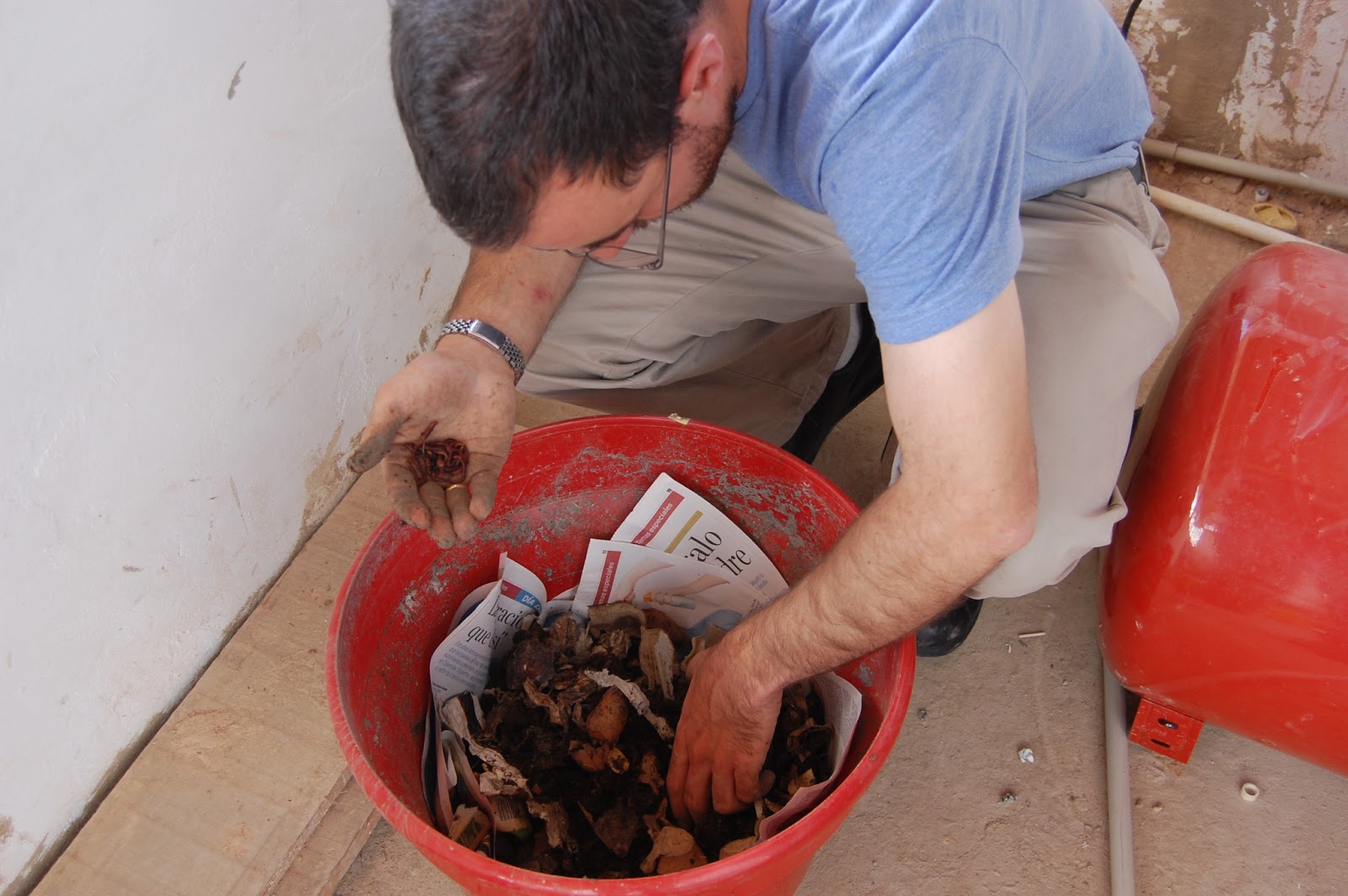
At this time I also pick old nails out of the finished compost; they come from the wooden fruit crates I often burn in our fireplace, which is the source of our citrus peel-neutralizing wood ash.
A problem I've had lately, again because of my thoughtlessness, is a fruit fly plague.

They don't affect the black, almost-done worm compost, but they absolutely flock to and multiply in the fresh scrap bin, which I stupidly haven't been covering. Fruit flies are the big problem people have to manage in a worm bin. They aren't actually harmful to anyone or to the compost, but they're kind of gross and annoying when they swarm around every time you open the worm bin. I have resorted to a new, multi-pronged strategy to control them. First off, I freeze all food scraps overnight before throwing them on the pile. This kills any eggs on the fruit peels. Equally as important, I cover and totally seal the scrap pile whenever I'm not adding new stuff to it. In my case, I do this with a healthy layer of newspaper atop every new scrap addition (this really doesn't effectively seal the pile, as the flies can crawl through the paper to get to the fruit scraps underneath), and more importantly, I not only cap the pile with an upturned tub, but I put a "caulk" of wood ash around where the tub meets the walls of my worm bin.


This way no flies can get in or out of the pile. They would have to crawl through a desiccating, highly basic layer of wood ash to do so. These measures seem to be preventing further fly multiplication, but I still have to get rid of the existing population. I have hung up flypaper, and it quickly filled up with swarming flies, desperately seeking the food scraps they smelled but unable to enter the bin and feed there. Also, as I have taken away their prime food source, some stray flies have wandered down to the kitchen, drawn by the smell of fruit there. For the time being, I am keeping all fresh food in the fridge, even stuff like oranges and passionfruit that normally doesn't need it. I hope that in the next week or two I will totally erradicate the fly populace, and then I won't need to be so drastic in hiding food and putting flypaper up everywhere.
So that's how I manage my worms. It's far from a step-by-step guide for my readers, but I hope you have at least seen how, with little fuss but a fair amount of thought and observation, I have been able to install this worm system in my context, with the materials at hand. I now throw away no food waste (not even bones or gristle), and my garbage pickup consists in little more than a shopping bag of plastic wrappers and packages every week or so. Best of all, I have a ready, nutritive growing medium for anything I choose to plant.

Tuesday, January 15, 2013
Third World Green Daddy 41: Costumes


Last year
Caro and I went to a Halloween party. It
was our first Halloween since having Sam, and since he was ten months old
already, he was sleeping on his own through the night. We left him with his sister, Gabri, who
obligingly babysat for the night, as she had done earlier that month when we
were in Chicago. I guess this is one of
the perks of your kid’s having much older siblings.
Anyway, we
went to this party at our friends’ house a few blocks away. I came up with the idea of dressing as some
sort of a missionary and his exotic local wife.
The main criteria that entered into this were the last-minute ready
availability of clothes to dress the part.
I just wore khakis and a formal collared shirt, put on a nametag, and
carried around an old-looking book (which, incidentally, was not actually the
Bible). I guess my main esthetic
inspiration was the Mormon missionaries from the US that you sometimes see
around Colombia or any other developing country, but I could have been from any
denomination. The idea was just to look
clean-shaven, very much from the US, and rigidly out of place. My wife Caro dressed up in a color-print
two-piece dress I got her in Benin when I was doing thesis research, and a more
or less matching head scarf she’d gotten in Laos (where she was doing her
research while I was in Benin).

I thought
we looked good, with a visual authenticity and a tongue-in-cheek flair. I did wonder if our outfits were somehow
offensive, though in the end I didn’t worry about it. I mean, we basically went as a silly
exaggeration of what we are—a binational couple, one from the US and the other
from a developing country. On top of
that, I am a development worker, which is pretty much like a missionary (though
my wife is a development worker too, and frankly the nature of our work and our
interests has me more in the role of backwards, exotic peasant in the
backcountry, and my wife in a more formal professional role). So I don’t think we offended anyone, though
it was a bit odd to ask ourselves to what extent our costumes were costumes and
to what extent they represented who we really are!
No one at
the party exactly got what we were trying to convey with the costumes,
especially in my case, since I was dressed essentially as I always dress, just
with a nametag. One person came up to my
wife and said something like, “I don’t mean to be offensive, but is that a
costume, or how you always dress? I
mean, are you Afro-Colombian?” My wife
didn’t quite know what to say, and stuttered out something like, “Well, yeah,
part of my family is black, but I don’t really dress like this. I’m supposed to be dressed as an exotic
native.”
Some months
later we went to a distant niece’s quinceañera party. I know that in the US lots of Latinos make a
big, official deal out of a girl’s quinceañera, but it’s not really a common
custom here in Colombia. I mean, people
have a larger-than-normal party for a girl’s 15th birthday, but
there’s no formal Mass or official ritual for such a celebration. That said, I get the impression that some
wealthy people in Colombia are starting to institute the quinceañera as a way
to showcase their wealth and their love for their daughters. This party we went to was more or less such
an affair. At an exclusive social club
in Bogota, with a huge guest list, a delicious multi-course meal, and even a
live reggaeton singer that I was informed was actually a known name. Caro’s niece did a choreographed dance with
hired dancers to a Beyonce Knowles song, and went through various dress changes
in the course of the night, according to the different moments in the night’s
program.
I reflected
on a number of things during this party, beyond the delicious food and the fun my wife and I had dancing together.
First, that it takes a certain type of family to put one of these things
together. A comfort with attention and
ostentation, a certain lack of shame, certainly. But on the positive side, such an event
implies a sincerity, a lack of acidic irony, and is an important ritual marking of the girl’s entry into
adulthood. In particular I was impressed
with the niece’s performance throughout.
She exuded a confidence and a comfort with being in the spotlight at key
moments, but didn’t seem ugly or like a ham or anything. If our teenage charges had been there, they
probably would have laughed at the tacky presumption of it all, and they’d be
right to. But on the other hand, I don’t
know that either would have had the presence of character to do all that
dancing and singing in front of everyone.
Beyond
this, I reflected that this was another event in which we were donning
costumes. In this case it was a suit for
me and a lovely dress for my wife. Both
outfits were very far from our habitual dress, and the attitude of ease and
wealthy joviality we and everyone else assumed for the party were also
different from our everyday, “real” selves.
I didn’t feel artificial. Just
conscious of our costumes, of the special nature of the event. In fact, I think it’s good to wear costumes
at times. For much of our history as a
species I imagine people have used different clothing for different occasions
and activities. In the early 21st-century,
I sometimes feel that we are standardizing our dress into sloppy T-shirts and
jeans, which is no less a costume than any other, but would certainly represent a
cultural loss if it or any other outfit were to become the only one we ever
wear.
As I mentioned,
my teenage charges were not in attendance.
They didn’t know their cousin that well, and at any rate the party
wasn’t their type of scene. I understood
this, but frankly I knew the girl even less than they did, and I’m certainly
not given to big, fancy private club parties.
As I’ve mentioned in a recent blog post, I am concerned when these kids of ours don’t participate in family events.
I wonder if it will lead to the disintegration of the extended
family. If their lack of interest is
just a temporary, teenage thing, then I don’t mind that much. But sometimes I worry that they’ll stay that
way, like certain friends and family members we know who are in their 30s and
still act like goofy, unthinking teens.
In the year since this particular party, both Gabri and Manu have been
generally a lot better about participating in family events. But I still worry.
Despite the
positive spin the magazine was trying to put on its analysis, it still would
have pissed me off when I was a teenager.
Back then (as now), I just wanted people to treat me like a human being,
like a normal person, without classifying me or second-guessing what I was
doing. Imagine if, in response to
everything you did, people said or implied that you acted that way because of
your age, or your race, or your economic status. We do this to teenagers all the time when we
fixate on their being teens as a means of explaining (or even pathologizing)
their thoughts or actions. I realize
that there are indeed physical and chemical changes occurring in adolescents,
and the National Geographic article helped me to understand some of them. But as a teen, I was just trying to act
coherently and decently, as I do now, and I wanted the respect that such
behavior merits at any age. I didn’t
want to be analyzed or pigeonholed.
For me
family and work have always been important.
I like being around family, and I like working, especially doing skilled
manual labor like fixing things around the house or building things. As a teenager, and especially as one that
felt sort of insulted and demeaned by the very idea of being a teenager, I
think I further latched onto these two things so as to feel more adult. I felt it was very important to go to family
gatherings, even if I wasn’t always in the mood to talk much with my parents
from day to day. And doing useful, adult
work validated me, made me feel grown-up.
I don’t think I was ever very lazy, or had many “typical” teenage days
of just sleeping in all day. When I was
about 12, my friends and I would lie around after intense basketball sessions,
and joke about how lazy we were, not even wanting to get up to serve ourselves
more food or drink. But that was about
as close to lazy as I ever got. Today I
don’t brook laziness in anyone, and I don’t consider adolescence as a valid
excuse for being lazy. Even as a
teenager I despised laziness in other kids, and this was compounded because I
felt that it gave all us teens a bad name.
I remember one summer day when I was 18 or 19 already, and I was sort of
mentoring a friend’s boyfriend’s 14-year-old brother. We were with a bunch of my friends, and all
they wanted to do was sit around under a fan.
The younger kid and I spent all day in and out of the house, fixing
things, hiking around, swimming, and every time we passed through I was amazed
to see my own friends just sitting there like slugs!
In short, I
was perhaps not a typical teenager, at least if the stereotypes and National
Geographic truly depict typical adolescence.
I wanted the genuine respect of other people, and I tried to earn it by
being coherent and correct and responsible.
Surely I didn’t always live up to these standards, but I tried. Later on in life, I have at times regretted
being so serious and trying to be so grown-up as a teenager; maybe I would have
had a better time and learned more if I just enjoyed the moment and didn’t
worry about appearing immature to others.
In this respect, I often feel that I still exhibit certain adolescent
tendencies, perhaps because I never officially closed a clear, obvious phase of
adolescence in my life. I still like to
try new things, sometimes even to the point of taking irresponsible risks. I am still curious and rebellious and I think
I still feel quite a bit of wonder at the world around me, as a teenager does
when he drives for the first time, or sees a grown-up movie, or kisses a girl. Is this seemingly prolonged adolescence a good
thing, or a sign of a stunted development because I didn’t let myself act like
a teenager when I actually was?
Maybe I’m
not so atypical. Maybe lots of people
have continued their adolescence into middle age, or maybe this isn’t at all a
continuation of adolescence, but simply one part of being an adult. I’ve met adults in many different places who,
for better or worse, still act like kids in many ways. Furthermore, even though my friends and I
were relatively calm and well-behaved teenagers, we did have some “typical”
adolescent growing pains, and most of us seem to be fully-developed, normal
adults. We tried light drugs and liquor,
we argued with our parents, we fell in and out of love and lust. Maybe this adolescence, relatively drama-free
and tranquil, is in fact the norm.
At any
rate, I hope my son Sam has a normal adolescence, which is to say a time of
testing and discovery, surely with some idiocy and incoherence along the
way. I don’t want him to be as serious
and self-righteous and self-conscious as I was, though from the contemplative attitude
he’s borne since birth, I have a feeling he will fall into some of my same
habits. But part of what passes as “normal”
adolescence for many people that I don’t want to deal with in Sam is
laziness. I want him to be at least somewhat
responsible, active, motivated. I wonder
if I can help him along in this by assigning him certain responsibilities in
the household, like washing the dishes or milking the cow. In my own experience, both as a teenager with
a fair amount of household responsibilities, and as an adult observer of teens with
and without responsibilities, it seems that having these duties makes kids feel
grown-up (indeed, if responsibility for others is the hallmark of adulthood, it
doesn’t just make them feel grown-up but in fact makes them grown-up). I often think that much of the dangerous and
self-destructive behavior teens are wont to engage in, like joining gangs or
doing drugs or fucking promiscuously, are things that make them feel grown-up. These things are a warped vision of adulthood
held by kids who’ve rarely been called upon to act as responsible, healthy
adults. My theory is that feeling
useful, alongside feeling loved, is a big part of what can steer a teenager
toward relatively wise life choices.
This idea of feeling useful is something we’ve perhaps forgotten in a
post-agrarian society, where even as adults we often feel more like a burden on
the world than like a productive force. If
we remember that work is not degrading or undignified but in fact exalts a
person, we will see that keeping our children from working and contributing to
the household economy is not a privilege or a benefit to them, but rather a way
to make them feel useless and immature.
I could be
wrong, and Sam will still be a lazy goof-off even if he has to milk cows and
clean sheds and fix dinner. But even in
that case, at least we’ll have milk and a hot meal and an orderly house. It reminds me of a carpenter who fixed
something here at our house in Bogota, and he was ragging on his kid for being
lazy and not getting up until 7am to come to work with him during school break. Maybe his kid was lazy in that household’s
standards. But I looked at my teenage
charges that day, and they were still asleep in bed at 10am, and certainly
weren’t planning on helping with carpentry around the house. If you set the bar high enough, even
underachievement can be pretty productive!
Monday, January 14, 2013
Small victories at the farm
I have written about my father-in-law's farm in the past on this blog. It is always a joy to go there, for the warmer climate, for the lush rural setting, and most of all because I can live out some of my agrarian fantasies starting silly little projects. Usually these projects consist in my planting something, not being able to tend it very well in our infrequent visits, and eventually the plant's succumbing to the weedwhacker or the machete of a careless farmworker too busy doing real work to tiptoe around my caprices. At times this gets me down, because I spend time and effort trying to get tree seedlings growing or whatever, only to have them die.
One of my earliest and most longstanding silly projects was planting a pineapple from the crown of a fruit we got from the nearby market. I knew this breed of pineapple was not exactly suited to the farm's climate but rather to a warmer, drier zone, but I planted it anyway. The plant grew and I guess you could say it prospered, but in three years it had never yielded fruit. Normally pineapples give their first fruit in about a year and a half after planting, so I figured that this breed was simply too far out of its comfort zone. It would grow leaves ad nauseum, but was destined never to flower. Imagine my surprise when this last weekend I went to do my regular machete-weeding around the plant's base, only to find this:


A pineapple's fruit is really many fruits fused together, each cell having arisen from an individual flower, which then closes to form one of the hexagonal scales on the pineapple skin. This little bright pink thing is the beginning of such flowers and fruits. It looks like we will have a pineapple, after all!
You can't imagine how thrilled this little pineapple made me. I was buoyed, for once feeling that my farm projects were not entirely futile, and I not entirely incompetent as a grower. All the dog-trampled gardens, all the sun-baked cotton seedlings, all the disease-affected avocadoes were counterweighted by my triumphant pineapple.
Reassured by this, I went with great fervor to dig postholes for a fence I'm building there. My idea is to cordon off a steep hillside that doesn't really serve for any other productive use, and convert it over time into a flourishing agro-forest, with an understory of plantain, banana, and coffee, and a high canopy above of different fruit and timber trees. But since the rest of the lot is flat and used for occasional horse and cattle grazing, I have to fence off my little edge of it, both in order to prevent the livestock from eating my seedlings, and to avoid their breaking a leg in one of my planting holes (which spend at least a month empty after digging, so as to let the soil decompress and the manure soak in before I put the coffee seedlings in).
I only got five postholes dug this time, and my body was really torn apart by the task of hauling each heavy wooden post about 100 yards up and down hills in order to place it in its corresponding hole. But thanks to my pineapple victory, I was motivated and enthusiastic throughout the job.
That same weekend I learned that a good friend's ex-girlfriend had died. I hadn't spoken to her in years, but you get to know a close friend's girlfriend practically as if she were your own girlfriend, especially if you've shared breakfasts with her in a ramshackle, semi-heated house during your college years. I was happy that she had reached a sort of a pinnacle in her career before dying--that must have made it feel at least like she'd gotten to a fair place for a rest amidst life's constant climbing and chaos. I thought of her the whole time I was building my fence, and I wondered what she'd think if she were there with me. I don't think heavy physical labor in hot, wet tropical savanna would have been her thing, but I bet she would have liked to at least see the surroundings. At any rate, when I got as far as I could for that weekend, I decided to dedicate my labors to her memory. It isn't much for now, but eventually that fence will be long and sturdy, and enclose a beautiful forest oasis. It will heretofore be called the Melissa fence.
One of my earliest and most longstanding silly projects was planting a pineapple from the crown of a fruit we got from the nearby market. I knew this breed of pineapple was not exactly suited to the farm's climate but rather to a warmer, drier zone, but I planted it anyway. The plant grew and I guess you could say it prospered, but in three years it had never yielded fruit. Normally pineapples give their first fruit in about a year and a half after planting, so I figured that this breed was simply too far out of its comfort zone. It would grow leaves ad nauseum, but was destined never to flower. Imagine my surprise when this last weekend I went to do my regular machete-weeding around the plant's base, only to find this:


A pineapple's fruit is really many fruits fused together, each cell having arisen from an individual flower, which then closes to form one of the hexagonal scales on the pineapple skin. This little bright pink thing is the beginning of such flowers and fruits. It looks like we will have a pineapple, after all!
You can't imagine how thrilled this little pineapple made me. I was buoyed, for once feeling that my farm projects were not entirely futile, and I not entirely incompetent as a grower. All the dog-trampled gardens, all the sun-baked cotton seedlings, all the disease-affected avocadoes were counterweighted by my triumphant pineapple.
Reassured by this, I went with great fervor to dig postholes for a fence I'm building there. My idea is to cordon off a steep hillside that doesn't really serve for any other productive use, and convert it over time into a flourishing agro-forest, with an understory of plantain, banana, and coffee, and a high canopy above of different fruit and timber trees. But since the rest of the lot is flat and used for occasional horse and cattle grazing, I have to fence off my little edge of it, both in order to prevent the livestock from eating my seedlings, and to avoid their breaking a leg in one of my planting holes (which spend at least a month empty after digging, so as to let the soil decompress and the manure soak in before I put the coffee seedlings in).
I only got five postholes dug this time, and my body was really torn apart by the task of hauling each heavy wooden post about 100 yards up and down hills in order to place it in its corresponding hole. But thanks to my pineapple victory, I was motivated and enthusiastic throughout the job.
That same weekend I learned that a good friend's ex-girlfriend had died. I hadn't spoken to her in years, but you get to know a close friend's girlfriend practically as if she were your own girlfriend, especially if you've shared breakfasts with her in a ramshackle, semi-heated house during your college years. I was happy that she had reached a sort of a pinnacle in her career before dying--that must have made it feel at least like she'd gotten to a fair place for a rest amidst life's constant climbing and chaos. I thought of her the whole time I was building my fence, and I wondered what she'd think if she were there with me. I don't think heavy physical labor in hot, wet tropical savanna would have been her thing, but I bet she would have liked to at least see the surroundings. At any rate, when I got as far as I could for that weekend, I decided to dedicate my labors to her memory. It isn't much for now, but eventually that fence will be long and sturdy, and enclose a beautiful forest oasis. It will heretofore be called the Melissa fence.
Sunday, January 13, 2013
My stepdaughter's photo contest
Here is a link to a photo my stepdaughter took on a recent trip. She entered it in a contest, where online viewers can rate it from one to five. She also entered this other photo in the contest. Check out the photos, and give her a five if you like them.
Friday, January 11, 2013
Elite education?
Here are a number of old articles from the New York Times regarding education. (A disclaimer: I'm sorry I always link to the NYT. It's just that that's the main online paper that reaches me through friends and family).
The first article highlights the trend (in the very delimited setting of New York City) of wealthy foreign-born parents' sending their kids to public schools. It contrasts this with the US-born elite of New York proper, who tend to send their kids to private schools. While I like the idea of Manhattan's being a very different, unique local culture, which includes among other things a high-rise-dwelling elite sending its kids to a handful of elite schools, I of course don't think that elitism and private schools serve the greater good of our country or any country. So I think it's cool that expat Germans and the like go ahead and take advantage of the public schools. In so doing, they surely raise the bar of achievement at these schools. I like economic and ethnic diversity in my place of residence, though I'm not entirely convinced that just being around diversity actually makes kids any better or more open-minded. In fact, I've seen articles to the effect that kids at more diverse schools just learn to ignore other groups more efficiently, and this was the case to some extent at my very ethnically and economically diverse high school. At any rate, I like and agree with one parent's quote: that public schools are "a whole world of different people and different values, which is what the world is like". If our kids can learn to live together respectfully and work together with other people and viewpoints, then the world will be a better place in the future. As my wife and I contemplate a career moving between relatively poor foreign countries, it will be good for us to keep in mind that “It’s important to be a part of a community where you live and not to be estranged from your environment.”
Here is another article that calls for elite schools to return to their original vision of preparing those fortunate enough to attend them (thanks usually to their parents' economic situation and not so much to their own inherent merits) for a life of public service and giving. The old "to whom much is given, much will be asked" approach. If I may take the argument one step further, I'd link it to the traditional role of the economic and social elite in the US as protectors and servants of the public good, as discussed in a recent lecture by George Packer that I discussed in a prior blog post. I would love for Harvard grads to be aware of their debt to society and to act accordingly, instead of flocking massively to jobs in the financial sector that is undercutting and ripping apart our social fabric.
Anyway, I agree with the article's central premise, but I wanted to comment on its starting point: President Obama's call for everyone to go to college, and Rick Santorum's ridicule of such a proposal. I guess I would stand somewhere in between these two extremes in my stance on a university education. On the one hand, I think that a background in the humanities and the liberal arts, traditionally the mainstays of a university education, would do us all well. Everyone should be exposed to the Great Books, the great questions, new languages, mathematical queries, an understanding of history, and all the moral, philosophical, and existential questions raised by a Classical education. From welders to bankers to farmers to doctors, I think we'd all do well to spend at least four years pondering these big things.
That said, today's college education is a far cry from an exploration of existential questions. Most people (myself including) major in such a specific field that college becomes essentially a white-collar vocational training. This being the case, it wouldn't be very desireable for everyone to go to college. What would happen, who would we be as a nation, if everyone studied to be a doctor, or a lawyer, or a teacher, or any other one thing or narrow range of professions? We wouldn't have food, or clean floors, or cars, or electricity, if there were no farmers, or janitors, or welders, or coal miners. Given this, in my ideal society people wouldn't all aspire to be white collar workers, because there wouldn't be a large pay or prestige differential between those who cure patients and those who construct their houses. Hell, I'd do away with white and blue collars altogether Everyone would have access to study the Classics, as well as technical formation of all types, and thus you'd choose a job based more on what you like and enjoy than on how much privilege you had access to. In an essay on racism (whose exact title I don't remember) in his collection The Art of the Commonplace, Wendell Berry makes the trenchant observation that US culture has long scorned physical work, and in general the honest, tangible production of anything using both hands and mind. Hence we are obsessed with "rising" through the social ranks, instead of becoming better at our own calling. Farm kids study to get off the farm, not to farm better, with the result that in all sorts of non-prestigious fields, from farming to customer service to appliance repair, quality of workmanship is steadily deteriorating. Excellence is discouraged in these fields, and any go-getter is socially conditioned to enter another, more prestigious field. Our society steers any would-be excellent appliance repairman away from appliance repair, and toward some other field (usually involving scamming the public, as in marketing or finance or law).
Who knows what Rick Santorum was thinking when he called Obama's call for expanded college education snobbery, but if part of what he was saying is that not everyone should be or want to be a doctor, then I agree. Every job is important, and the noblest parts of education (expanding one's mind, as opposed to training people in narrow technical skills) should be open to all. Of course I assume Santorum wouldn't be so keen on my proposed solution of social levelling and equality among all workers, but that's his problem.
Here is an article on a program (called Posse) to get a united group of inner-city students to attend elite colleges together. The idea is that the students can offer each other moral and academic support, thus overcoming the social hurdles that apparently drive many young people to failure in college. I like the idea of recognizing strength in numbers, and the non-academic factors that make for success or failure in school. Granted, I don't know what all the fuss is about all these supposedly elite colleges. Many of them I've never heard of, and that makes me wonder if they're just status quo mills for the East Coast upper crust to maintain their mystique of cultural capital and shared in-jokes. Indeed, it seems that part of the support offered by Posse is cluing kids into the stupid race and socioeconomic prejudices of their elite classmates, what the article euphemizes as "how to negotiate the social world". I wonder if anyone's tried a Posse-type program in high-achieving public universities. I know there are certainly lots of kids who work hard to get into these schools but then never finish, all for the same reasons the article discusses. Maybe though part of Posse's appeal and funding strategy is catering to Manhattan elites or something, who find more cache in sending ghetto kids to Harvard than to SUNY or Rutgers. Along the same lines, is it really good that Carlos Salcedo, Brandeis graduate, is now a financial derivative salesman? On a society-wide level, it might have been better if he'd never gone to college and just worked at a post office or something, as opposed to entering the ranks of the high-level scammers. As Wendell Berry remarks in his essay on racism in the US, it too often seems that we see progress for oppressed groups (women, gays, people of color) as their joining the ranks of the oppressors.