Thursday, May 30, 2013
Wednesday, May 29, 2013
Questioning rational modernity 2: The technology worshippers
My first exhibition of the flawed, arrogant thinking that comes about when we have too much faith in modern rational thought comes from an article I read recently about a guy named Rob Rhinehart who has "figured out" how to replace eating with a nutrient mix he calls Soylent. Aside from the innate "yuck"-factor many may feel at the idea of subsisting mainly on a liquid diet, I want to point out some ethical and even scientific problems with his project.
First off, I ask myself what else he could possibly be doing to merit getting rid of eating. What else is so worthwhile? Is he using the time he saves cooking and eating to write symphonies or help old ladies cross the street? Part of the modern rational paradigm to which I so object is the dismissive relegation of traditional human endeavors and sources of meaning (food, culture, religion) to the realm of irrational (and thus unimportant) trifles. It is a variation on what Wendell Berry would call the "boomer" mentality that derives pleasure only from that which it does not yet possess, as opposed to the "sticker" philosophy of simple satisfaction in what one already has and is. The modern rational paradigm would in theory have us all pursuing pure intellectual inquiry and enlightenment instead of "wasting" our time with either base animal desires like eating and shitting, or with "primitive" human needs like community and physical labor. But the net effect for most of us isn't that we have become a society of enlightened contemplators and researchers, but rather that we fill all of the newfound free time given us by labor-saving technologies with things like TV and video games and other consumption, which might or might not be harmful in and of itself, but which is clearly less satisfying to our primal needs than are things like working outdoors or sharing meals or spending time with our loved ones. It seems that Rhinehart, like many people in the US, is so removed from these more elemental pursuits and joys that he is unaware of their value, doesn't mourn their absence, and detects no desire in himself to devote time to them. In this respect, if you are already spending so much of your time working or stimulating yourself that your eating consists mainly in expensive processed garbage, then I can't object to Rhinehart's proposal to eat slightly less expensive, healthier processed food. But it is only a slight improvement within the context of a fundamentally flawed way of living.
On this note, my second criticism of the Soylent experiment deals with cost. I don't see how the petroleum-derived processed ingredients of Rhinehart's concoction (mainly industrially-extracted polysaccharides and vitamins) can be cheaper than real food. His calculations show that he was mainly buying expensive, processed food to begin with, so it makes sense that Soylent would represent a cost savings. However, in the situation of my family, and perhaps most families in the developing world, we buy relatively cheap, unprocessed food, and our food system, unlike that of the US, is not so industrialized as to make inexpensive the processed ingredients like those Rhinehart is using in Soylent. My family's entire food budget last month worked out to about $650US. That includes many more expensive meals out than we should have had (we were still back and forth to Bogota a few times, which always obligates us to eat out a lot). With this we fed four people full time (one of them pregnant), plus lunch for another person most days, and quite a few other meals where two to four family members ate at our place. So for a healthy, balanced diet of mainly fresh produce (and even including a lot of eating out), we paid quite a bit less per person than his $155 for Soylent. Our budget would likely be even lower in the US, where lots of food tends to be cheaper. Rhinehart's savings of "hours" daily by not preparing food also seem specious, especially considering that over half of his prior food consumption was eating out.
In a blog post Rhinehart lays out and deconstructs some of the common objections or criticisms he's received in the course of his project of doing away with food. Many of the points he raises are valid; he finds rhetorical fallacies in many grand classes of objections people have raised to his project. But in quite a few of his counterarguments he betrays very deeply-held, subjective preconceptions of the world, for instance when he claims, "Nature is not on our side. Most of it is trying to kill us. Nature abounds with neurotoxins, carcinogens, starvation, violence, and death. It is technology that makes our lives so comfortable." This is clearly some major ideological baggage he's carrying, and it calls into question the objectivity of his experiment and the motivations thereof. Given the articles on the human microbiome with which I started this series of essays, Rhinehart's view of Nature as hostile and technology as unequivocally positive seems downright factually inaccurate. I don't begrudge Rhinehart or anyone else their prejudices, but I do object to his (erroneous) framing of himself as a rational, unbiased actor fighting against a sclerotic status quo of irrational prejudice. Likewise I feel that he is too eager to confirm his own (uninformed) preconceptions, such as when he flippantly (and without any citations) dismisses concerns that a monotonous, liquid diet might harm the intestinal tract and the organisms that live there.
This brings me to my last criticism of Rhinehart's Soylent experiment, which cuts to the core of my questioning of rational modernity: he is too eager to presume absolute certainty after obtaining a bit of information, as opposed to constantly considering that he may not have the whole picture. In his case, he assumes that our current basic, brute understanding of nutrition is complete, and that whatever he hasn't included in his Soylent isn't necessary for a functioning body. Indeed, Rhinehart's experiment is in many ways a refinement of a larger-scale experiment that has been undertaken on the US diet over the last half-century or so (without prior consent from the public). Scientists and food companies have insisted that the human body just needs a few given nutrients to function, and it doesn't matter if those nutrients reach us in the form of Twinkies or pasture-grazed bison or denatured liquid Soylent. But these assertions that food is little more than a faceless agglomeration of chemical components have been accompanied by all sorts of diet-related illness and dysfunction in our country. For this and many other reasons, I'm not buying the argument that "parts is parts" when it comes to food.
We've seen in farming that merely injecting a mix of base elements doesn't make for the best plant or soil health. Adding only mineral fertilizer to a soil, even a very complete mineral fertilizer that includes microelements like boron, makes for sick plants and a sterile soil over time. On a larger scale, the Biosphere experiment also seemed to indicate that there are many things in the functioning of life that we do not understand, and that any attempt by humans to completely control natural systems is doomed to failure due to the countless little factors we know nothing about. There are things far beyond our understanding, and to ignore the limits of our knowledge is dangerous hubris.
This point is again illustrated in this article about a natural fix for bedbugs. Apparently bedbugs get stuck in the fine hairs on the surface of bean leaves, and the remedy of strewing these leaves around an infested bed has apparently been used in many cultures. Now scientists are trying to replicate the shape and function of these bean leaf hairs, by designing a patentable, petroleum-based commercial fix. These researchers find it more logical (and certainly more profitable) to make a whole new textured polymer than to have a few bean plants in your backyard to spread around the bed. They are opting for a technological fix when a perfectly operable natural one already exists, but they are running up against the limits placed on them by incomplete knowledge of complex natural systems.
Rob Rhinehart seems honest and sincere, and he is not in any way doing something immoral in the sense of destroying something for personal gain. But therein lies the problem. The rational modern paradigm is full of well-meaning, purportedly objective, unbiased, ethical thinkers, who possess the fatal flaw of unthinkingly worshipping technology and the new. In the name of modern rationality, they succumb to a very primitive, irrational tendency to unquestioningly devote themselves to an ideal without thinking of the harm it might entail. They invent something new with the best of intentions, but end up inadvertently destroying some part of the natural and cultural infrastructure that has assured a more or less stable existence for humanity during millennia. As Wendell Berry says, rational modernity has taken us from a wise knowledge that "our intelligence could get us into trouble that it could not get us out of" to a childish belief that our intelligence can "transcend all limits and to forestall or correct all bad results of the misuse of intelligence".
As such thinkers come and go, each chips away a bit at the foundations of sustainability for our species and our planet, until we've gotten to a very precarious state today in the 21st century. The tech-worshippers pursue their gee-whiz ideas, but ultimately their pursuits of rational curiosity (tinged with an irrational awe before novelty) involve all of us, and because of the way the market functions, they obligate all of us to conform to their "great idea", even if we don't want to. Author Steven McFadden addresses the issue of loss of autonomy and free will in the case of corporate imposition of genetically-modified food on the general public, but his argument is valid for any number of scientific novelties whose originators were surely driven by honest intellectual curiosity, but which are ultimately imposed on the rest of us by the dynamics of our modern rational world. To again quote Wendell Berry (who was referring to corporate capitalism, but whose words can also be applied to techno-worshipping), it is an "oppression that [involves a] mechanical indifference, the indifference of a grinder to what it grinds. It was not, that is to say, a political oppression. It did not intend to victimize its victims. It simply followed its single purpose of the highest possible profit, and ignored the 'side effects.'" Everyone has a right to new ideas, but why should all of us be in thrall to the ahistorical, acultural new developments that the tech-worshippers and the consumerist system impose on the rest of us?
First off, I ask myself what else he could possibly be doing to merit getting rid of eating. What else is so worthwhile? Is he using the time he saves cooking and eating to write symphonies or help old ladies cross the street? Part of the modern rational paradigm to which I so object is the dismissive relegation of traditional human endeavors and sources of meaning (food, culture, religion) to the realm of irrational (and thus unimportant) trifles. It is a variation on what Wendell Berry would call the "boomer" mentality that derives pleasure only from that which it does not yet possess, as opposed to the "sticker" philosophy of simple satisfaction in what one already has and is. The modern rational paradigm would in theory have us all pursuing pure intellectual inquiry and enlightenment instead of "wasting" our time with either base animal desires like eating and shitting, or with "primitive" human needs like community and physical labor. But the net effect for most of us isn't that we have become a society of enlightened contemplators and researchers, but rather that we fill all of the newfound free time given us by labor-saving technologies with things like TV and video games and other consumption, which might or might not be harmful in and of itself, but which is clearly less satisfying to our primal needs than are things like working outdoors or sharing meals or spending time with our loved ones. It seems that Rhinehart, like many people in the US, is so removed from these more elemental pursuits and joys that he is unaware of their value, doesn't mourn their absence, and detects no desire in himself to devote time to them. In this respect, if you are already spending so much of your time working or stimulating yourself that your eating consists mainly in expensive processed garbage, then I can't object to Rhinehart's proposal to eat slightly less expensive, healthier processed food. But it is only a slight improvement within the context of a fundamentally flawed way of living.
On this note, my second criticism of the Soylent experiment deals with cost. I don't see how the petroleum-derived processed ingredients of Rhinehart's concoction (mainly industrially-extracted polysaccharides and vitamins) can be cheaper than real food. His calculations show that he was mainly buying expensive, processed food to begin with, so it makes sense that Soylent would represent a cost savings. However, in the situation of my family, and perhaps most families in the developing world, we buy relatively cheap, unprocessed food, and our food system, unlike that of the US, is not so industrialized as to make inexpensive the processed ingredients like those Rhinehart is using in Soylent. My family's entire food budget last month worked out to about $650US. That includes many more expensive meals out than we should have had (we were still back and forth to Bogota a few times, which always obligates us to eat out a lot). With this we fed four people full time (one of them pregnant), plus lunch for another person most days, and quite a few other meals where two to four family members ate at our place. So for a healthy, balanced diet of mainly fresh produce (and even including a lot of eating out), we paid quite a bit less per person than his $155 for Soylent. Our budget would likely be even lower in the US, where lots of food tends to be cheaper. Rhinehart's savings of "hours" daily by not preparing food also seem specious, especially considering that over half of his prior food consumption was eating out.
In a blog post Rhinehart lays out and deconstructs some of the common objections or criticisms he's received in the course of his project of doing away with food. Many of the points he raises are valid; he finds rhetorical fallacies in many grand classes of objections people have raised to his project. But in quite a few of his counterarguments he betrays very deeply-held, subjective preconceptions of the world, for instance when he claims, "Nature is not on our side. Most of it is trying to kill us. Nature abounds with neurotoxins, carcinogens, starvation, violence, and death. It is technology that makes our lives so comfortable." This is clearly some major ideological baggage he's carrying, and it calls into question the objectivity of his experiment and the motivations thereof. Given the articles on the human microbiome with which I started this series of essays, Rhinehart's view of Nature as hostile and technology as unequivocally positive seems downright factually inaccurate. I don't begrudge Rhinehart or anyone else their prejudices, but I do object to his (erroneous) framing of himself as a rational, unbiased actor fighting against a sclerotic status quo of irrational prejudice. Likewise I feel that he is too eager to confirm his own (uninformed) preconceptions, such as when he flippantly (and without any citations) dismisses concerns that a monotonous, liquid diet might harm the intestinal tract and the organisms that live there.
This brings me to my last criticism of Rhinehart's Soylent experiment, which cuts to the core of my questioning of rational modernity: he is too eager to presume absolute certainty after obtaining a bit of information, as opposed to constantly considering that he may not have the whole picture. In his case, he assumes that our current basic, brute understanding of nutrition is complete, and that whatever he hasn't included in his Soylent isn't necessary for a functioning body. Indeed, Rhinehart's experiment is in many ways a refinement of a larger-scale experiment that has been undertaken on the US diet over the last half-century or so (without prior consent from the public). Scientists and food companies have insisted that the human body just needs a few given nutrients to function, and it doesn't matter if those nutrients reach us in the form of Twinkies or pasture-grazed bison or denatured liquid Soylent. But these assertions that food is little more than a faceless agglomeration of chemical components have been accompanied by all sorts of diet-related illness and dysfunction in our country. For this and many other reasons, I'm not buying the argument that "parts is parts" when it comes to food.
We've seen in farming that merely injecting a mix of base elements doesn't make for the best plant or soil health. Adding only mineral fertilizer to a soil, even a very complete mineral fertilizer that includes microelements like boron, makes for sick plants and a sterile soil over time. On a larger scale, the Biosphere experiment also seemed to indicate that there are many things in the functioning of life that we do not understand, and that any attempt by humans to completely control natural systems is doomed to failure due to the countless little factors we know nothing about. There are things far beyond our understanding, and to ignore the limits of our knowledge is dangerous hubris.
This point is again illustrated in this article about a natural fix for bedbugs. Apparently bedbugs get stuck in the fine hairs on the surface of bean leaves, and the remedy of strewing these leaves around an infested bed has apparently been used in many cultures. Now scientists are trying to replicate the shape and function of these bean leaf hairs, by designing a patentable, petroleum-based commercial fix. These researchers find it more logical (and certainly more profitable) to make a whole new textured polymer than to have a few bean plants in your backyard to spread around the bed. They are opting for a technological fix when a perfectly operable natural one already exists, but they are running up against the limits placed on them by incomplete knowledge of complex natural systems.
Rob Rhinehart seems honest and sincere, and he is not in any way doing something immoral in the sense of destroying something for personal gain. But therein lies the problem. The rational modern paradigm is full of well-meaning, purportedly objective, unbiased, ethical thinkers, who possess the fatal flaw of unthinkingly worshipping technology and the new. In the name of modern rationality, they succumb to a very primitive, irrational tendency to unquestioningly devote themselves to an ideal without thinking of the harm it might entail. They invent something new with the best of intentions, but end up inadvertently destroying some part of the natural and cultural infrastructure that has assured a more or less stable existence for humanity during millennia. As Wendell Berry says, rational modernity has taken us from a wise knowledge that "our intelligence could get us into trouble that it could not get us out of" to a childish belief that our intelligence can "transcend all limits and to forestall or correct all bad results of the misuse of intelligence".
As such thinkers come and go, each chips away a bit at the foundations of sustainability for our species and our planet, until we've gotten to a very precarious state today in the 21st century. The tech-worshippers pursue their gee-whiz ideas, but ultimately their pursuits of rational curiosity (tinged with an irrational awe before novelty) involve all of us, and because of the way the market functions, they obligate all of us to conform to their "great idea", even if we don't want to. Author Steven McFadden addresses the issue of loss of autonomy and free will in the case of corporate imposition of genetically-modified food on the general public, but his argument is valid for any number of scientific novelties whose originators were surely driven by honest intellectual curiosity, but which are ultimately imposed on the rest of us by the dynamics of our modern rational world. To again quote Wendell Berry (who was referring to corporate capitalism, but whose words can also be applied to techno-worshipping), it is an "oppression that [involves a] mechanical indifference, the indifference of a grinder to what it grinds. It was not, that is to say, a political oppression. It did not intend to victimize its victims. It simply followed its single purpose of the highest possible profit, and ignored the 'side effects.'" Everyone has a right to new ideas, but why should all of us be in thrall to the ahistorical, acultural new developments that the tech-worshippers and the consumerist system impose on the rest of us?
Tuesday, May 28, 2013
Calling into question the revolutionary potential of social media
This is a fascinating talk with a Belarussian academic who posits that social media, far from being the tool for social consciousness and revolution that we've come to think of in the context of the Middle Eastern uprisings, may in fact merely sedate people and facilitate the tracking of people by governments. One more example of diminishing returns to technology.
Monday, May 27, 2013
Chicago's decline
This is an article about Chicago's economic decline over the past decade. I feel it is sadly accurate.
Saturday, May 25, 2013
Questioning rational modernity part 1: Microbial prologue
I recently
read two articles about the complex ecosystem of microbes that live on andinside the human body, one by Michael Pollan and the other from National Geographic. Both articles containedamazing factoids, such as that only some ten percent of the cells in your bodyare your own, with the rest comprised by the bacteria, fungi, and other lifeforms that exist in this so-called microbiome.
The main message of these two surveys of current knowledge about the
human microbiome is that the functioning of our bodies is much more nuanced and
complex than we have thought in the past.
In addition, both articles point out that we remain very ignorant about
these internal ecosystems of ours, and that this ignorance has driven us to
endanger or eliminate certain valuable components of our internal environment.
For me the
new discoveries about the human microbiome parallel findings in soil science
and agriculture, which for me show that the biological sciences are drawing nearer to
Socrates’s old adage that true wisdom is merely consciousness of one’s own
ignorance. That is to say that as we
learn more about how the world works, we increasingly realize how ignorant we
were and continue to be of the universe’s complexities. This should be no surprise to experimental
scientists; at least in my experience, for every one question you answer through
study and trial, one hundred new questions and hypotheses spring up, each more
nuanced than the last (this conundrum is also explored tangentially in Zen and the Art of Motorcycle Maintenance, as I recall). What’s new now is perhaps that, at least in
biology and ecology as manifested in the examples above, I feel that science is
finally starting to touch some of the great mysteries of our world, questions
we hadn’t even thought to ask before, about how organisms and ecosystems are
interlinked by complex networks of symbiosis, not to mention ambiguous shadings between symbiosis, indifferent coexistence, and pathology.
In some ways we are finally beginning to see the inner, invisible
workings of Nature, and we are thus realizing just how indecipherable some of
these things are. At the same time, the
hubris of certain people in acting as if our limited, simplified understanding
of the world is indeed final and complete tends to destroy the complexity in
such natural systems, which in turn leaves the world in fact as the simplified,
limited place such people thought it was in the first place (which is also in
most cases a more unstable, unhealthy place).
At any
rate, the reflections these articles inspired in me are a good excuse to enter
into a larger series of questions and thoughts I’ve been grappling with over
the past few years. I might summarize
these collected thoughts as a “questioning of rational modernity”, which is to say a
doubting of some of the tenets that underlie rational thought, the
establishment of scientific fact, and the modern functioning of the world as
founded on this scientific rationality.
I hope in the examples I give in the forthcoming essays I will clearly convey what I
mean by all this.
Friday, May 24, 2013
Sunday, May 19, 2013
Dmitry Orlov's take on anarchy
Dmitry Orlov is a writer on collapse, specifically the collapse he witnessed in his native Soviet Union and the collapse he foresees in the USA. I believe I've linked to his site before. Anyway, here is his take on what anarchy is, and why it is a more natural and desireable way to organize human society than is a hierarchical system.
Saturday, May 18, 2013
Friday, May 17, 2013
Spy webcasts
I've talked before about my enjoyment of the podcasts from the Pritzker Military Library. But now I've listened to all of them that interested me, so recently I've been looking about for other options to listen to on long car rides and such. I just found a great replacement: podcasts from the International Spy Museum. I have gotten into spy stuff recently thanks to a close childhood friend who's also into learning about spy history. Sometimes these spy podcasts are shallow or too technical for my tastes, but a lot of them are really fascinating. Plus, they're only a half hour long, which is a great length for massive consumption of various podcasts at one sitting. Check out the site if you're interested.
Thursday, May 16, 2013
Mothers' Day news from Colombia
We were at the farm this weekend for Mothers' Day, and I got a few more stakes driven to mark where I'll be planting shade trees in my future coffee plantation. There were two dominant news items this weekend in Colombia. One was the official sainthood ceremony in the Vatican for Mother Laura Montoya, the first Colombian to be named a saint. I don't know anything about her, but according to this article she was an advocate for the marginalized indigenous population of our country. I hope her example and recent newsworthiness will cause more Colombians to think about the poor and the marginalized. On another note, and equally good news in my eyes, the infamous paramilitary leader Jorge 40 has been officially accused as the intellectual author of a horrible massacre in a town called El Salado in the year 2000. He is already behind bars in the US for many other crimes, so I don't understand exactly if he'll be processed in Colombia or what, but it's good to see evil people called to trial for their sins. At any rate, whether he ends up in the US or Colombia, I hope he gets a fair dosage of daily sodomy in his prison.
Wednesday, May 15, 2013
Adventure in Peru 9: Parque de la Papa
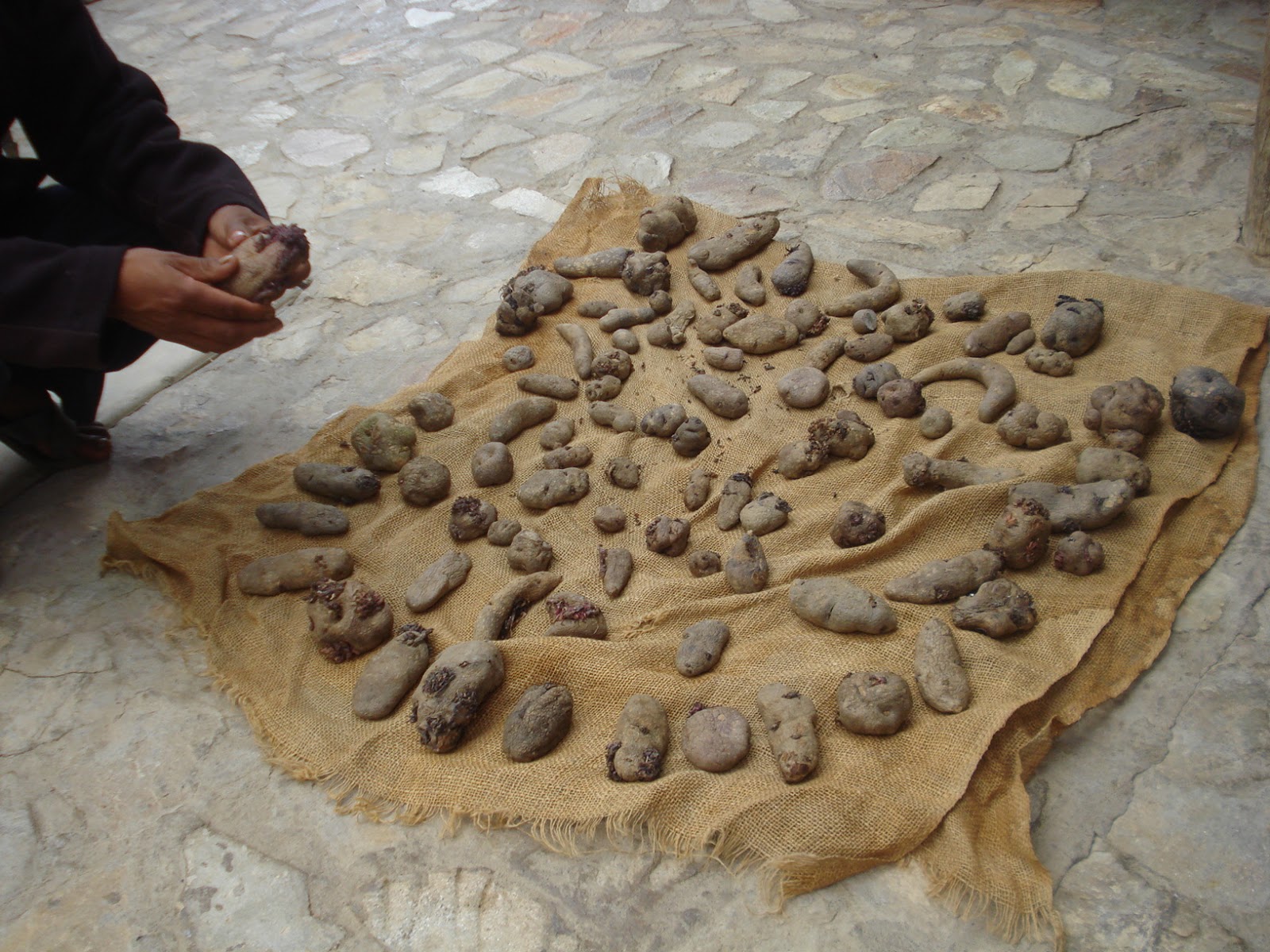
Finally towards the end of our trip to Peru, we arrived at the Parque de la Papa, a park set up in collaboration between a group of indigenous villages and a few NGOs, with the aim of preserving the agrobiodiversity of the high Peruvian Andes. We received a musical welcome from costume-clad local residents and their impressive display of over 70 potato varieties:

After a brief explanation of the park's history and its geographical layout, we set out to see the sights. We were treated to warm baked potatoes served with local cheese and a sort of chimichurry sauce.

First we visited the potato introduction center. Here the park laboratory crew (all comprised of local peasants) receives in-vitro potato plantlets from CIP, the International Potato Center. The park's communities have an agreement with CIP whereby CIP repatriates potato varieties that the center had collected from the area decades ago and that have since been lost (because farmers stopped growing them). CIP offers these in-vitro plantlets, which also happen to be free from the viruses and fungi that inevitably accumulate in tuber-propagated crops, and the Parque de la Papa reintroduces them to the community. It is a great example of peasants and research centers working together. If the peasants and their ancestors hadn't created all these potato varieties, CIP wouldn't have been able to collect and use them. But if CIP hadn't collected them when they did, they would have been lost, because the short-term profit motive of farmers led them to abandon many of these varieties over the last few decades. As is, today the park houses something like 2000 potato varieties.
The park staff receives the plantlets in test tubes, and transplants them to pots in a sterile laboratory in the adobe shed at the right.

They then move these pots to the mesh-house at the left, which is kept free from pests and disease by a strict quarantine procedure whereby only certain people can enter, and they must change into lab clothes and disinfect themselves with quicklime in this anteroom.

The plants in the mesh-house produce a few tubers, and these are replanted to another, less sterile mesh-house for further multiplication.

In turn these pots produce more tubers, which are moved to communal fields in each village for another round of multiplication. Finally, individual farmers can take varieties they like from this communal field for planting at their house. The flow also goes in the other direction, as farmers and communal village fields donate interesting varieties to the multiplication center for distribution.
Later on we went up higher (to more than 4000 m altitude) and saw a little hamlet where members of a certain village (there are six villages contained in the park) sow Andean tubers. Things are so chilly up here that the donkeys have evolved to be shaggy and warm.

Here is a big reservoir that they've dammed to serve the intricate irrigation system that runs down the hills below.

The hillside fields here in the background are not irrigated, though. They farm them one or a few years, then let them regenerate for seven years or so. The whole hamlet coordinates this such that they are all planting their crops in just one patch any given year.

They have potatoes adapted to very high altitudes

Oca, which we call ibia in Colombia.

Mashua or cubio.

And even wild potato species that grow in uncultivated areas

We also visited a women's enterprise center, where they fabricate cosmetics from local herbs.

Here is a batch of soap in process of packaging.

They also package powdered coca leaves in teabags.

In all of the villages we passed through in the park, I was impressed by their adobe construction and mud plaster, just like my house back in Colombia. It appears there is a pool of local artisans who even do designs and figures in the plaster.


We also saw some women and men at work spinning wool (both sheep and alpaca, I believe) and weaving things, from these narrow bands to large shawls.

I also liked seeing the local pigs. They are understandably woolly, but it's also impressive to see the long, strong legs and efficient gait of a peasant pig that lives by semi-independent foraging, as opposed to the stall-fattened pigs most of us know in the modern age.


Our formal tour was topped off with a delicious meal at the park's tourist restaurant. A cooperative of local women served us alpaca in uchuva sauce, cooked quinoa, potato, and local greens.

This was accompanied by a potato and quinoa soup,

And a sort of vinegary juice made from a local herb.

All the dishes used in the restaurant are locally-made pottery with designs and captions of different potato varieties found in the park.
Our visit was fascinating, though my two colleagues and I were woozy and weak through most of it due to the effects of gastric problems and the ridiculously high altitude. So it was a relief to arrive at the houses we'd be staying at that night. They too had decorated mud plaster, though the interior decorations were not bas-reliefs but rather painted words and animals.

Here was the room I had a nap in that afternoon.

In the house's patio was the ubiquitous chaquitaclla, the foot-driven plow/shovel instrument indigenous Peruvian farmers use in the highland areas.

The people hosting us were Quechua-speaking natives, and only a few spoke Spanish. They didn't introduce themselves as indigenous people but rather as peasants, and indeed, aside from the different language, many of their practices, their ways of organizing space, their homes, their fields, even their landscape, were very similar to the highland peasant areas of Boyaca, Colombia. They don't deny that they are indigenous, and they maintain the pre-Spanish cosmovision of mountain spirits and community between humans and nature. But I guess that in a region where everyone is indigenous, the description "indigenous" doesn't say much, while "peasant" says more about how you live your day-to-day life.
Here I am in the low 2nd-floor corridor of the house I was to sleep in that night.

I of course did a fair amount of nosing about the local house-gardens. The houses are at a lower altitude ("only" 3500 masl) than the drier, highland tuber row crops we saw above. The house-gardens are planted more densely, managed more intensively, and generally everything is much greener.
There were fields of fava beans and barley, both mixed and solo, that were used mainly not for their grains but to cut fresh as animal feed.

Here is a barly plot that has been cut little by little as feed. To the left is a new planting of quinoa.

Here is some alfalfa, another feed crop that is common in this region, but that is inexplicably absent from most of highland Colombia.

What is all this feed for? There certainly aren't many cattle around, few sheep, and the alpacas are all pasturing far away in the high heaths. The answer is one of the most important animals domesticated in America: the guinea pig. One family I visited had a shed just for these little critters.

But I think most families just keep them in a corner of the kitchen, where they can readily feed them scraps.

Here are some filmed exploits of these silly little creatures.
This rascal was my favorite, all disheveled.

Here is the adobe house amid non-native pines and eucalyptus trees. Again, a scene that could be straight from central Colombia.

There is a garden of different herbs and medicines.

And a few plants of yacon, a sunflower (and Jerusalem artichoke) relative that, like its North American tuberous cousin, produces an edible root full in fact not of starch but of inulin, a long-chain carbohydrate that the human body can't digest. As such, yacon is used in many processed foods as a source of soluble fiber and as a mild sweetener that doesn't hurt diabetics.

In the evening I took this photo of twilit quinoa (or maybe kaniwa amaranth, which looks very similar).

As night fell, my hosts treated me to toasted corn and tea.

The kids took a picture of me looking silly in this special occasion attire.

Then the host mother gave me a delicious quinoa soup. Again, save the quinoa, which we hardly use in Boyaca, the flavor and other components were very similar to what I know from Colombia.

The kids even use quinoa for their school projects. Look:


Here's me again in a tiny room.

But lest I or any of the local Quechua inhabitants every think we're too big and lose sight of our minor place in the world, these ancient abandoned terraces are always present, watching over everything and reminding us that many have come before us and left their mark on the world with their work.


This is perhaps the major lesson gleaned from my whole visit to Peru, where the past is always present (it's not even past!). We are all part of a history that is unfathomably deep. We can and should work hard and be inspired by others that do so, but never make the mistake of becoming centered on how great one person or even one generation is. We should never forget all that have gone before us, because they have much to teach.
Tuesday, May 14, 2013
Interesting video from David Foster Wallace
This is an interesting video based on a commencement speech by David Foster Wallace. I haven't ever read anything by him, and frankly I have always had some inherent reticence to read him. I guess I have the image of him as too navel-gazing, and certainly verbose with his multi-hundred-page books, though now I'd like to give his writing a chance.
This speech does a good job of pointing out the noble aspects of boring, everyday life, especially as lived in the US where cars and supermarkets and all the other trappings of our version of consumerist modernity can easily deaden human feeling and sympathy. It is interesting that such insight and wisdom and love for life comes from a man who ultimately couldn't bear to keep living. I will try to keep in mind the teachings of this video as my wife and I settle into a new life in the US this year. I hope I can be a decent person amidst even some of the more boring, soul-crushing aspects of everyday life (while at the same time striving to really change some of those aspects for the better).
This speech does a good job of pointing out the noble aspects of boring, everyday life, especially as lived in the US where cars and supermarkets and all the other trappings of our version of consumerist modernity can easily deaden human feeling and sympathy. It is interesting that such insight and wisdom and love for life comes from a man who ultimately couldn't bear to keep living. I will try to keep in mind the teachings of this video as my wife and I settle into a new life in the US this year. I hope I can be a decent person amidst even some of the more boring, soul-crushing aspects of everyday life (while at the same time striving to really change some of those aspects for the better).
Monday, May 13, 2013
Milk and Marxism
As I've mentioned in past posts, last year I worked for a time giving sustainability workshops for dairy farmers. I was very happy with this short-term job, because it allowed me to interact directly with farmers, and I felt I was doing them a good service. Namely, I tried to help farmers to improve their profitability and environmental and social responsibility. I was trying to find realistic ways of improving life for farmers, which meant promoting some things that were recommended by academia or government regulations, while quietly ignoring other suggestions that weren't feasible in the actual conditions of Colombian dairy farms.
In this job as in many agrarian issues, I tend to
go for very practical, almost technical responses to social problems. Whenever participation in my workshops devolved into discourse, into dramatic but unfocused denunciations of current political or market conditions, I always tried to steer the discussion back to small, practical measures that farmers could take to respond directly to the problem at hand. Such measures ran the gamut from changes in milking or feeding practices on an individual farm, to banding together with neighbors to make demands of the local mayor's office, but I always insisted on concrete proposals over grandstanding and political discourse.
Obviously I understand that you can’t fix a
social ill with a new gadget or simply by following "best practices", and I realize that sometimes the only solution to a problem is to take grassroots political measures. But I guess that more concrete proposals seem more
realistic and sincere to me, while the social proposals (and especially the verbose denunciations) that come from civil society groups often seem like empty
discourse that is pretty to hear but not to actually implement.
I have been pretty firm in my conviction that this is the right way to proceed. In the radical left-wing environment of the university where I work, where the walls are adorned by murals of Che Guevara, Salvador Allende, and even a Christ of the Sacred Heart wearing a Subcomandante Marcos-style balaclava, and many student groups are committed precisely to the type of big revolutionary declarations that sound noble but propose little in terms of practical change, I have stood strong in my way of doing things. This has at times earned me the scorn or at least the misunderstanding of colleagues and especially students; in a real Leninist-Marxist’s view, I
guess I’d be qualified as a petty bourgeois reformer as opposed to a revolutionary.
Recently for work I read the book "El Hombre y la Tierra en Boyaca", Fals Borda's seminal study of the social and economic conditions of peasant farmers in our region. When I took it out from the library, I noticed that the subtitle to the 1957 edition translates to "Sociological and Historical Bases for Agrarian Reform". It is a reformer
book, not a revolutionary one. The author is on the peasants' side, and uses his findings to support an agrarian reform to improve their life. He is a bit condescending towards
peasants, describing certain of their practices and customs as backwards and undeveloped; it is the position of a charitable interlocutor. In the foreword, Fals Borda even justifies the need for reform by advise that, if the peasants' living conditions continue to deteriorate, the government and larger landholders will possibly face their revolutionary wrath. He is trying to warn these large landholders and the government to avoid such a situation.
I understand that after publishing this book, Fals Borda was named Agriculture Minister or something in the national government, and along the lines of his book's proposals, he implemented the system of Juntas de Accion Comunal, which are citizen councils in urban neighborhoods and rural hamlets that bring some control of daily affairs and local government to the peasants and local people themselves. He was also behind a very ambitious agrarian reform by the government in 1961, which took land from large landholders and distributed it to landless peasants, organizing these latter into strong popular political groups.
Perhaps it was the eventual sabotage of this reform by retrograde elements that terrorized and dispossessed the newly-formed peasant groups (which sometimes responded, rather effectively, by working militarily with the guerrillas), that disillusioned Fals Borda and turned him off of the reformer track. Maybe it was his having worked since then at the National University with Camilo Torres Restrepo, the left-wing priest who eventually joined the ELN guerrilla group.
At any rate, by the 1973
and 1978 editions of "El Hombre y la Tierra en Boyaca", Fals Borda was a raving revolutionary. The subtitle of these editions changed to "the Historical Development of the Minifundia Society", and though he didn't make any major changes to the text itself, his new foreword calls for absolute change, radical revolution. He is no longer warning the powers that be in order to avoid revolution, but rather calling on peasants to enact this revolution. His new approach seems more full of hot air to me than his
prior, practical solutions; indeed, he expresses frustration that peasants in Boyaca don't become as incensed and radical as he is, that they don't take drastic measures. But what strikes me is that, even though I am not rationally convinced by it, the
fiery revolutionary discourse will always seem much stronger and more
admirable, while the reformer's approach seems complacent, bourgeois,
compromised.
At any rate, my sympathy
with Fals Borda's first, seemingly naïve attitude of reform and compromise, made me wonder how I must look to a
real radical. I have said that in my dairy workshops and
many other fora, I pride myself on shying away from discourse and focusing on
concrete proposals. Should I continue to be proud of
my practical, anti-political approach, or should I be more self-critical?
I see the same conflict between fiery (yet ineffectual) discourse and practical (though uninspiring) solutions in the differing approaches of Malcolm X and Martin Luther King, Jr. Malcolm X
was a discourser, with a very pure, internally-coherent vision and argument
that threw blame clearly at the white man.
King was more realistic in many ways, as he proposed a peaceful
coexistence as opposed to an African exodus or an empowered segregation that
was never to happen. So in practical terms, King was thinking more soundly. Of course Malcolm
seems more pure, more noble, less compromised, and rightfully so; racism in the United States was and is an unqualified evil, and it is coherent to make severe judgments of the racist establishment. But King achieved the more concrete objectives through his mix of practice and moral reasoning. Malcolm X and the Nation of Islam were not instrumental in passing any Civil Rights legislation, and frankly they weren't interested in that. They didn't want to negotiate with white devils in order to mildly palliate the black man's suffering.
King, on the other hand, achieved dramatic changes in both written laws and in human attitudes in the South.
That said, in this respect, Malcolm was perhaps more realistic in the long term—he was
protesting not the laws and social norms of Southern oppression, but rather the
economic oppression that existed in the North and would remain even long after
the end of legalized oppression. It is arguable that the changes King and his ilk achieved were more symbolic, and didn't change the underlying fact of poverty and inequality. In
fact, behind the fiery rhetoric, the Nation had perhaps a more realistic
program for economic liberation through local economic development. They did propose practical measures like local ownership of businesses, neighborhood-based programs for social improvement, and the like (and the similarly radical Black Panthers after them had even more of a social program with their free breakfast programs and other anti-poverty measures). It's just that, since Malcolm's and the Nation's vision didn't see a place for participating in national, integrated politics, their concrete proposals remained at the local black level, and never became nationwide programs. King started to turn his sights on economic
injustice toward the end of his life, but I don’t imagine his method of marches
and prayer vigils (which were so effective in changing laws and human morality in the States) would be very effective in resolving with hard, faceless, amoral
economics.
A very distantly related tangent--recently when we were watching Spike Lee's film version of Malcolm X, I asked Caro if she recognized who was singing "A Change is Gonna Come". She did; it was that fellow I like who sings about mathematics!
Returning to the topic of milk, here is an interesting article from GRAIN about the transition in many countries from an informal system of milk provision, with few intermediaries between farmers and consumers, to a more formalized system involving big companies and packaged milk. It isn’t quite accurate for Colombia, because even the formal companies here tend not to be big multinationals but rather local companies with their base in peasant regions. While the GRAIN report is right in pointing out that raw, direct-sale milk isn't the hotbed of infection and filth that the big companies try to convince us of, it is also true that direct-sale milk in Colombia has some problems that you need to watch out for. Most people who sell raw milk don't do tests for tuberculosis or antibiotic residues, and it’s not unheard-of for farmers to give them their worst milk (since the raw milk buyers don’t pay as well as the big companies). Luckily, a recent law was passed that at once recognizes the validity of direct-sale milk and their right to sell to consumers, while it also stipulates some basic sanitary measures that milk producers and sellers should take to assure the quality and cleanliness of raw milk. This law overrides one that had stupidlly outlawed the sale of raw milk, despite its providing a majority of the milk supply for Colombians. Again, this to me seems a sensible measure, a concrete action to assure a good milk supply for the people, while recognizing the existing system that has worked for so long. It is a practical, concrete proposal instead of a big, extreme discourse (like that found in the GRAIN report), though in the Colombian case as in many cases, it took big discourses and grassroots political organization to bring about this law.
In short, I support those who produce and sell raw milk in Colombia, but it’s not quite the black-and-white, good-vs.-evil story the GRAIN report presents. Maybe I’m sold out to the Colombian formal milk industry and that's why I'm not so hard on it as GRAIN is—but it's true that it's easier to make large pronouncements from an international NGO than to live with the nuances on the ground. That said, they are largely right about the incursion of Big Dairy into many countries, which is an important adjunct to the issue of large-scale land grabs (a topic which I hope to address soon in a blog post).
For now I’ve finally gotten in touch with my local raw milk seller, who comes around the neighborhood most mornings honking a horn to announce her presence. I've been wanting to do so for some time, but I never was able to catch her when I was around. Last week we bought a liter and a half from her for less than what a liter costs in the supermarket. Neither we nor anyone else in Colombia is like the raw milk nuts in the US, who insist on drinking unpasteurized milk—we boil the milk, knowing it may have harmful bacteria. And by boiling, we separate out the cream, which we can then mix with arepas or beat into butter.
Returning to the topic of milk, here is an interesting article from GRAIN about the transition in many countries from an informal system of milk provision, with few intermediaries between farmers and consumers, to a more formalized system involving big companies and packaged milk. It isn’t quite accurate for Colombia, because even the formal companies here tend not to be big multinationals but rather local companies with their base in peasant regions. While the GRAIN report is right in pointing out that raw, direct-sale milk isn't the hotbed of infection and filth that the big companies try to convince us of, it is also true that direct-sale milk in Colombia has some problems that you need to watch out for. Most people who sell raw milk don't do tests for tuberculosis or antibiotic residues, and it’s not unheard-of for farmers to give them their worst milk (since the raw milk buyers don’t pay as well as the big companies). Luckily, a recent law was passed that at once recognizes the validity of direct-sale milk and their right to sell to consumers, while it also stipulates some basic sanitary measures that milk producers and sellers should take to assure the quality and cleanliness of raw milk. This law overrides one that had stupidlly outlawed the sale of raw milk, despite its providing a majority of the milk supply for Colombians. Again, this to me seems a sensible measure, a concrete action to assure a good milk supply for the people, while recognizing the existing system that has worked for so long. It is a practical, concrete proposal instead of a big, extreme discourse (like that found in the GRAIN report), though in the Colombian case as in many cases, it took big discourses and grassroots political organization to bring about this law.
In short, I support those who produce and sell raw milk in Colombia, but it’s not quite the black-and-white, good-vs.-evil story the GRAIN report presents. Maybe I’m sold out to the Colombian formal milk industry and that's why I'm not so hard on it as GRAIN is—but it's true that it's easier to make large pronouncements from an international NGO than to live with the nuances on the ground. That said, they are largely right about the incursion of Big Dairy into many countries, which is an important adjunct to the issue of large-scale land grabs (a topic which I hope to address soon in a blog post).
For now I’ve finally gotten in touch with my local raw milk seller, who comes around the neighborhood most mornings honking a horn to announce her presence. I've been wanting to do so for some time, but I never was able to catch her when I was around. Last week we bought a liter and a half from her for less than what a liter costs in the supermarket. Neither we nor anyone else in Colombia is like the raw milk nuts in the US, who insist on drinking unpasteurized milk—we boil the milk, knowing it may have harmful bacteria. And by boiling, we separate out the cream, which we can then mix with arepas or beat into butter.
On the same
note of milk and pragmatism, I recently ran across a few articles that posit industrialized dairy
farms as more sustainable than organic or other low-input farms. This article claims that the use of recombinant bovine growth hormone in dairy farms has lowered the environmental impacts per gallon of milk produced, by extracting more milk from the same cow without adding any additional manure output or feed intake. This is called dilution of maintenance energy; the base amount of energy needed just to maintain the cow alive, as well as the base amount of manure and farts and general pollution, comprises a relatively smaller part of the total energy and pollution needed to produce milk when you produce a lot of milk per cow.
This other article more ambitiously lays out the ways in which today's high-input, high-output model of dairying has lower impacts per gallon of milk produced than the seemingly bucolic model practiced in the 1940s US. At first glance, their approach of looking beyond the discourse of low-input, supposedly sustainable agriculture to find what is really most environmentally responsible, seems like an objective, sensible way of doing things, very much in line with my preference for practical solutions over nebulous discourse.
On reading them, their numbers seem sound, though there are a few problems to their approach. First off, their methods a bit opaque, I believe mainly because the limitations of a short article don't allow for in-depth descriptions of your model. Beyond this, in the bovine growth hormone article two of the authors either work for or with the producer of this chemical input, so I don't know how objective we can expect their interpretations of data to be. Finally, the assumption in the second article that today's organic farms are basically throwbacks to the 1940s isn’t very accurate; organic farming is a fully modern, scientifically-informed set of practices, not just the absence of the past 70 years' worth of technological advances.
But beyond these more or less superficial problems with the prior two articles, there is another report that has fundamentally opposed findings. This other guide, which corresponds to a computer calculator for dairyfarms, is more considered and in-depth in its explanations of methodology, and comes to the opposite (thoughcommon-sense) conclusion: that heavy use of synthetic inputs, crowding of animals into small areas, and storing liquid waste in airless lagoons is not as environmentally sound as a pasture-based approach to dairy farming. It is not peer-reviewed in the same way as an academic journal article, but it is put out by a respected research center. It takes a more nuanced look at conventional and organic dairy systems, and as such it takes into account (where the other articles don't) things like the difference in milk quality between high-yield Holsteins and lower-yield other breeds, which somewhat diminishes the apparently glaring difference in milk yield seen in the other articles. And this report still hasn’t incorporated soil sequestration figures for methane under a pasture system, nor differences in carbon dioxide or nitrous oxide emissions, all of which would leave organic farming coming out even better on a per-gallon environmental footprint basis. (According to this bit by Bill McKibben, methane and carbon dioxide sequestration may be very high on awell-managed pasture, though I don’t know if the FAO would agree given theircomments on extensive grazing and its methane creation). It seems that the narrower you look at something, the easier it is to say it's sustainable, but as you consider more aspects, the story changes.
This other article more ambitiously lays out the ways in which today's high-input, high-output model of dairying has lower impacts per gallon of milk produced than the seemingly bucolic model practiced in the 1940s US. At first glance, their approach of looking beyond the discourse of low-input, supposedly sustainable agriculture to find what is really most environmentally responsible, seems like an objective, sensible way of doing things, very much in line with my preference for practical solutions over nebulous discourse.
On reading them, their numbers seem sound, though there are a few problems to their approach. First off, their methods a bit opaque, I believe mainly because the limitations of a short article don't allow for in-depth descriptions of your model. Beyond this, in the bovine growth hormone article two of the authors either work for or with the producer of this chemical input, so I don't know how objective we can expect their interpretations of data to be. Finally, the assumption in the second article that today's organic farms are basically throwbacks to the 1940s isn’t very accurate; organic farming is a fully modern, scientifically-informed set of practices, not just the absence of the past 70 years' worth of technological advances.
But beyond these more or less superficial problems with the prior two articles, there is another report that has fundamentally opposed findings. This other guide, which corresponds to a computer calculator for dairyfarms, is more considered and in-depth in its explanations of methodology, and comes to the opposite (thoughcommon-sense) conclusion: that heavy use of synthetic inputs, crowding of animals into small areas, and storing liquid waste in airless lagoons is not as environmentally sound as a pasture-based approach to dairy farming. It is not peer-reviewed in the same way as an academic journal article, but it is put out by a respected research center. It takes a more nuanced look at conventional and organic dairy systems, and as such it takes into account (where the other articles don't) things like the difference in milk quality between high-yield Holsteins and lower-yield other breeds, which somewhat diminishes the apparently glaring difference in milk yield seen in the other articles. And this report still hasn’t incorporated soil sequestration figures for methane under a pasture system, nor differences in carbon dioxide or nitrous oxide emissions, all of which would leave organic farming coming out even better on a per-gallon environmental footprint basis. (According to this bit by Bill McKibben, methane and carbon dioxide sequestration may be very high on awell-managed pasture, though I don’t know if the FAO would agree given theircomments on extensive grazing and its methane creation). It seems that the narrower you look at something, the easier it is to say it's sustainable, but as you consider more aspects, the story changes.
The main
point of divergence between the Organic Center report and the 1944 paper is the incorrect assumption
in the latter that 1944 farms (or present-day organic farms) maintain the same high culling rate as modern conventional dairy farms. In a modern dairy system, cows are kept at a high level of production that wears out their bodies, such
that they are killed (culled, in technincal terms) after two lactations (lasting just over two years). This means that the cow has spent two years or so as an unproductive heifer, and then two years or so as a highly productive cow, which in turn leaves about as many heifers as mature cows in the population. The Organic Center report posits a longer
life for lactating cows, such that they are milked over more than four
lactation cycles before culling, as opposed to just under 2 cycles. If this is accurate, there are fewer unproductive heifers in the population under a less intensive, pasture-based systems. What accounts for the different findings are that while the 1944 study speaks of dilution of maintenance energy in a high-producing cow, the Organic Center shows a dilution of maintenance across the population, by having more cows in production and fewer heifers just eating and pooping without producing milk.
So in this case, the discourse of organic and sustainable advocates in favor of lower-intensity, pasture-based dairy systems seems not to be a noble-sounding but ultimately impractical ideology, but rather based on fact. Sometimes discourse exists because it is what's true, not just what sounds nice. And in any case, often to bring about practical, realistic change, you need an ideological lens and an eloquent discourse.