This is a scary, well-reasoned article that argues that the biotech industry is not involved in agriculture as an end in itself, but rather as a jumping-off point to create private, propietary technological processes while aided by lots of public money. The end goal would be to create advanced biotech pharmaceutical innovations (organs for transplant, medical proteins, etc.) for the high-end medical consumermarket. Pursuing advances in a given field in order to realize high profits isn't bad in and of itself. But compromising and manipulating the agriculture upon which humanity's well-being depends in order to achieve private gain is a real sin.
Monday, August 29, 2011
Greg's Haitian Adventure 7: Loving and Leaving Haiti
As my time in Haiti came to an end, I realized how much I love the country. This may not come as a surprise to the objective outside observer. I return time and again to Haiti, I keep up with its history and current events, I am constantly worrying about people there, I am an avid student of the country's culture. But in the day-to-day rush of working there for a month, being consumed and sometimes frustrated by the demands of my job, I hadn't simply laid back and enjoyed being there, at least not consciously.
My last weekend changed this. I began saying my farewells to different people I'd shared the past month with, and I closed up my professional commitments. I felt like I'd done my job well, which I think allowed me to relax and take in the surroundings a bit. And what surroundings! Here are some photos from the roof of my little dwelling. There were avocadoes and mangoes hanging tantalizingly, ready for the picking.


Even a few cacao pods.

I began reading about development issues in Haiti, no longer with my obsessive, grave quest for guidance and practical direction in my profession, but rather as an intrigued student of Haiti and the developing world, someone interested in learning and really understanding things. I was once again an enthusiast for the subject, and not just a cynical practitioner. I hadn't felt this way for years, I guess since I stopped merely reading about Third World development and started living it. I'm happy now to be living and working amidst the things that have always interested and concerned me, but it's also important to step back sometimes and recall the wonder of these things that matter to you, that fascinate you.
This last weekend also coincided with a big Vodou festival in Plaine du Nord, a town near Cap Haitien. It was the annual feast day of Saint James the Greater. This is the apostle James, one of the first selected by Jesus. As I understand it, after Christ's death and resurrection, James wandered the Roman Empire preaching, which is why he's often represented in icons as a wandering wayfarer, bearing a staff topped by a calabash gourd. Upon his death, the legend is that his remains were taken by a barbarian queen and floated in a stone boat to an unknown locale in Iberia. I don't know how much if any of this story is taken from the Acts of the Apostles. Anyway, James's burial site remained unknown for centuries, until one day in the Middle Ages a shepherd saw a star that led him through Spain, to a particular field, much as the three kings had been guided to Bethlehem. This field was James's burial site, and became a town called Santiago de Compostela, “Saint James of the field of the star”. To this day the city is one of the four holiest places in Catholicism (I believe the others are Jerusalem, Rome, and another town in northern Spain that I've been to but whose name I forget).
Anyway, Saint James is later said to have appeared in visions inspiring the Spanish to reconquer Iberia from the Moors. This is why this wandering, peaceful saint is also commonly represented as a late Medieval knight on horseback, trampling and spearing swarthy heathens underfoot.

It is this image that Haitians venerate in Plaine du Nord in late July. For you see, this is not only Saint James (Saint Jacques in French), but a representation of Ogun Feray, the Vodou spirit of war, of iron, of valor, of freedom from slavery. 
It is the same Ogun as is (I believe) represented in this statue from Benin.

The translocation of Vodou spirits onto Catholic images is common. Slaves were forcibly converted to Catholicism, but they found a sort of loophole in which they could venerate their spirits while appearing to venerate Catholic saints. Thus the image of Saint Patrick with snakes at his feet is really Danbala, the spirit of snakes.

Different iterations of the Virgin Mary are really Ezili in her different manifestations of love, fertility, and rage. It is Saint Jacques/Ogun Feray that inspired and possessed Dessalines in the final throes against the French in 1803.
So the Vodou festival at the end of my Haiti sojourn gave me an opportunity to remember a bit of what I know about Vodou, and to explain it to my coworkers. Once again I was stepping away from the day-to-day of Haiti to recall the fascinating things about the culture, as seen by a student. When I commented this to my wife, she laughed and told me that when she first met me, one of her overriding impressions was that I was a lover of Haiti. She was happy I'd realized that once again.
The festival itself was bustling and chaotic. We got to the town early in the afternoon. Initially it seemed like a yearly village party anywhere else in the world.


Lots of music blaring from houses, cars, and stages, stalls selling food, drink, and trinkets, sweaty bodies packed together on streets and in arriving trucks and buses. At one point a dude was bothering some people in our group as we were drinking a beer. Some of the girls thought he was trying to push up on them or otherwise take advantage of them, so they stuck me on him. But the guy was just a drunk musician that wanted to talk, in that rambling, boring way universal to drunks. Sometimes the preconception that there's this insurmountable cultural gap between Haitians and foreigners prevents us from seeing the honest, innocent motivation behind certain acts. I politely humored him for a half hour until we left.
There was another shady guy who seemed to be following us the whole time. I don't know how he thought that a 6-foot-three guy wearing a bright yellow shirt might trail us unnoticed, but he kept following my group. As long as I was with everyone I didn't worry about them, but when I split off from the main group with a few others, I warned another tall, burly companion to keep an eye on the guy. Apparently the rest of my group indeed hadn't noticed the guy, height and yellow shirt and all!
This fellow never caused any problem, and very possibly had no ill designs on our group. Something I've found often in Haiti is that just as the basest, most cynical mentalities can find expression in acts of crime or cheating or dishonesty, sometimes Haitians are inexplicably generous and decent. Just like anywhere else, people in Haiti can be really nice or really mean, but the manifestations seem to me more extreme than I've seen elsewhere in the world. So it's perfectly plausible that Mr. Tall Yellow Shirt was concerned about the safety of a bunch of foreigners and wanted to tail us to protect us, or that he was interested in hearing our English, or some other innocent aim like that.
I was reminded of a story my boss Hector told me that explained how he fell in love with Haiti. He was in college and was finishing up perhaps his second visit to the country. He still hadn't mastered the language, and was tentative about whether he would become more involved in work in Haiti or not. During the final days of a month spent helping to fix up a hospital building (hanging doors, wiring electricity, etc.), he'd been really disillusioned when some young guys that had been working all month with his team stole a bunch of their equipment. How could they be so cold-hearted as to steal from people they'd shared laughter, work, and beers with? Around the same time, Hector had ordered a big traditional drum from a master artisan. He pressed on the artisan that his flight would leave Tuesday, so the drum had to be ready by Monday. But when Monday and then Tuesday rolled around, there was no drum in sight. As my friend was leaving for the airport, a few kids came running up and said the drum would be ready the next day. It would be too late, and Hector would simply lose the money he'd fronted for the drum. It was another disillusionment.
A few months later, back at college and probably glad to be shut of Haiti forever, Hector got a phone call from his mother in rural Virginia. She wanted to know if he'd ordered a drum, because there was a Haitian dude at her house with a drum for Hector. It turns out the artisan had brought the drum along on his first trip ever to the US. He was probably headed for New Jersey, but he'd carried the damn drum on the flight, and then all the way to Virginia. He'd not only not cheated Hector, he'd gone out of his way to give him this special, cumbersome drum. From then on Hector was hooked. The extremes of generosity and cruelty in Haiti, the vitality of day-to-day life as created by its people, make for an intensely-lived existence, a true sucking of life's marrow. Hector has lived in Haiti for almost six years now, a fifth of his life!
Anyway, back to the Vodou ceremony. If you look closely you start to see differences from any other village festival. Many of the vendors are selling perfume, rum, candles, prayer books. These are things you buy to then offer to a spirit. Many people are dressed in traditional dresses in bright red and blue, two important Vodou colors, especially for Ogun Feray.

Sprinkled throughout the town there are occasional altars covered in people and offerings.

And if you follow the river of people, you arrive to the Basilica.

Basically Plaine du Nord has a big mud pool under a painted ceiba tree.

Both are sacred, and as I understand people refer to them as the Basilica. I believe that if you make a request to Ogun at this mud pool, it will be granted, and the next year you have to go and make an offering of gratitude, either by throwing it into the pool or giving it to the musicians playing frenetically around the pool.
The more serious devotees bathe in this disgusting mix of mud, water, and surely a bit of feces, garbage, broken glass, etc.

There are a few guys that stand in the mud the whole time, attending to these bathers, giving them puffs of cigarettes or drags of liquor.


The whole theology of the thing is not entirely clear to me. In general, Vodou has no rigid orthodoxy. I have read a lot of books explaining the different spirits, their roles, their powers, their representations, their equivalent names in Kreyol, French, and original African names. But in my limited direct contact with the practice of Vodou, I am increasingly convinced that the neat categories and explanations I read in books are idealized academic systematizations. Day-to-day Vodou practice seems not to follow these rules and order. A colleague of mine had also read some about Vodou, and asked people questions along these explicit academic lines. She was universally met with vague responses that seemed to refute her premises. There is no Vodou Pope to say what is acceptable, what is orthodox or not. And I imagine that as more Haitians convert to Christian sects that are intolerant of Vodou, explicit theology becomes less important or known to many Haitians, but the belief in the raw power of Saint Jacques or Ezili or whoever remains. At any rate, I was not able to get much explanation of what was occurring in the festival, beyond the idea that you ask for something and it will be granted, after which you must offer a repayment of gratitude. The experience was nevertheless very moving and impressive. Here's a video I shot with my impressions that night.
Aside from the Vodou ceremony, I was to MC a traditional Vodou dance presentation at our residential compound in my last days in Haiti. The manager of the compound had started scheduling really fun events on the weekends, with barbecued burgers and Haitian food, and occasionally dance troupes. A few weeks before a twoubadou group had come.


They had an amazing musical ensemble, and great, raw dancing. Check out these clips from a dance in which one guy is inspired and possessed by the spirit, stumbling around drunkenly and infecting others, who begin dancing wildly too.
This was the group I was to MC for this time.
The week prior another group had come. They were more polished in some respects, with glossy outfits and an English-speaking troupe leader.


But their production didn't seem as spirited and authentic as the other group. One thing that was cool was that the troupe leader was really effeminate, like a Haitian Liberace.
I thought it was nice that someone like him could find a niche to work and flourish in in a society that isn't too flexible on gender identity. I had wondered in meetings with farmers if certain guys were gay, and if so, how it would be to be a gay Haitian farmer.
Anyway, the group I MCed for on my last weekend put on another excellent show. I was moved by the music, moved by the common Afro-descendent roots that run through all of our national cultures in the New World. I thought I would like my son to learn Afro-Colombian dances as a way of connecting to this part of his heritage. In Bogota and probably in Chicago there are cultural groups that teach kids traditional dances and put on occasional shows. Along with basketball, Chinese, and piano, I think I'll push my kid to learn traditional dances from different parts of the US and Colombia. Those will be the things I force on him and he'll thank me for later!
When the day came to leave Cap Haitien, I wasn't too sad or nostalgic. I'd had a good time, done good work, and bid my adieus, all the while rediscovering my love for Haiti. I took a few last photos of the educational farm I'd been working on, then headed out to the airport.


In fact, as I waited in the Okap airport to head to Port-au-Prince, I was just anxious to get back home to my wife and kid. I was not thrilled that I still had two days to go, in PAP and then Panama, before seeing my family.
My old buddy Darilus picked me up at the airport in Port-au-Prince. We drove in his taxi to his place. A few years ago I helped him to buy a pickup truck to serve as a taptap, Haiti's de facto public transport buses. After some initial mechanical problems, the business was going well, until the earthquake, when the truck got beat up pretty bad. Darilus spent months trying to keep it going, but the repairs ate up most of his profits. So he traded it in for a smaller car, a taxi that ran decently. Nevertheless, I was shocked to see how shoddy the taxi was, too. It had a broken windshield, a hotwired ignition, the engine was weak. He's hoping to save some money and get a newer model. I hope it's sooner rather than later.

We drove from the airport through Delmas. I didn't see much if any earthquake damage; we were on flat ground far from the epicenter. There were however sprawling displaced persons camps in most of the large open spaces around town. When we got to the historic Bel Air neighborhood, I started to see more and more fallen houses. By no means entire blocks, but occasional holes in the urban fabric, vacant lots piled with rubble. As we got farther into the center of town, there were more fallen houses, but still not the majority. It seems that construction was not as shoddy in Port-au-Prince as many would claim (especially concrete company-funded NGOs that want everyone to use their ready-mix or their equipment). Later that night I'd talk with a friend working in disaster prevention, who explained more to me about the nexus of soil type, slope, building foundations, construction technique, and location with respect to the Leogane epicenter. Most of the damage in PAP occurred in places like Martissant, which combined conditions of lots of poorly-built houses on steep, denuded slopes, with proximity to the epicenter. So the story is a bit more nuanced than “Haitians construct poorly”. As we advanced up the mountainside to Petionville later on, I saw huge slums perched precariously on steep slopes, where there was no visible earthquake damage. My friend explained that much of that area is solid limestone bedrock, so somehow the vibrations of the earthquake were dampened or something. But Petionville, relatively untouched this time, is on a major fault line, so they may be next up for a big tragedy.
As Darilus and I drove through the true center of town, near the Champ Mars, I marveled at my intrepid youth. Almost ten years ago I walked this whole area frequently, going from the center of town to my host's place in Canape Vert (which suffered widespread earthquake damage). I don't think I took inordinate risks or anything, but I walked long, grueling treks around Port-au-Prince, navigated successfully areas that are now forgotten and foreign to me. They zoomed by now in the car, but I thought of what a haul it would be on foot. I was happy to be in the car this time. Have I become soft and lazy?
I also marveled at the Champ Mars itself. Most of the surrounding buildings were in fine shape, but I saw firsthand the now-famous image of the National Palace collapsed in on itself. Also, much of the erstwhile park was now a massive refugee camp. The National Museum did maintain its modernist subterranean construction and landscaped gardens, but everywhere else was tarps and tents.
Eventually we got to Darilus's place. It's in a glum, ugly building in an undamaged part of Carrefour Feuilles. His room is reached at the end of a long, narrow, dark hall. There isn't much in the way of locks anywhere—I think everyone knows everyone in the neighborhood, and keeps an eye out for robbery. My friend's room itself is really nicely-appointed. He has a stereo system, a fridge, a TV, a comfy bed, a clean carpet, a fan.

Almost round-the-clock electricity, a pleasant interior temperature. I've always considered Port-au-Prince harsh and ugly and exhausting, especially compared to the idyllic countryside, and certainly no one would consider it the lap of luxury to live in a single small room. But after seeing Darilus's room, I better understand the pull of the capital. My friend has been able to work, to study, to live more or less comfortably with constant power and water. None of this would be possible in his rural home area, such as it is now. Of course he still returns there weekly, and in fact the owner of the building he lives in is from the town. So there's still a strong tie to the countryside, but I can see how Darilus and thousands of others like him come to PAP to form a burgeoning prole-working-class, with a humble but steadily-rising quality of life. It all reminds me of the massive urbanization Dickens described in his day, surely with a lot of desperation, but also with a definite, visible trend to upward mobility, at least for the lucky ones.
After seeing my buddy's place, we continued on to a dinner date in Petionville. Petionville has always been the reserve of Haiti's wealthy, but in the past it had always seemed like a still relatively crappy, rundown place to me. The restaurants weren't good, the hotels mediocre, and everything shut down early at night, making for sad walks down streets of endless high walls. This time though it was more bustling than I remembered, looking more like a trendy or artsy neighborhood of a Colombian city like Cali. Still not too luxurious, but more or less recognizable for a bourgeois urbanite from anywhere else in the world, especially the developing tropical world.
However, my friend Susan's place, where we were to dine that night, was still beyond Petionville, on the road to Kenscoff, with its cool mountain clime. The ride there looked a lot more like ultra-exclusive European housing developments. High walls, modern apartment towers, lots of stone paving and verdant hedges. I began to understand what people meant when they talked about the wealth of Petionville. I also marveled that so many expats should live high up here but work below in the city. It had taken us more than an hour to get here. I couldn't imagine it at rush hour!
Finally we got to my friend's place. It was a lovely, well-constructed apartment building. Susan's apartment was the most luxurious, huge, well-built dwelling I'd ever seen in Haiti. It contrasted starkly with where I'd been staying in Okap, which despite belonging to a wealthy family, was rundown, poorly-built, poorly maintained. Susan's place had high quality floor tile evenly laid, carefully-designed kitchen and bathrooms with functioning hot and cold water, the works. It looked like a modern, big apartment anywhere else in the world. There was even AC, though it was never necessary, because the cooler mountain clime, the abundant surrounding vegetation, and the smart design of the building made for a comfortable temperature at all times.
My friend Darilus was to dine with us there, but he was worried about the logistics of getting back home, so he left early. That left Susan, her husband, and me to talk about the old days. They had met each other, and I them, years ago in the village of Fondwa. They were both volunteers, he with a decidedly more agrarian bent to his work, and they fell in love. To this day, I believe their main language of communication is Kreyol, since neither is as fluent in the native tongue of the other.
Anyway, I reviewed what they'd been through in the past nine years. We'd kept up sporadic contact, and even seen each other in Chicago in 2005, but I wanted to catch up and get the full story of what they'd been up to since our shared pastoral in Haiti in 2002. I learned about Susan's return to the US and months of aimless drifting, unsure of what to pursue after her intense living and loving in Haiti. She eventually studied a masters degree and went to work for a few years in a big NGO in Washington. Before my present visit she'd just gotten back from a stint working in Afghanistan, a high-stress environment she describes as toxic for the unhealthy, self-destructive practices and bad behavior taken up by many expat aid workers there.
Susan's husband, on the other hand, had accompanied her in the US while she studied. He worked in a few small agricultural enterprises during those years, which I really admire, because I as a US citizen agronomist was never able to find gainful employment in agriculture that didn't involve working for input supplier oligopolies or output purchaser oligopolies. Susan's husband then studied a masters degree in his native Europe, seeing as I later did that a career in ag development would be impossible without a higher degree. After that he worked for NGOs in DC alongside Susan, and branched out of agriculture into other sectors. Finally his work brought him back to Haiti, and now that Susan had returned from Afghanistan, they could be together again for the first time in a long time!
I really admire them. Obviously for their personal qualities, which drew me to them in the first place, but now I'm also in awe at the important positions they hold at important development NGOs. While I'm happy in my career track as something of a freelance development agronomist, and I don't think I'd like being involved in a long-term position with a big NGO (though I would like the money and stability!), I aspire to the standard my friends have set. They're all groweds up and sophisticated. They've studied hard and now have high-level posts, decent pay, fascinating lives. They are able to work for organizations that sometimes display flawed priorities or frustrating bureaucracy, but they've maintained their commitment to the poor and the marginalized. Susan and her husband are progressive, passionate voices that surely improve the organizations they work for. Meanwhile, they read my silly rambling on this blog and think I'm much more principled than I really am!
Catching up with my old friends made me reflect on my life of the last nine years, since I first went to Haiti. That was a third of a lifetime ago! I've gone through a lot since then. By the end of that first visit to Haiti in 2002, after my sophomore year of university, I was disillusioned with the country, disillusioned that the rural poor and the Third World in general didn't conform to the noble, idealized image I'd created from books and such. I returned to the States in that summer of 2002, after a stopover in Paris to visit a girlfriend that was no longer very interested in me. It was too late to reenter school for that semester—I'd planned on spending six months in Haiti, but my frustration and an ailing uncle back home cut my trip to two months. So I spent the semester in Chicago, weekly visiting Beloit to care for my uncle, working nights at a sleazy porn theater, rehabbing my mother's kitchen, accompanied by radio rumblings of impending war with Iraq. In early 2003 I returned to college in Urbana, living in a tent in a friend's uninsulated attic. I led a tour to Haiti over spring break, and spent the semester working for the U of I chemistry department, which eliminated my tuition obligations and gave me some spending money.
My senior year of school I reunited with the Paris girlfriend, and had a pleasant last year. The summer of 2004 I studied sustainable farming in North Carolina, then went on a study trip of corporate agriculture in Brazil. After that I worked a lonely October shoveling grain at a Champaign grain elevator, then returned to my parents' house and worked at a bar. 2005 was spent mainly in Altgeld Gardens, the Chicago housing project where I ran a community gardening program, but that ended abruptly amid allegations of corruption and internecine strife. By that point I'd been out of college for a year and a half, and felt like I'd never find an agricultural development job without a masters degree. But finding the right degree would take time, during which in any case I'd have to work some dead-end job. So I decided to work my unavoidable dead-end job in Spain as I searched for a good postgraduate program. At least that way I'd be able to learn a new language, experience a new culture. So from late 2005 to the middle of 2006 I worked teaching English in Spain, and I got pretty good at Spanish. I also found and was accepted to a good masters program called Agris Mundus, which conformed precisely to my aspirations of learning about the social angle of farming systems.
The middle of 2006 was wild and carefree. I'd broken up with the Paris girlfriend during a trip to Morocco we'd designated for that purpose. The trip was filled with medieval cities, mosques, French colonial chic, and lots of shouting matches. I spent the summer back in Chicago, working again at my old bar haunts. This time was full of parties and a happiness that I was going on to study what I loved. I think it was much like the moment of life in which many of my current Haiti expat colleagues find themselves. They've been out of college for a few years, and are finding a place for themselves between youngster fun and meaningful work. In August of 2006, I headed off to Europe to start my masters degree.
Agris Mundus started off with an orientation in Montpellier, France, after which I had a month free before starting classes in Madrid. I went on a train trip around Germany, to the lesser-visited corners. It was a cold, melancholy September, with few fellow tourists about. In general a time for learning about history (I visited the towns of Marx, of Charlemagne, of the 1848 revolts, of the popular movement of 1989), and being alone. After that I started a fun year in Madrid of studying abstruse concepts, partying a fair amount, and eventually meeting my future wife. From there she and I went on to spend a sweltering summer in Montpellier, brushing up on our French, staying at farms, hiking through beautiful Mediterranean villages, and getting ready for the upcoming school year.
France was challenging for me. I loved what we were learning, and I loved many things about Montpellier's food, daily life, its culture. But being a foreigner in France, especially a foreigner like me, is not easy. We were constantly met with intolerance of our way of doing things, and I spent the better part of most days in a frothing fury over rude treatment, inefficient systems, and suffocating bureaucracy. Summer of 2008 was spent doing thesis work, I in Benin in Africa, and Caro in Laos studying opium eradication. We were happily reunited in Paris after four months apart, and I got to see my first-ever Indiana Jones film in a theater! The next two months were spent assembling theses that got hammered by our jury, and we were thrilled to get out of France with degree in hand!
Since late 2008 we've been in Colombia. I spent some months in Chicago to be with my father in his last days, and then I was back to Colombia to get married and establish a new life. I spent 2009 trying to make ends meet by organizing tours to Colombia, and my wife and I started a jam business, which we've since put on the backburner but which we aspire to revive very soon. In general I was often frustrated that despite what I considered to be a good knowledge base and lots of ability, I was not able to find steady gainful employment. Most of 2010 I spent as a house husband. I kept things clean, made meals, and started my blog in my free time. I also frequently accompanied my wife in her work in the Tenza Valley, but I also started to get jobs here and there, and to feel fulfilled professionally. I eventually got to the point I'm at now, where I am happy with and even prefer being a self-employed freelancer in the field of agricultural development. 2010 also saw us buying and starting to rehab a house of our own. And of course the defining event of the year was Caro's pregnancy and the birth in December of our wonderful son.
I recounted all this to my hosts in Petionville, and felt good to review all the different experiences, people, and places I'd been through in the past decade. Much of my own account of my recent life transpired during dinner (a delicious pasta with white wine sauce), after which I also did a fair share of showing Susan and her husband photos of my son. That night I had my first hot shower in a long time, which was so uncomfortable that I switched to cold water, and then I slept immediately and soundly.
The next morning I had the house to myself, and hours to kill until my afternoon flight to Panama. I felt like doing something leisurely, different from my routine of the last month, so I decided to watch a movie on my hosts' TV/DVD setup. Susan's husband has a lot of good movies, particularly documentaries on topics of development, poverty, and the like. But I wanted something less serious, less real. So I plugged in a French action flick called “Secret Agents”.
Secret Agents is a pretty cool movie. It's typical action, espionage, slick takes and not much character development. But there's a European flair, a sophistication you don't see in US action flicks. For instance, the entire action-packed opening sequence, perhaps some ten minutes, has no dialogue. There are a bunch of dudes chasing this other guy, but we don't know who anyone is, why they're doing what they're doing, nothing. It can appeal to a wide audience, regardless of language. From there on the action continues for two hours, with parachute drops, high-speed chases, underwater operations, undercover burglaries. Allegiances change, things are not as they seem. I was surprised not to understand a lot of the French. I guess it's been a while since I've been exposed to the language spoken in rapid fire. But I still understood what the film was about. Also very European was the star, Vincent Cassell, a funny-looking, elfish guy who would never be a star in the US, and his wife, the sensuous older Monica Bellucci, who also wouldn't be cast as a hot spy vixen in the US.
After my movie it was time to meet up again with Darilus and his cousin for a lunch at the Hotel Kinam, an elegant place in Petionville. It is a really classy hotel in an old gingerbread building. I had conch in tomato sauce, a typical Haitian dish. The bill was steep, but I wanted to treat my buddy to a nice meal as a thank-you for all his help getting around and established in Haiti.
From there we went to the airport again. It is striking in Petionville to see high-end hotels and restaurants looking onto what used to be landscaped plazas that are now converted into packed refugee camps. An extreme and jarring example of the injustices still present in Haiti.
Back in the airport, I was stricken once more by impatience. That night I'd have a layover in Panama City, which meant yet another day away from home, away from my family. At the same time, it also offered a brief chance to discover a new country and culture.
Sunday, August 28, 2011
Third World Green Daddy 21: Magic Formula
A few months ago Sam had a big development in his eating habits. He'd always been a voracious eater, and in fact he'd already started eating things other than breastmilk. But one day we were returning from a long trip somewhere or other, and his appetite simply exceeded his mother's milk supply at that moment. My wife Caro had been working long, hectic hours, traveling a lot in the closing months of the ecotourism project she was coordinating in the Valle de Tenza region.
It seems that that particular day her personal stress and Sam's massive appetite met head-on. The baby wanted more milk than Caro could give, and became furious with hunger. He started hollering and screaming like a madman, and at that moment we took a strategic decision we'd been mulling over as a possibility for some time. As soon as we got back to our hometown, we stopped at a pharmacy and got some infant formula for the baby.
We had thought before that if Caro's milk supply or her schedule ever impinged on her ability to feed Sam exclusively breastmilk, we could buy formula as a complement to, if not a total replacement for, mother's milk. It isn't an ideal solution, because the limits of the unknown in nutritional science (as in any science) mean that no matter how much they fine-tune infant formula to approximate human milk, it will never be as good. There will always be minor compounds in mother's milk that elude our best efforts to replicate it exactly, so it will always be better to go with mother's milk.
Until that moment, Caro's and my work schedule had allowed us to keep Sam on pure breastmilk. For almost three months our health plan had given my wife paid leave, so she could be at home and relax with the baby (though she still ended up having to do a lot of work from home during this time). After her leave was up, Caro worked days at our local university, expressing her milk in the morning and evening with our nifty electrical breast pump, which provided enough bottles to feed the baby between the times she was home. Caro returned to the house for lunch, and could always come home from her work nearby if there was any need. Even when she had to go to spend a few days in the field, her work environment was flexible enough that Sam and I could accompany her, and thus she could keep him fed even during important meetings. But the day of our long trip, Sam's pressing hunger forced our hand, and we started a new era of infant formula. It will surely not be the last synthetic invention we introduce Sam to. My apologies to Nicholas Kristof, who admonishes us Third World types to stick exclusively to breast milk.
Even after the fateful day (during which my mom happened to be present, and was I think surprised at our resorting to formula given our generally pro-natural stance on childrearing), Sam continued to eat mainly breastmilk. As before, when Caro felt her milk supply getting low, I'd prepare lots of hot panela (molasses) water with milk and fennel, which is a common Colombian remedy for increasing breastmilk. Only rarely would we (or the babysitter, whom I'll talk about in another post) open the metal tin to spoon out four dollops of sticky powder to mix with four ounces of boiled water. The infant formula thus represented a valuable insurance policy, a rarely-used backup option that nevertheless gave us the peace of mind of knowing that Sam would never go hungry.
Formula was not without its drawbacks. We noticed that it seemed to constipate Sam, or otherwise give him digestive problems. If we gave him formula right before bedtime, he'd spend much of the night grunting and straining to poop or fart or something. Again, despite the best efforts of nutritional science, it seems that synthetic infant milk just isn't the same as human breastmilk. It also seemed as if certain brands of formula were less digestible than others, and like a little dog changing brands of kibble, Sammy got gassy and irritable when we couldn't find our typical brand (Wyeth S-26, I believe) at the pharmacy and had to buy another.
Recently my wife has moved to Bogota for a few months as she works in a short-term gig at the UN. This move has entailed a lot of stress for everyone, as Caro and I had to move out of our hometown apartment, divide our stuff between the house rehab in our hometown, my in-laws' house where I'm staying these days, Caro's sister's house in Bogota, and finally the new apartment. Caro had to find a Bogota school to accept my daughter-in-law for the last four months of high school, all while working a more typical 9-5 job far from the house. Amid all this, tragedy struck with the illness and eventual death of a close family member. Caro spent over a week running to and from the hospital, hardly sleeping.
All these factors conspired to drastically lower my wife's milk supply. All the fennel and molasses in the world can't make up for a sever lack of sleep and monumental amounts of stress. This leads to a vicious cycle, as Sam gets frustrated at not getting milk from the breast, and either loses interest, which frustrates Caro, or wakes up hungry and screaming at night, which exhausts Caro. His nascent teeth also at times lower his desire for breastmilk, and he prefers to drink from a bottle.
For the weeks since then, Sam has been mainly dependent on his formula for his sustenance, increasingly complemented by real food. I'm not talking furtive spoonfuls of strained, boiled guava mash. Sam eats half plates-full of paella, lentils, yogurt, crackers, whole fruits, potatoes, water, even olives in vinegar! When he does eat guava now, we spoon the flesh directly out of the fruit and give it to him, seeds and all.
Another drawback that's come up now with the formula is the cost. For a month's supply of Sam's heavy consumption, we're spending upwards of $30US. It may not seem like a lot, but we sure notice it on our tight budget.
Recently though, breastmilk has been making a comeback. I have undertaken a revitalization campaign for Caro's milk supply. Those of you who know me personally can imagine how intense and annoyingly single-minded I am about this. I have been plying Caro with fennel-molasses-milk, and enforcing a two-to-three-times-daily pumping routine, even when Caro's long work hours make her tired and unenthusiastic about the Milk Augmentation Campaign, as I call it in my more Maoist moments. It's also important for Sam to try to breastfeed, even when not much milk comes out, because it stimulates the glands to produce more. My implementing the campaign is made the more difficult by the fact that I am only in Bogota with Caro and Sam some two or three days a week. The rest of the time I am in far-flung rural villages in Boyaca, working on two big projects. I'll write more about this new professional situation in a future post.
Despite my being far away, Caro humors my obsession by heeding my phone requests for frequent breast feeding and pumping. It seems the campaign is working. Caro's milk supply is steadily increasing, and Sam is slowly consuming more milk and less formula. A recent doctor visit confirmed our belief that it's important to keep giving Sam breastmilk, even if in small doses. We're hoping we can continue breastfeeding until a year of age or so, when Caro and probably Sam will be happy to be done with this phase of their lives. Even in her moments of low milk supply, Caro was able to maintain the closeness and shared warmth with Sam through things like holding him close at bedtime as he fell asleep. At this point she doesn't feel as if breastfeeding is the only path to that emotive bond, and by the time Sam's a year old, it won't be that important nutritionally, either. We have friends here in Colombia whose work schedules have permitted them to continue breastfeeding to two years of age and beyond, and in some cases it frankly gets a bit pathological, like a reluctance to let the kid advance to the next stage of life.
Whatever our personal preferences in the matter, I don't see Sam breastfeeding beyond this first year. As the title of this blog series indicates, sometimes our green childrearing aspirations must give way to the Third World reality of our having to work long hours in multiple jobs to make ends meet. We always try to navigate these two poles as best we can, and I think that's what makes our life interesting and worthwhile.
Monday, August 22, 2011
Food reserves
This is a well-researched article by Sophia Murphy about food reserves. She touches on the history of food reserves, different reasons for them and models to implement them, and their potential use in a future of volatile prices. I learned a lot reading this.
Articles on agroecology
I recently linked to a Journal of Peasant Studies article by Miguel Altieri and Victor Toledo about a rising agroecological revolution in Latin America. I wanted to give another special shout-out to this paper, because it critiques the vision of sustainable or fair-trade agriculture that hinges on exporting luxury products. Here's a direct quote: "Niche (organic and/or fair trade) markets for the rich in the North exhibit the same problems of any agro-export scheme that does not prioritize food sovereignty (defined here as the right of people to produce, distribute and consume healthy food in and near their territory in an ecologically sustainable manner), often perpetuating dependence and at times hunger."
I had criticized Altieri in a past post precisely for what I felt was his advocacy of keeping Third World peasants poor but ecologically friendly, and providing environmentally-friendly luxury goods like chocolate and coffee for rich-world consumers. I still feel that the article of his I was referring to when I made this critique does tend towards this vision, especially in its concluding paragraphs, but I respect Altieri more intellectually after having read the new article in the Journal of Peasant Studies.
In this post I also want to link to two older papers I'm currently reading by Frederick Buttel and A. Wezel et al. reviewing different conceptions of agroecology. Buttel touches especially on agroecology in the US and land-grant universities, while Wezel et al. have a broader historical and geographical focus.
I had criticized Altieri in a past post precisely for what I felt was his advocacy of keeping Third World peasants poor but ecologically friendly, and providing environmentally-friendly luxury goods like chocolate and coffee for rich-world consumers. I still feel that the article of his I was referring to when I made this critique does tend towards this vision, especially in its concluding paragraphs, but I respect Altieri more intellectually after having read the new article in the Journal of Peasant Studies.
In this post I also want to link to two older papers I'm currently reading by Frederick Buttel and A. Wezel et al. reviewing different conceptions of agroecology. Buttel touches especially on agroecology in the US and land-grant universities, while Wezel et al. have a broader historical and geographical focus.
Prescriptions for a difficult future
Here is a harsh assessment by JH Kunstler of the US's current economic and political juncture. But beyond the cynicism he offers some hopeful guidelines for a future economy: revitalized agriculture and small local industry. He rightly asserts that the future economy cannot be based on marketing, video games, outsourcing, golf courses, or any of the things that have defined our pseudo-economy for some years now.
Tuesday, August 16, 2011
A take on the England riots
I don't know much about the recent rioting in London and elsewhere in the UK, and I certainly don't pretend to understand it. Here though is the take of a writer from the Nation, who feels the rioting in England (and elsewhere in Europe) is linked to the increasing inequality and political rape of the people by elites.
Sunday, August 7, 2011
Economic lessons from China for Africa
This is a brief opinion piece by Calestous Juma, a sometimes-cheerleader of Chinese incursion in Africa. He argues that China's rapid economic growth and improvement in quality of life offers lessons for African countries, even as China now tries to make land and resource deals with these countries. Something Juma doesn't mention (neither do others who look to developed European, American, or Asian economies as an example for development of Africa) is that China and all other countries that are prosperous today developed without much development aid or outside investment. There were no land grabs by outside countries in late-20th-century China, few outside investors coming in (at least not during the first stages of China's upward swoop), no humanitarian sector trying to shape China's government and economy. In fact, the early 20th century in which there was a lot of outside influence in the Chinese economy was one of the darker, more backwards moments in the country's history.
Furthermore, since the middle of the century, China has been such a powerful player in world politics that it can operate with relative autonomy regarding trade, social, and monetary policies. None of these factors are true of African countries today. So I don't see how China, or France, or the US, or Japan, or any other country that developed relatively autonomously can offer many lessons to Africa, especially if these countries are now intervening (interfering?) in Africa's development in a way they themselves were never touched during their own historical drive to prosperity.
Saying China's search for resources and markets is a way of helping Africa sounds a lot like France's claims that its colonial experiments were a civilizing force for the continent. I don't mean to make a strict comparison of Chinese economic expansion abroad to colonialism, because this would be facile and not very accurate. But let's not pretend that China's pursuit of its own self-interest is some sort of enlightening force in Africa.
Furthermore, since the middle of the century, China has been such a powerful player in world politics that it can operate with relative autonomy regarding trade, social, and monetary policies. None of these factors are true of African countries today. So I don't see how China, or France, or the US, or Japan, or any other country that developed relatively autonomously can offer many lessons to Africa, especially if these countries are now intervening (interfering?) in Africa's development in a way they themselves were never touched during their own historical drive to prosperity.
Saying China's search for resources and markets is a way of helping Africa sounds a lot like France's claims that its colonial experiments were a civilizing force for the continent. I don't mean to make a strict comparison of Chinese economic expansion abroad to colonialism, because this would be facile and not very accurate. But let's not pretend that China's pursuit of its own self-interest is some sort of enlightening force in Africa.
Third World Green Daddy Part 20: The diaper issue
My boy is seven and a half months old now, and he's starting to shit like a big boy. On his pot (after much dramatic grunting and farting to tell us when he's ready), solid, once a day. This is to say that he's on his way to not using diapers anymore, which makes me think it's finally time for me to finish up and post a blog on Sam's diapers.
A few months before Sam was born, I started worrying about the diaper issue. My wife Caro and I didn't want the cost, and especially the environmental damage of disposable diapers. We couldn't fathom buying an expensive pack of diapers every week, and contributing day by day, diaper by diaper, to filling up landfills with a toxic, non-decomposing mix of plastic, paper, and poop.
Surprisingly (or not), there is actually a lot of discussion on the Internet regarding disposable diapers. Those in favor cite their convenience. The arguments of the cloth-diaper crowd are summarized by Autumn Beck, who runs the All About Cloth Diapering blog. She cites three reasons for using cloth diapers as opposed to disposables: health, environment, and cost. She also gives a primer on the different cloth diapering systems.
The issue of toxicity is important to consider with any product your children are exposed to. Much has been made of the potentially toxic effects of sodium polyacrylate, the drying agent used in disposable diapers. There are those who say it is highly toxic, and those who shrug off such concerns. If we look at the material safety data sheet (sort of a summary of risks) for sodium polyacrylate, we see that it's a skin irritant, but doesn't seem to be highly toxic. However, the MSDS for the acrylic acid from which sodium polyacrylate is synthesized (and which we can assume will remain unreacted at low levels in a typical batch of sodium polyacrylate) indicates that it is an acute irritant, and there are reasons to believe that long-term exposure (like having it next to your baby's crotch for a year or so) can have nasty effects. Beyond this, the bleaching and other industrial processes for making disposable diapers can leave traces of dioxin, one of the most toxic substances known to man. While you're probably not going to notice any major, immediate harm to your child by using disposable diapers, I'd go for avoiding needless exposure to these chemicals if you can.
Anyway, I think that the most common reason people in the US use cloth diapers might be this health issue. We tend to have an individualistic, consumerist mentality, whereby what hurts us or ours is more important than what hurts others or the collective. My wife and I tend to value the collective pretty highly though, so for us the most important factor in favor of cloth diapers is environmental. Disposable diapers are a mix of different materials (mainly wood cellulose, plastic, and chemical absorbents) that use a lot of resources (water, petroleum, land, fertilizer) to produce. The individual components of a diaper wouldn't present much of a disposal problem, but when you mix paper, plastic, reactive chemicals, and piss and shit, the end product is impossible to biodegrade, recycle, or even incinerate. This means that the diaper your kid uses for a few hours will last hundreds or thousands of years in a landfill or the ocean. In our small town, with poorly-designed open pit landfills, the disposal issue is especially troubling, because pathogens would leach out of our kid's shit into the local waterways every time it rains.
The last issue is cost. This one is sort of a wash, because cloth diapers cost a lot up-front (at least if you're using the pre-tailored ones instead of square cloths that you fold into a plastic outer liner). Also, cloth diapers must be washed and dried, which adds to your weekly laundry time, and uses water and electricity. However, in the long-run cloth diapers are a sight cheaper than disposables. Once you've bought them, you don't need to make store trips or pay weekly for diapers. In our case, we spent a little under a thousand dollars for a whole bunch of diapers, and haven't invested anything since other than time, soap, and water, all of which are cheap. At an average clip of $15US a week for disposable diapers, after a year and a half we'd break even with the initial cloth investment, and from then on disposables would be the pricier choice. It seems that our Sam is on track to stop using diapers pretty early, so the disposable route might have been cheaper in his case, but we'll still have his old cloth diapers for any future kids.
I recognize that something like disposable diapers have their reason for existing. For many people, a diaper that you can quickly put on your kid, then take off and throw away when it's soiled, is a big convenience. Disposable diapers obviously have their drawbacks in that they use a lot of resources to produce and don't biodegrade, as well as costing more cash money than cloth diapers. Like many manufactured products, I'd say that disposable diapers are good for people who work long hours outside the home and/or don't feel too bad about creating a lot of solid landfill waste.
Often green parents are seen as somehow elitist. Of course it's easy to caricature the seemingly boundless worries of someone who's conscious of the ecological and health effects of many aspects of modern society. But green parents don't seem so ridiculous if we consider their conduct as an outgrowth of concern for their wellbeing and that of their children. Yes, everyone in the world today is probably exposed to toxic substances, and most people's existence entails some damage to the environment. But then doesn't it make sense for us to try as much as possible to reduce our exposure to harmful substances and situations, as well as reducing our destruction of the environment that sustains us?
With that philosophical context out of the way, I'll describe the logistics of our using cloth diapers. I must admit that for the first few weeks of Sam's life we used disposables, because he was so tiny we didn't know if the cloth ones would fit him. But since then it's been basically all cloth, all the time.
Here's a sampling of the different styles of diaper we bought, front and back.

From left to right we've got: Babyland cheap-ass diapers with a polyester insert, bought new on eBay from a manufacturer in Singapore. They're cheap, lightweight, and work pretty well (though after a while they build up some sort of residue that you have to rinse the hell out of with vinegar to get them absorbent again). Next is the BumGenius Flip diaper, a plastic outer cover with a thick, ultra-absorbent synthetic insert. I bought this new at an online store, as I also bought the Bumgenius organic cotton all-in-one diaper, pictured below.
Bumgenius seems to be the Porsche of cloth diapers. They're pricey, but they work well and come in nice colors.
To the right of the Flip is a wool outer cover,

with a normal cloth diaper like the ones my mother used when I was a baby (of which we still have three that my son now uses!). The modern twist is the Snappi fastener, a little rubber strip with plastic hooks that obviates the need for safety pins.

To the right of that is another Bumgenius offering I got on clearance from their online store. Here is a photo of all those diapers stuffed with their liners and seen from inside:

Note also the plastic diaper cover under the diapered stuffed animal.
Below are two photos of another brand called Kushies. I also got these on eBay, not used but not new. Those of you who know me well won't be surprised to learn that it was my first time using eBay. I actually got pretty into the whole thing, bidding on the diapers, waiting to see if I was outbid, calculating what price I could go up to and still get a better deal than buying them new. The Kushies inner towels are cotton, with an unattractive outer plastic layer. The cotton makes them very absorbent (also slow to dry after a wash), and they come in sizes. This is a disadvantage compared to other diapers that are adjustable as your child grows, but on the other hand the Kushies still fit Sam well, while many of the supposedly one-size-fits-all diapers are now getting small for him.


Above are two photos of different diapers, liners, and cloths hanging out to dry behind our house. When we first got the diapers (and before our son was born) I washed them a number of times with and without soap and hot water. The idea of this is to break down the fibers a bit (especially with cotton, which has natural water-repelling oils) so they'll be more absorbent. My son was born during our area's dry season, so it was easy for me to do so many washes and dries in short order. Most of our clothes we hang in an indoor patio, where they dry in a day, but the heft of the diapers demands more drying. This is why we usually hang diapers outside to dry in the wind and sun, the latter of which also totally removes shit stains. When I first started reading about cloth diapers, I assumed they would always retain some brown stains. I mean, when you're young and you occasionally have poop smears in your undies, they never come out. I was skeptical when cloth diaper enthusiasts insisted otherwise. But I was pleasantly surprised to learn that the washer followed by the sun really does get out all the stains!
What about washing Sam after waste processes? We usually just wash his ass off in the sink when he poops. This is tricky in Bogota, where the water is ice-cold, but he doesn't seem to mind. When we are traveling we pack some store-bought handy-wipes, and sometimes even disposable diapers, but we rarely use either. In fact, if we need a handy-wipe in the house, we've come up with an innovative Third World Green solution:
 These are scraps cut from old shirts of mine.

When my undershirts get embarassingly ripped and worn and holey, I do a little show where I hum "Thus Spake Zarathustra" and rip my shirt apart at the climax. From there it's just a bit of handy scissors-work until we've got a nice supply of handy-wipes. Wet with water and use.


Okay, the 500 lb. gorilla in the room is "How do you deal with the diapers? Is it really disgusting?" Not really. Basically we have a pile of clean diapers. When Sam soils his diaper, we take it off, rinse his butt, and change him to a new one. We take the dirty diaper to a plastic bucket and throw it in there (removing the inner towel if necessary).

Handling this dirty diaper is no more or less disgusting than dealing with a soiled disposable. We keep filling that (sealed) plastic bucket for two-four days, depending on how our clean diaper supply is looking. When it's full and we need to do a wash, we dump the contents of the bucket into the wash machine, fill it with water and non-chlorine bleach, and let the diapers soak overnight. The next morning we drain the water and do a regular wash with cold water. The diapers come out nice and clean, and any that still have shit stains we hang in the sun, which bleaches them in a matter of hours.
So there's the poop on cloth diapers. As I said, I've been meaning to post this since December, but never got around to it until now. I guess I just felt strangled by the pressure of writing a comprehensive bit about cloth diapers.

A few months before Sam was born, I started worrying about the diaper issue. My wife Caro and I didn't want the cost, and especially the environmental damage of disposable diapers. We couldn't fathom buying an expensive pack of diapers every week, and contributing day by day, diaper by diaper, to filling up landfills with a toxic, non-decomposing mix of plastic, paper, and poop.
Surprisingly (or not), there is actually a lot of discussion on the Internet regarding disposable diapers. Those in favor cite their convenience. The arguments of the cloth-diaper crowd are summarized by Autumn Beck, who runs the All About Cloth Diapering blog. She cites three reasons for using cloth diapers as opposed to disposables: health, environment, and cost. She also gives a primer on the different cloth diapering systems.
The issue of toxicity is important to consider with any product your children are exposed to. Much has been made of the potentially toxic effects of sodium polyacrylate, the drying agent used in disposable diapers. There are those who say it is highly toxic, and those who shrug off such concerns. If we look at the material safety data sheet (sort of a summary of risks) for sodium polyacrylate, we see that it's a skin irritant, but doesn't seem to be highly toxic. However, the MSDS for the acrylic acid from which sodium polyacrylate is synthesized (and which we can assume will remain unreacted at low levels in a typical batch of sodium polyacrylate) indicates that it is an acute irritant, and there are reasons to believe that long-term exposure (like having it next to your baby's crotch for a year or so) can have nasty effects. Beyond this, the bleaching and other industrial processes for making disposable diapers can leave traces of dioxin, one of the most toxic substances known to man. While you're probably not going to notice any major, immediate harm to your child by using disposable diapers, I'd go for avoiding needless exposure to these chemicals if you can.
Anyway, I think that the most common reason people in the US use cloth diapers might be this health issue. We tend to have an individualistic, consumerist mentality, whereby what hurts us or ours is more important than what hurts others or the collective. My wife and I tend to value the collective pretty highly though, so for us the most important factor in favor of cloth diapers is environmental. Disposable diapers are a mix of different materials (mainly wood cellulose, plastic, and chemical absorbents) that use a lot of resources (water, petroleum, land, fertilizer) to produce. The individual components of a diaper wouldn't present much of a disposal problem, but when you mix paper, plastic, reactive chemicals, and piss and shit, the end product is impossible to biodegrade, recycle, or even incinerate. This means that the diaper your kid uses for a few hours will last hundreds or thousands of years in a landfill or the ocean. In our small town, with poorly-designed open pit landfills, the disposal issue is especially troubling, because pathogens would leach out of our kid's shit into the local waterways every time it rains.
The last issue is cost. This one is sort of a wash, because cloth diapers cost a lot up-front (at least if you're using the pre-tailored ones instead of square cloths that you fold into a plastic outer liner). Also, cloth diapers must be washed and dried, which adds to your weekly laundry time, and uses water and electricity. However, in the long-run cloth diapers are a sight cheaper than disposables. Once you've bought them, you don't need to make store trips or pay weekly for diapers. In our case, we spent a little under a thousand dollars for a whole bunch of diapers, and haven't invested anything since other than time, soap, and water, all of which are cheap. At an average clip of $15US a week for disposable diapers, after a year and a half we'd break even with the initial cloth investment, and from then on disposables would be the pricier choice. It seems that our Sam is on track to stop using diapers pretty early, so the disposable route might have been cheaper in his case, but we'll still have his old cloth diapers for any future kids.
I recognize that something like disposable diapers have their reason for existing. For many people, a diaper that you can quickly put on your kid, then take off and throw away when it's soiled, is a big convenience. Disposable diapers obviously have their drawbacks in that they use a lot of resources to produce and don't biodegrade, as well as costing more cash money than cloth diapers. Like many manufactured products, I'd say that disposable diapers are good for people who work long hours outside the home and/or don't feel too bad about creating a lot of solid landfill waste.
Often green parents are seen as somehow elitist. Of course it's easy to caricature the seemingly boundless worries of someone who's conscious of the ecological and health effects of many aspects of modern society. But green parents don't seem so ridiculous if we consider their conduct as an outgrowth of concern for their wellbeing and that of their children. Yes, everyone in the world today is probably exposed to toxic substances, and most people's existence entails some damage to the environment. But then doesn't it make sense for us to try as much as possible to reduce our exposure to harmful substances and situations, as well as reducing our destruction of the environment that sustains us?
With that philosophical context out of the way, I'll describe the logistics of our using cloth diapers. I must admit that for the first few weeks of Sam's life we used disposables, because he was so tiny we didn't know if the cloth ones would fit him. But since then it's been basically all cloth, all the time.
Here's a sampling of the different styles of diaper we bought, front and back.

From left to right we've got: Babyland cheap-ass diapers with a polyester insert, bought new on eBay from a manufacturer in Singapore. They're cheap, lightweight, and work pretty well (though after a while they build up some sort of residue that you have to rinse the hell out of with vinegar to get them absorbent again). Next is the BumGenius Flip diaper, a plastic outer cover with a thick, ultra-absorbent synthetic insert. I bought this new at an online store, as I also bought the Bumgenius organic cotton all-in-one diaper, pictured below.

Bumgenius seems to be the Porsche of cloth diapers. They're pricey, but they work well and come in nice colors.
To the right of the Flip is a wool outer cover,

with a normal cloth diaper like the ones my mother used when I was a baby (of which we still have three that my son now uses!). The modern twist is the Snappi fastener, a little rubber strip with plastic hooks that obviates the need for safety pins.

To the right of that is another Bumgenius offering I got on clearance from their online store. Here is a photo of all those diapers stuffed with their liners and seen from inside:
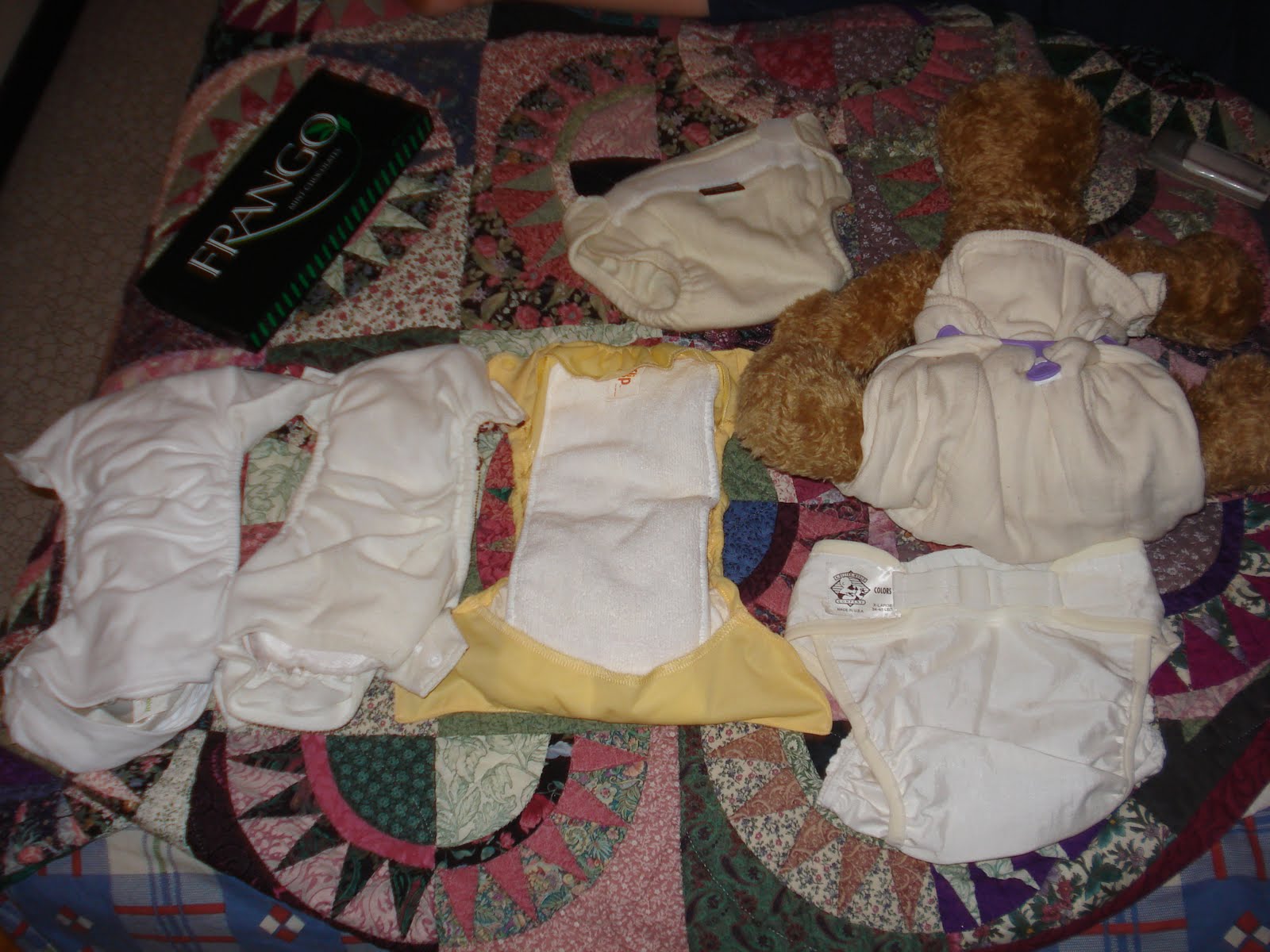
Note also the plastic diaper cover under the diapered stuffed animal.
Below are two photos of another brand called Kushies. I also got these on eBay, not used but not new. Those of you who know me well won't be surprised to learn that it was my first time using eBay. I actually got pretty into the whole thing, bidding on the diapers, waiting to see if I was outbid, calculating what price I could go up to and still get a better deal than buying them new. The Kushies inner towels are cotton, with an unattractive outer plastic layer. The cotton makes them very absorbent (also slow to dry after a wash), and they come in sizes. This is a disadvantage compared to other diapers that are adjustable as your child grows, but on the other hand the Kushies still fit Sam well, while many of the supposedly one-size-fits-all diapers are now getting small for him.


Above are two photos of different diapers, liners, and cloths hanging out to dry behind our house. When we first got the diapers (and before our son was born) I washed them a number of times with and without soap and hot water. The idea of this is to break down the fibers a bit (especially with cotton, which has natural water-repelling oils) so they'll be more absorbent. My son was born during our area's dry season, so it was easy for me to do so many washes and dries in short order. Most of our clothes we hang in an indoor patio, where they dry in a day, but the heft of the diapers demands more drying. This is why we usually hang diapers outside to dry in the wind and sun, the latter of which also totally removes shit stains. When I first started reading about cloth diapers, I assumed they would always retain some brown stains. I mean, when you're young and you occasionally have poop smears in your undies, they never come out. I was skeptical when cloth diaper enthusiasts insisted otherwise. But I was pleasantly surprised to learn that the washer followed by the sun really does get out all the stains!
What about washing Sam after waste processes? We usually just wash his ass off in the sink when he poops. This is tricky in Bogota, where the water is ice-cold, but he doesn't seem to mind. When we are traveling we pack some store-bought handy-wipes, and sometimes even disposable diapers, but we rarely use either. In fact, if we need a handy-wipe in the house, we've come up with an innovative Third World Green solution:
 These are scraps cut from old shirts of mine.
When my undershirts get embarassingly ripped and worn and holey, I do a little show where I hum "Thus Spake Zarathustra" and rip my shirt apart at the climax. From there it's just a bit of handy scissors-work until we've got a nice supply of handy-wipes. Wet with water and use.


Okay, the 500 lb. gorilla in the room is "How do you deal with the diapers? Is it really disgusting?" Not really. Basically we have a pile of clean diapers. When Sam soils his diaper, we take it off, rinse his butt, and change him to a new one. We take the dirty diaper to a plastic bucket and throw it in there (removing the inner towel if necessary).

Handling this dirty diaper is no more or less disgusting than dealing with a soiled disposable. We keep filling that (sealed) plastic bucket for two-four days, depending on how our clean diaper supply is looking. When it's full and we need to do a wash, we dump the contents of the bucket into the wash machine, fill it with water and non-chlorine bleach, and let the diapers soak overnight. The next morning we drain the water and do a regular wash with cold water. The diapers come out nice and clean, and any that still have shit stains we hang in the sun, which bleaches them in a matter of hours.
So there's the poop on cloth diapers. As I said, I've been meaning to post this since December, but never got around to it until now. I guess I just felt strangled by the pressure of writing a comprehensive bit about cloth diapers.

Ode to Bogota
I have written often and forcefully about my dislike of many things about Bogota. It is crowded, polluted, pretentious. But since I've gotten back from my Haiti trip two weeks ago, I've had to spend a lot of time in Bogota as my wife gets set up in a temporary job here, and I must begrudgingly acknowledge that the city is growing on me. Its bustle, its industry, and frankly its architectural beauty can't be denied, and these are the things that make for a great city.
I have realized that Bogota belongs to the ranks of the great grey cities of the world. The most typical examples are Madrid and Buenos Aires, and of course Paris, which all grey cities are trying to imitate. My definition of a great grey city is very particular, and perhaps not very coherent. Basically I use the term to refer to those elegant, tragically beautiful Latinate cities that are filled with lots of early-20th century architecture. Of course Berlin, Chicago, and most other major European and US cities of the industrial age are known for their early-20th century architecture, Beaux Arts and Deco styles, wide boulevards, etc. And most such cities are suitably grey and overcast to create an elegantly sad ambiance. But I think the Romance culture is a key part of my definition of a great grey city. Paris is dramatically Romance, in its language, its chic style, the physical beauty and blase ennui of its people. And it is grey, from the limestone buildings to the steely Seine to the misty, cool, cloudy air.
Actually, Madrid is one of the sunniest cities in the world, but I still consider it a great grey city for its beautiful-yet-cold boulevards and early-20th century buildings, and the Clasically tragic existential malaise of its people. Buenos Aires has its sunny moments too, and gets hotter than hell in the summer (like Madrid), but the beautiful, neurotic Latin people combine with the Paris-style buildings and boulevards to add it to the ranks of the great and the grey.
In its own way, Bogota outdoes them all for greatness and greyness. It is literally cool and grey all year round in terms of weather, the people are bustling, discontent, professional, elegant, bored, rude. The proletariat is grey too, not grey like sleek wool suits and tailored skirts, but simple and frank and industrious, like the Madrid cafeteria class. There are deep green parks, wide boulevards (often with an Andean creek running down the center), and lots of architecture from the early 20th century. Often these buildings tend more towards English imitations, steep-roofed Georgian manor houses crammed into dense city blocks, but the end effect is similar to Paris's mix of Gothic and Nouveau. Furthermore, Bogota feels more authentic and gritty than Paris or Madrid or even Buenos Aires. There is no feigned decadence here; that dilapidated mansion with the roof caving in and dogs and hobos living behind the boarded-up windows is for real, not some iconoclastic decorating job by bohemian bourgeois artists from the Marais.
Of course not all of Bogota is grey early-1900s. Just like the other great grey cities, our capital has old colonial areas of low whitewashed adobe houses, high-rise financial districts of glass and steel, and huge swathes of mid-late-20th-century functional brick apartment towers and single-family rowhouses. Much of the city's residential periphery reminds one of the newer parts of European cities--boring but dense, well-designed mass-produced neighborhoods.
So that's my reluctant ode to Bogota. It is elegant and cold seen from afar, but its neighborhoods pulse with children playing in streets and parks, bums recycling, dogs being walked (or running wild), and nondescript bars at most corners, where local people create their own scene with no other aspiration than to enjoy one another's company. Those who want fun tropical chaos should look to Cali or Medellin for their kicks, the respective Seville and Barcelona to Bogota's Madrid. But for a world-class city of cool Euro-style culture and big decisions made behind reflective glass, Bogota is the place to be in Colombia.
I have realized that Bogota belongs to the ranks of the great grey cities of the world. The most typical examples are Madrid and Buenos Aires, and of course Paris, which all grey cities are trying to imitate. My definition of a great grey city is very particular, and perhaps not very coherent. Basically I use the term to refer to those elegant, tragically beautiful Latinate cities that are filled with lots of early-20th century architecture. Of course Berlin, Chicago, and most other major European and US cities of the industrial age are known for their early-20th century architecture, Beaux Arts and Deco styles, wide boulevards, etc. And most such cities are suitably grey and overcast to create an elegantly sad ambiance. But I think the Romance culture is a key part of my definition of a great grey city. Paris is dramatically Romance, in its language, its chic style, the physical beauty and blase ennui of its people. And it is grey, from the limestone buildings to the steely Seine to the misty, cool, cloudy air.
Actually, Madrid is one of the sunniest cities in the world, but I still consider it a great grey city for its beautiful-yet-cold boulevards and early-20th century buildings, and the Clasically tragic existential malaise of its people. Buenos Aires has its sunny moments too, and gets hotter than hell in the summer (like Madrid), but the beautiful, neurotic Latin people combine with the Paris-style buildings and boulevards to add it to the ranks of the great and the grey.
In its own way, Bogota outdoes them all for greatness and greyness. It is literally cool and grey all year round in terms of weather, the people are bustling, discontent, professional, elegant, bored, rude. The proletariat is grey too, not grey like sleek wool suits and tailored skirts, but simple and frank and industrious, like the Madrid cafeteria class. There are deep green parks, wide boulevards (often with an Andean creek running down the center), and lots of architecture from the early 20th century. Often these buildings tend more towards English imitations, steep-roofed Georgian manor houses crammed into dense city blocks, but the end effect is similar to Paris's mix of Gothic and Nouveau. Furthermore, Bogota feels more authentic and gritty than Paris or Madrid or even Buenos Aires. There is no feigned decadence here; that dilapidated mansion with the roof caving in and dogs and hobos living behind the boarded-up windows is for real, not some iconoclastic decorating job by bohemian bourgeois artists from the Marais.
Of course not all of Bogota is grey early-1900s. Just like the other great grey cities, our capital has old colonial areas of low whitewashed adobe houses, high-rise financial districts of glass and steel, and huge swathes of mid-late-20th-century functional brick apartment towers and single-family rowhouses. Much of the city's residential periphery reminds one of the newer parts of European cities--boring but dense, well-designed mass-produced neighborhoods.
So that's my reluctant ode to Bogota. It is elegant and cold seen from afar, but its neighborhoods pulse with children playing in streets and parks, bums recycling, dogs being walked (or running wild), and nondescript bars at most corners, where local people create their own scene with no other aspiration than to enjoy one another's company. Those who want fun tropical chaos should look to Cali or Medellin for their kicks, the respective Seville and Barcelona to Bogota's Madrid. But for a world-class city of cool Euro-style culture and big decisions made behind reflective glass, Bogota is the place to be in Colombia.